David Borenstein on “Mr. Nobody Against Putin”: a film born from risk and resistance
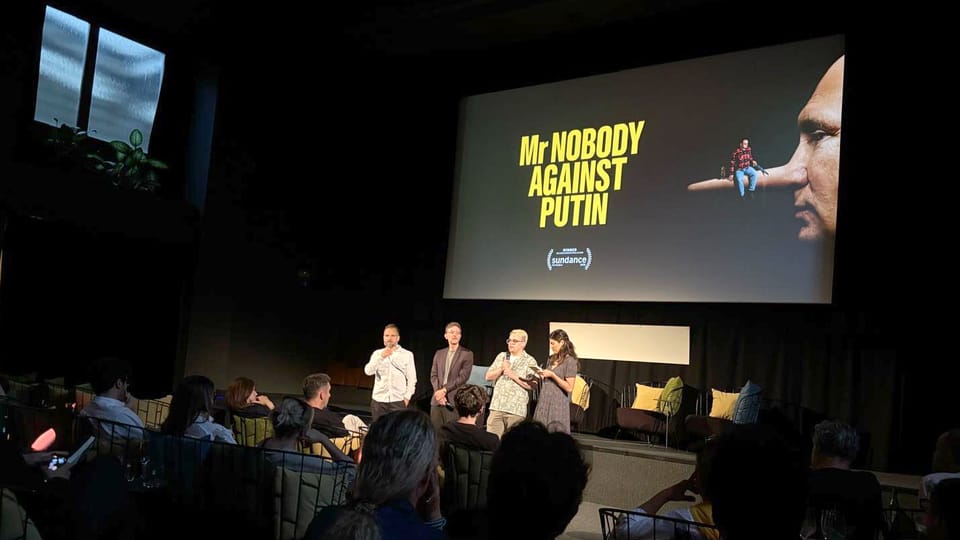
The award-winning documentary Mr. Nobody Against Putin is the result of a unique collaboration between American director David Borenstein and Russian teacher Pavel Talankin. Filmed secretly in Russia, it portrays how state propaganda shapes the lives of children. In an interview with Radio Prague International's Alexis Rosenzweig, Borenstein recalls the risks, the Czech role in the production, and the impact the film has had both abroad and within Russia.

When director David Borenstein first began working on Mr. Nobody Against Putin, he knew the risks were enormous. The film is based on secret footage recorded by Russian schoolteacher Pavel Talankin, known as Pasha, who eventually had to leave his homeland to ensure the film could be released safely. What began as a daring experiment has since become an award-winning documentary that has been shown at dozens of festivals, including Sundance, where it premiered.
For Borenstein, watching the film with audiences for the first time was both nerve-wracking and emotional.

“The number one feeling was relief because there was a lot of risk in this project. The story behind this project is working together with Pasha, who at the time of making it was a schoolteacher in Russia. And he basically took a lot of risk to make it.”
Talankin secretly filmed inside his classroom in the small industrial town of Karabash in the Chelyabinsk region. His footage revealed the daily reality of how Russian schools became saturated with war propaganda after the full-scale invasion of Ukraine. Children sang patriotic songs, absorbed nationalist messages, and were increasingly pressured to conform to the state’s militarized vision of society.

The idea for the film emerged only weeks after the war began. Borenstein recalls that he immediately recognized the unique importance of what Talankin was recording, but he also felt deeply uneasy about the risks.

“It was the first time that I pitched something, but was also trying to convince the commissioning editor not to take it. On the other hand, the security concerns were so difficult.”
Indeed, the central dilemma was whether it was even ethical to pursue such a project. Could Talankin’s identity be protected? What about the children who appeared in his classroom? Would their families face reprisals for what the camera revealed? These questions nearly derailed the project, until the BBC stepped in. The British broadcaster had long experience with filming under repressive regimes and offered both expertise and security protocols.
Czechia also became a crucial partner in bringing the film to life. Czech producer Radovan Síbrt and the production company Pink devised a plan to bring Talankin to Prague. His modest teacher’s salary would never have allowed him to resettle in the EU on his own, but Czech collaborators helped secure his safety and supported him as he rebuilt his life abroad. Beyond that, much of the film’s post-production took place in Prague. The final color correction was done with UPP, while music was composed by Michal Rataj. Even the Czech Radio Children’s Choir contributed — recording Soviet-era school songs in Russian because sanctions prevented the filmmakers from licensing original recordings from Russia.

Adding to the difficulty, the BBC and independent security experts reviewed the film frame by frame to eliminate any material that could endanger participants. Borenstein admits this meant leaving out powerful testimonies that might have made the people of Karabash appear more openly critical of the regime.

“Of course, we didn’t show the whole truth because some things needed to be taken out in order to protect people.”
Despite these constraints, the film has had an impact even within Russia. After the Sundance digital screening, it was quickly pirated and uploaded to the Russian internet. To the filmmakers’ surprise, responses inside the country were not uniformly hostile. Even in pro-regime media outlets, the comments under articles denouncing Talankin as a “traitor” were often more supportive than negative.

“I get messages from people in Russia all the time. So we know that it’s made an impact, and it continues to make an impact.” For Borenstein, who previously spent a decade working in China on film and journalism projects, the Russian response underscored an important difference between authoritarian systems. Where Chinese audiences might uniformly reject such a film, Russian society showed a more fragmented, messier, but also more open spectrum of opinions.
Today, Talankin lives in Prague, where he works alongside Borenstein to promote the documentary. Their film has ambitions for an Oscar campaign, though the director insists awards are secondary. What matters most, he says, is sparking dialogue — both abroad and within Russia itself.
Ultimately, Mr. Nobody Against Putin is not just a story of propaganda, but also of sacrifice and resistance. It captures the high stakes of telling the truth in an environment where free expression can cost one’s livelihood, one’s community, or even one’s life.






