Inside Russian classrooms: interview with the teacher who secretly filmed the material for Mr. Nobody Against Putin

Pavel Talankin is the Russian teacher and filmmaker behind the documentary Mr. Nobody Against Putin, which exposes the militarization and propaganda in Russian schools after the 2022 invasion of Ukraine.
Talankin secretly filmed videos during classes of what is officially called “patriotic education”, but in practice is closer to military training, at an ordinary Russian primary school. Those unique recordings eventually became a Czech–Danish documentary, Mr. Nobody Against Putin, which has already won an award at the prestigious Sundance festival, and has made the shortlist for an Academy Award. Ahead of the film’s Czech premiere, Libor Kukal spoke with Pavel Talankin, who now lives in Europe after fleeing Russia.
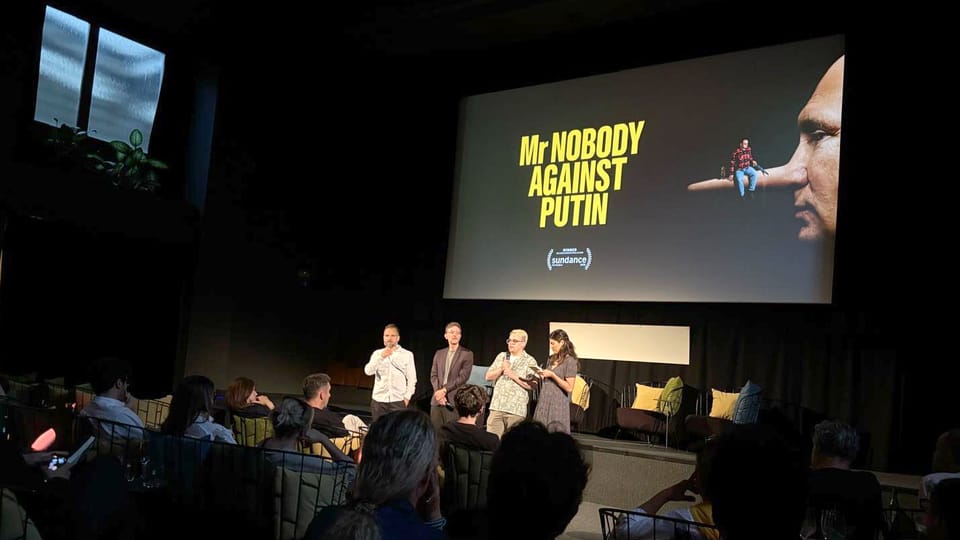
Military training and even grenade throwing were part of school life for today’s fifty-somethings, both in the former Soviet Union and in Czechoslovakia. Most agree that in the 1980s it was more or less a formality. Today’s Russia is completely different. Why?
“Teachers who went to school in the 1980s or earlier say, “We had this at school too, so what? We survived it, we grew out of it.” They say this has always happened. Well, I don’t know. When I was a child, it wasn’t done like this. Yes, we might have had a poetry recital on 9 May to celebrate victory, but that was it. Today we present war to children in a romanticised way, we glorify fighting and heroism. When people started talking about our film, journalists from Al Jazeera called the Ministry of Education to ask whether they knew that such things were happening in schools. They said they knew, of course, and that the programme would continue, because younger children are more receptive to having this kind of information instilled in them.”
So militaristic education starts from the first grade?
“It starts already in kindergartens. They have introduced a subject called “Conversations About Important Things”. This is still relatively mild propaganda. First, children are taught that Russia is our homeland and how beautifully we live here. Older children are then told that others want to take away our beautiful country and our great life, and want to enslave us.”
So children are meant to remember that Russia is surrounded, encircled by enemies. By the way, who is the main enemy now — Ukraine, or already the entire so-called “collective West”, as it is called in Russia?

“These days it’s hard to say who is not yet an enemy, because almost everyone already is. Several maps are used as teaching aids in Russian schools. One map is called “Countries Where You Can Drink Tap Water”. Another map shows countries hostile to the Russian Federation. You may be surprised, but these two maps are identical — the same countries are marked on both.”
You were filming as part of your official job. When did you realise that what you were recording might have greater value than just documentation material for the archive of one ordinary primary school, of which there are tens of thousands in Russia?
“If you remember, before the full-scale war began, Russian troops were stationed along the border with Ukraine for some time. I didn’t believe there would be a war. I thought it was some kind of maneuver, political games, and that the situation would calm down. But at that time I watched Mikhail Romm’s film Ordinary Fascism. It’s an old Soviet documentary about how Hitler came to power and how he shaped most Germans. It all starts there in schools: children’s drawings, schoolchildren marching in military style. Exactly two months passed, and in our schools these patriotism lessons and school parades and marching drills began. And it was an exact copy of what I had seen in the film about Nazi Germany. It seems that Goebbels is sitting somewhere in the world, clapping enthusiastically and giving Putin an A with a star. A case of the pupil surpassing the teacher.
“My job was to film and document all of it. I don’t know whether anyone in the authorities ever watched it or checked it. Perhaps the idea was that for the teachers I was the inspector who filmed everything, so they knew they couldn’t make a mistake. Once I deliberately filmed only the beginning and the end of such a lesson; most of the recording was just static and screeching, as if my camera wasn’t working. I waited to see if anyone would ask about it, but I received no complaint. Apparently, no one watched it.
“I remember the first such lesson very clearly. The teacher told the children that we Russians, Ukrainians and Belarusians are brotherly nations, we have the same fairy tales, the same songs. But Ukraine has gone astray into neo-Nazism and fascism, and now we must liberate it. At that moment I told myself that this material was testimony and should not belong only to me or to the ministry.”
When did you realise that you would have to leave Russia?
“The screws started tightening in Russia, the atmosphere thickened rapidly. New laws were adopted, it was forbidden to say anything negative about the Russian army, and many other similar regulations followed. Then a Danish producer called and said that the film could not be released publicly as long as I was in Russia.”
Are you satisfied with the film?

“When director David Borenstein started working with the material, he wanted me to shoot additional footage of myself cleaning my home, dusting, reading a book — scenes from my everyday life. I didn’t understand at all what that was supposed to mean. I told him: show people what I sent you…”
Was there a lot of material that didn’t make it into the film?
“I talked to David about this a lot. Why this or that wasn’t in the film. I wanted him to show certain specific things. He replied that if he included everything I wanted, the film would be ten hours long or would turn into a series. For example, it didn’t make it into the film how teachers are forced to collect money and buy things for soldiers. The school received a specific list of what had to be bought. Everyone had to give at least a thousand roubles. I refused, then another teacher refused too, saying her husband had forbidden it.”
Did any of the teachers support you when it became known what you had done? Are you in contact with anyone from the school?
“As far as I know, people from the FSB came to the school and forbade everyone from speaking to me or maintaining any contact. But I am still in contact with some of them, even if only very sporadically.”
When you see how foreign audiences react to the film, do you think foreigners understand all the nuances of what you show them?
“The film is made so that foreigners can easily understand what it is about. Of course, they see only the tip of the iceberg of what is happening in Russia. In reality, the situation there is more serious. The film is constructed so that at first the situations shown seem comical, but gradually you stop laughing. People in different countries react differently. In America, people say they too are slowly approaching what is shown in the film. In the Czech Republic, people say: “We know all this, we had it too.”
Do you think Czechs realize that it is still not the same as what some remember from the 1980s, which we talked about at the beginning? For example, that any disagreement can cost you dearly in Russia today?
“No, they don’t know how difficult it is to protest in Russia. Especially when you live in a small town.”






