Radovan Síbrt on Mr. Nobody Against Putin, the Oscar-nominated documentary exposing war propaganda in Russian schools

Czech interest in this year’s Academy Awards will centre on Mr. Nobody Against Putin, a Danish-Czech production nominated in the Best Documentary Feature category. The film contains footage shot surreptitiously by a teacher, Pavel “Pasha” Talankin, who wanted to expose war propaganda in schools in Russia. Talankin had no choice but to flee his native country before the documentary’s release and is now based here in Czechia. Radovan Síbrt is one of Mr. Nobody Against Putin’s two Czech producers – and I spoke to him just days after it also earned a BAFTA nomination.
How and when did you get involved in this project?
“It was a few years back when the Danish producer Helle Faber called me asking if we could meet.”
“She didn’t share why. We met in Poland, in Krakow, and went on a boat trip and she was so secretive.”
“She basically wouldn’t share anything with me – she just said that she would need my help as a producer.”
“It was a really weird meeting [laughs]. Then a few months later we met again, that time was in Berlin, and she was more specific.”
“She said she needed somebody to help her get a guy out of Russia.”
“She started working with [US-born director] David Borenstein on the film and from the start it was quite clear that there was no way that it was going to be made without the main protagonist leaving Russia.”

“When she realised that she was not able to do it from Denmark – because in Denmark refugees have to spend two years waiting for political asylum in an asylum camp, and nobody wanted Pasha to experience this – we said we would try it here, in the Czech Republic.”
Is it the case that Pasha was recording material in Russia and gradually sending it out, bit by bit?
“Yes, this was the case. There were months and months of work between David and Pasha.”
“Pasha first started recording things for the official propaganda machine of Russia; they were forced to record all these nationalistic things and military things and they were sending them to some ministry.”
“Pasha first started recording things for the official propaganda machine of Russia.”
“Pasha very soon realised he didn’t want to be part of this, so they started working with David on the film. David would tell him what to do and Pasha would record.”
“And he sent… not everything, which we didn’t know. He was careful, because he didn’t know us and we didn’t know him.”
“It was a period of building trust, because he didn’t know if we were not provoking him and sending it to the security services.”
“So when we finally met outside of Russia he brought many hard drives full of material that we hadn’t seen before.”
Did he have a collaborator in Russia? There are some scenes where somebody is evidently filming him – he’s not filming himself.
“At the start, yes, but then the laws in Russia changed and for helping him on the film, people could get 20 years in prison.”

“So they stopped helping him and they cannot be traced; they were not locals.”
“Later on he would tell the kids he had in his class to film him, without knowing they were working on a film.”
The film is a Danish-Czech co-production. What was the Czech involvement in terms of the actual making of the film and the putting together of the film?
“In order to get a subsidy from the film fund you need to have some creative input in the film.”
“The original plan was that we didn’t expect that all the film would be shot in Russia; we actually did shoot some scenes but we didn’t use them in the end.”
“Then of course there was a need for music. We had to re-compose and then have choirs to sing the music pieces. There was post-production of the sound and of the image.”
“To be honest, this can be done anywhere in the world. There is no need to bring it here.”
“The biggest impact we had on the film was that we managed to get Pasha out of Russia and arrange asylum for him.”
“The biggest impact we had on the film was that we managed to get Pasha out of Russia and arrange political asylum for him.”
“And that is what I value the most.”
I guess you can’t tell me how you got him out of Russia?
“It’s not a James Bond movie [laughs].”
“There were a lot of people on the way who helped us and I never saw them and I never met them.”
“Somebody connected me with somebody and that person connected me with somebody else, and there was a chain of people whose names I didn’t know, and I don’t know, who managed to get us a visa for Pasha, because as a Russian citizen he’s not allowed to get a visa.”
“And then they helped us to get it through the system, so the political asylum was executed within a few weeks or months.”

How is he doing here?
“He’s really busy now. The first months were extremely difficult for him, because he was sitting in his apartment and he couldn’t go anywhere.”
“He couldn’t travel. He didn’t have any passport, he didn’t have any documents.”
“So it was extremely difficult for him. The film was travelling, it was extremely successful and he wanted to share the story – and suddenly he was sitting in his room.”
“Yes, he would be connected via Zoom or other means, but it wasn’t what he really wanted to do.”
“So the moment he got a passport he was suddenly free to go.”
“He’s been travelling like crazy, especially with the Oscar nomination and the BAFTA nomination. In the next seven weeks he’s going to go all over the world, basically.”
“So this is great for him. He is busy, his mind is busy.”
“But the moment he stops… I must admit I have a feeling that there are moments when he feels lonely and homesick.”
Well, he gave up a hell of a lot.
“He gave up everything. And it’s not that he wanted to leave the country.”
“He gave up everything. And it’s not that he wanted to leave the country. He loves the people, he loves the place.”
“People keep asking him, How is it leaving this horrible place and suddenly living in this beautiful European city and this beautiful apartment?”
“And he says, I loved it there – I didn’t leave because I wanted to live in a better apartment. I loved my apartment.”
And he was teaching in his hometown [Karabash], right?
“Yes. He never moved anywhere, he never travelled properly, he didn’t speak any language apart from Russian.”
“So he had to start from really nothing.”
You mentioned the awards season, which is coming up at great speed. Just this week the film was announced as a BAFTA nominee. I was at a special screening of the film in May, which was just a few months after the premiere at Sundance, and I got the impression that you were kind of targeting an Oscar. Or that the Oscars were something that you had in mind. Was that paMrt of the plan?
“It wasn’t at all. At the start when I brought this film here to our company [Pink] I spoke with my partner, Alžběta Karásková, and we said, We have no idea what kind of film this is going to be, but let’s help Pasha to get out of Russia.”
“That was the only thing we said. And we succeeded.”
“Then suddenly we saw how people were reacting to the film. We saw its success at Sundance and at other festivals where we took the film.”
“And only later we sat down with Helle and said, What about trying to go for the Oscars?”
“A streamer at Sundance said they would buy our film and run it for the Oscars and pay for the campaign. But then they got scared.”
“The first idea came from a streamer, at Sundance. They said they would buy our film and run it for the Oscars and pay for the campaign.”
“But then they got scared once [laughs] Trump became president of the United States and they didn’t want to be connected with such a political film, so they dropped it.”
“But the idea was already there and there was a moment when we said, Let’s try it.”
Some feature films spend a huge amount of money on their Oscars campaigning. Obviously the world of documentaries is much smaller budget, but how have you been campaigning? Or how did you campaign to get to the stage where you are now?
“Yes, the campaign is extremely expensive. We got some support from the Czech Audiovisual Fund, we got some support from the Danish Film Institute, but that is a really small part of the money that we needed, and we still need.”
“We have approached several wealthy people in the Czech Republic, and because the topic is extremely important here, and they see it as an important film, they decided to support us.”
“Most of the campaign was paid by Czech millionaires.”
“So most of the campaign was paid by Czech millionaires, basically. And I would like to express gratitude to them.”
Now there are five nominees left in the race and you’re one of them. Is the campaigning still as intense, or is it more intense? What’s it like right now?
“It is actually more intense, because now it’s about everything. And we’re the only film that doesn’t have a big streamer behind us, so we are struggling with money.”
“We are [laughs] basically going around asking people for money, and we don’t have enough. We cannot compete in this sense.”
“We are trying to connect with people who watch the film and say, I loved it and I will support it, people who have standing in society.”
“For example, in the first phase Garry Kasparov, the famous Russian opposition political figure and world champion chess player, supported the film.”
“It’s about resistance. It’s about a guy who means nothing to the regime but still decides to fight it.”
“He posted about it on social media and he was doing anything he could to support the film.”
“We need people like this to stand up and say it’s a great film – and not only a great film from the cinema point of view, but a great film because it’s saying something about the world around us.”
“It’s about resistance. It’s about a guy who means nothing to the regime but still decides to fight it.”
“And it’s not only about Russia – it’s about the United States at the moment as well.”
Was it the case that Garry Kasparov came to a screening in New York? I think I saw a photo of him at a screening.
“Yes, that was a long story. Of course he didn’t come, we invited him.”
“He was a little bit hesitant at the start but then he came and fell in love with the film. And also with Pasha, because he saw that Pasha was a teacher from a small town in Russia who lost everything, just because he decided he didn’t want to be part of this horrible regime.”
Even if you don’t win the Oscar, and of course I hope you do, what does it mean to be nominated?
“It means a lot for Pasha. It means that his sacrifice makes sense. Suddenly he sees that people all around the world are watching the film and reacting to it.”
“Of course the exposure of the film is stronger now. There’s huge media interest. He’s doing interviews for The New York Times, for the biggest media all over the world, so he can share his story, which is great.”
“For us, from the professional point of view, it’s very good. Because for the future, at the market, when you have a nominated film your partners see that you know what you are doing.”
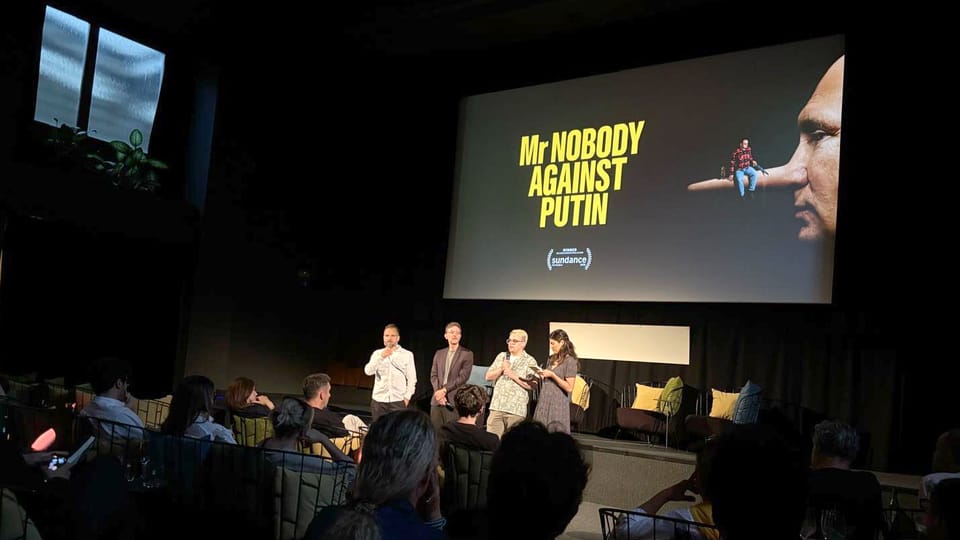
How much are you looking forward to the actual ceremony?
“We experienced winning the Berlinale a few years back and we were so exhausted at the ceremony that we only dreamt about going to sleep.”
“So it’s not really that you enjoy these ceremonies – it’s a lot of hard work.”
“And when you get to the ceremony you’re already exhausted.”
I guess Pasha will also be there, if he’s free to travel?
“Of course he’s going to be there.”
“At the moment we are negotiating, because Pasha is a co-director but according to the Oscar rules he couldn’t be nominated.”
“They nominated Helle, David, as the director, Alžběta Karásková, as one of the producers, and me. Because only four people can be nominated.”

“And now we are going through a really difficult process to replace me with Pasha, because we would really love him to be nominated as well – and in case we win to be standing on the podium as well.”
You’ve maybe kind of answered this question already, but still I would like to ask you – how do you view what he did, that amazing act of courage?
“I don’t think he sees it as an act of courage. He simply had to do it.”
“He felt that he was betraying the kids that he was supposed to educate.”
“He created a really safe place at school for the kids and suddenly he was supposed to become part of this military machinery of the regime.”
“He didn’t see it as an act of bravery – he just did what he felt that everyone should do, which is to stand up and say, What is happening next to me is not OK.”
“For me he is a hero, really. Because he’s not a political activist, somebody with a big ego who wants to be seen and wants to become the next Russian president.”
“No, he wanted to live a normal life and he wants to live a normal life.”
“He is now thinking about his future and one of his ideas is to maybe become a tram driver.”
“He is now thinking about his future and one of his ideas is to maybe become a tram driver.”
“So you might one day meet him on the tram going to work.”
“He doesn’t want to run a political campaign against Putin. This is not his dream.”
“He’s really Mr. Nobody who became a hero because he only stood up. There was no ego behind it, there was no need to be visible and to be successful.”
“No, he just wanted to say what he thinks about the stuff that was happening around him.”
Related
-

-

Inside Russian classrooms: interview with the teacher behind Mr. Nobody Against Putin
Pavel Talankin is the Russian teacher behind the documentary Mr. Nobody Against Putin, which exposes the propaganda in Russian schools after the 2022 invasion of Ukraine.






