The Pavel–Babiš clash in context: echoes of past power struggles at Prague Castle

The ongoing dispute between President Petr Pavel and Andrej Babiš — billionaire businessman and owner of the Agrofert Holding — over how he must resolve his conflict of interest is making headlines across Czechia. But historically speaking, tensions between the Castle and the head of government are far from unusual.
Today’s headline dispute — and why it isn’t new
The current disagreement between President Petr Pavel and Andrej Babiš has dominated Czech media for weeks. The dispute centres on whether Babiš must publicly outline how he will resolve his conflict of interest before being appointed prime minister — something President Pavel insists on, and something Babiš claims he was not told to do and points out that the Constitution obliges a prime minister to divest from private interests within 30 days after appointment.
To many observers, the dispute feels unprecedented: a president refusing to move forward without public assurance, and a would-be prime minister accusing the head of state of shifting expectations. But the truth is more complicated. When we look back over Czech and Czechoslovak history, disagreements between the Castle and the head of government appear again and again. The relationship has never been simple, and it has often been shaped as much by personalities and political pressure as by constitutional rules.

Already during the First Republic (1918–1938), the founding president, Tomáš Garrigue Masaryk, faced conflicts with his prime ministers. Karel Kramář, the first to hold the office, had a much more nationalist outlook and challenged Masaryk’s broader civic vision of the republic. Their clashes were so frequent that cooperation became difficult despite the historic moment of independence.

Masaryk’s relationship with Antonín Švehla — the most influential prime minister of the 1920s — was closer, but hardly free of tension. When Švehla tried to resign due to exhaustion, Masaryk simply refused to accept it. Švehla was indispensable to holding together the fragile coalition system, and Masaryk used his moral authority to keep him in place. It was a subtle but telling example of the Castle exercising influence over the government beyond what the constitution formally allowed.
These episodes show that even in the early years, presidents and prime ministers pushed and pulled against each other as they defined their respective roles.
Crises, personal clashes, and the reshaping of power

The late 1930s brought even more dramatic conflicts. President Edvard Beneš and Prime Minister Milan Hodža found themselves sharply at odds during the mounting Sudeten crisis of 1938. Hodža, confronted with diplomatic pressure from Britain and France, believed further concessions might preserve the state. Beneš viewed those concessions as dangerously destabilising. Their disagreement was not merely bureaucratic — it touched the heart of national survival. Neither man could fully impose his view, revealing the constitutional tension between representation and executive governance in a time of crisis.
The Second Republic (October 1938–March 1939) lasted only a few months and saw further strain between presidents and governments, as politicians operated under extreme external pressure while the democratic system rapidly deteriorated.

After the war, Beneš returned as president, but the new government was dominated by the Communist Party. Conflicts again emerged — most notably between Beneš and Prime Minister Klement Gottwald. Beneš attempted to defend the parliamentary system, while Gottwald pushed toward full communist control. Their clash culminated in February 1948, when Gottwald used the resignation of non-communist ministers to force a political crisis. Beneš, weakened and isolated, faced impossible choices; his refusal to appoint a non-communist government effectively ended democracy. The Castle had lost the power struggle.
Under the communist regime (1948–1989), tensions between presidents and prime ministers disappeared for a very simple reason: neither position truly mattered. Or rather, it was combined with the real authority that belonged to the General Secretary of the Communist Party and its apparatus. The office of the President and Prime Minister existed but in real life they were subordinate political roles within a totalitarian system.
Democratic restoration and new lines of friction
With the Velvet Revolution in 1989, the presidency regained its significance — and its potential for conflict. Václav Havel, a dissident playwright turned head of state, believed that the president should serve as a moral compass. But Prime Minister Václav Klaus had a different vision: he wanted the government, not the Castle, to set the political direction.

Their disagreements were often public, and sometimes personal. Klaus criticised Havel’s interventions in economic debates; Havel complained that Klaus ignored the ethical responsibilities of political leadership. These exchanges revealed an enduring question: how active should a president be in shaping politics?
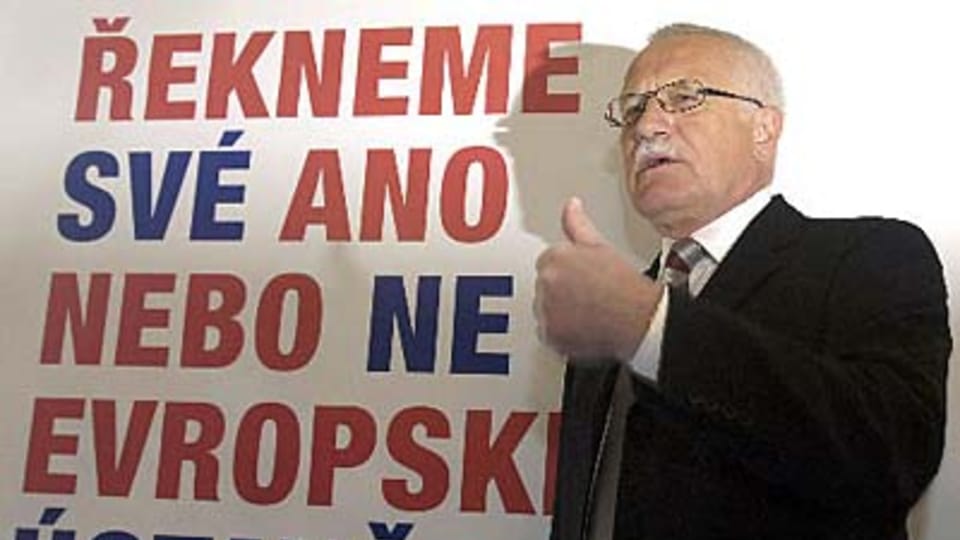
When Klaus became president himself in 2003, the relationship with successive prime ministers brought fresh friction. His disputes with Prime Minister Jiří Paroubek over EU matters, and later with Mirek Topolánek and Petr Nečas’s governments over judicial appointments and European treaty ratification, underscored the reality that even a president with a restrained formal view of his office could influence — and sometimes obstruct — government policy.
Direct elections and the Zeman transformation
A major shift occurred in 2013 with the introduction of direct presidential elections. The change followed two bitter parliamentary elections for president in 2003 and 2008, both associated with accusations of backroom deals, vote-trading and political blackmail. Lawmakers from across the spectrum decided the system needed more transparency and legitimacy.

The first president elected directly by the people was Miloš Zeman — and he interpreted his popular mandate far more expansively than previous presidents, arguing that millions of votes entitled him to shape politics actively. He appointed a government without parliamentary support in 2013, refused to endorse several ministerial nominees proposed by prime ministers Bohuslav Sobotka and Andrej Babiš, and inserted himself into coalition negotiations with a level of intervention unprecedented in post-1989 Czech politics. The Castle once again became a centre of political power — and political controversy.
And now: Pavel and Babiš
President Petr Pavel, a former NATO general, has presented himself as a supporter of constitutional restraint. Yet his dispute with Andrej Babiš — a billionaire businessman, owner of Agrofert Holding, and leader of the strongest party in the recent elections — demonstrates that interpretation of presidential powers is still evolving.

Pavel insists that Babiš must explain publicly how he will resolve his conflict of interest before he can be appointed prime minister. Babiš argues that the law allows him to do so after appointment, and accuses the president of shifting expectations. The dispute has become a headline story not only because of what is at stake politically, but because it touches the very heart of Czech constitutional identity: Who defines the standards of a prime minister? What powers does the president have — or believe he ought to have?
And where is the line between moral responsibility and political overreach?
Just like Masaryk and Švehla, Beneš and Hodža, Havel and Klaus, Klaus, Zeman and their cabinets, the Pavel–Babiš clash shows that the relationship between the Castle and the Government Office has never been simple. It is shaped by constitutional design, political culture, public expectation and the personalities of the individuals involved.
Today’s argument is just the latest chapter in a century-long story of balancing who represents the state — and who governs it.