Pavel-Babiš clash over NATO summit heads to Constitutional Court
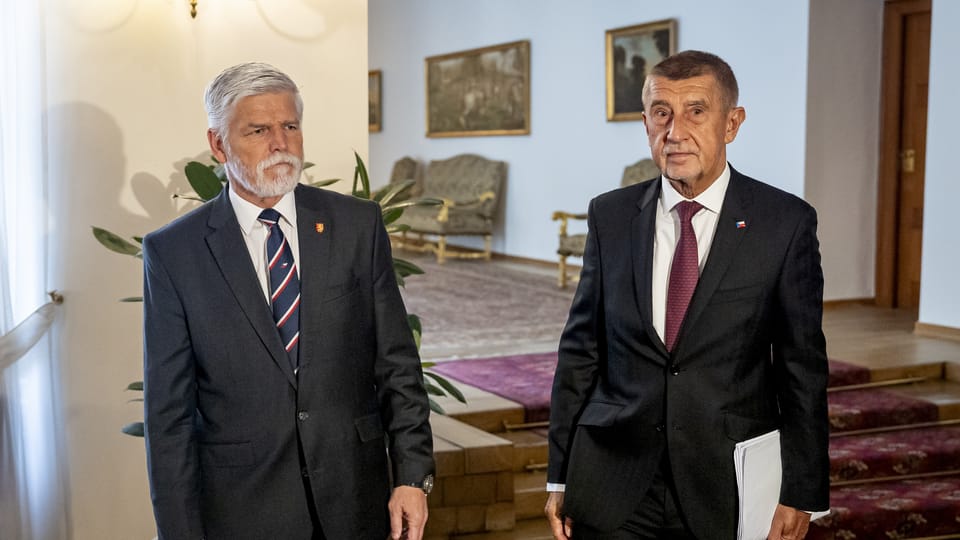
The clash between the Czech head of state and the cabinet over who should attend the upcoming NATO summit in Ankara has now reached the highest court in the land. On Tuesday President Pavel challenged the government’s decision to exclude him from the official delegation, on the grounds that it violated his constitutional rights.

Following weeks of controversy over who would lead the Czech delegation to the NATO summit in Ankara in July, Prime Minister Andrej Babis announced on Monday that he himself would take on that role, flanked by Defence Minister Jaromír Zůna and Foreign Minister Petr Macinka. The governmental team he said was in the best position to explain and negotiate decisions on defense spending since the government alone has executive powers in this respect.

He made it abundantly clear that the president, who previously served as chairman of NATO’s Military Committee and who publicly criticized the government for slashing spending on defense, was not wanted on this trip.
Petr Pavel, who has attended all NATO summits since taking office in 2023, filed a complaint with the Constitutional Court. He explained the decision in a video on social networks.

“I consider the government's decision to exclude the president from the delegation to the summit to be an unprecedented and exceptionally unfortunate step, as well as a restriction of his constitutional powers. I have therefore asked the Constitutional Court to determine who has the authority to decide on the president’s participation in the summit, and to order the government not to create administrative or other obstacles to the president’s exercise of his constitutional powers.”
Mr. Pavel added that in filing the complaint he was acting to protect the office of the presidency rather than his own interests, and would respect whatever ruling the Constitutional Court ultimately delivers.
Prime Minister Andrej Babiš (ANO) reacted by saying that he respects the president’s right to file the lawsuit but said he considers the move unfortunate. He said the set-up of the delegation to the NATO summit stemmed from practical considerations and the expected format of the summit and stressed that there was no concerted effort to restrict the president’s right to represent the country abroad.
“I really do not understand the president’s reasoning. He has undertaken 61 foreign visits altogether, 10 on a mandate from this government. We recently approved that he would represent the Czech Republic at the autumn session of the UN General Assembly. And the Constitution clearly states that all these activates require a mandate from the government.”
Babiš said the government would wait for the Constitutional Court’s decision before responding further, but stressed that it had no intention of backtracking on the decision.
The Constitutional Court said it is aware of the urgency of the case, adding that its full bench will decide on Wednesday whether the case should be given priority treatment.
However, even if it does, it is far from certain whether it will pass a verdict in time to alter the government’s plans for the upcoming summit. Constitutional law expert Marie Zámečníková says the wording of the respective article is intentionally vague.
“The respective article of the law is intentionally drafted in broad terms so that it can serve the given political situation or balance of power and provide room for the actors to negotiate, reach agreements, and compromise as the need arises. So to a large extent the constitutional practice is shaped by constitutional conventions.”

Whether or not the Court will base its ruling on the established tradition that, as commander in chief of the armed forces, the head of state has represented the country at NATO summits in the past, is unclear. However, commentators are already speculating on the wider political consequences of the awaited court verdict and its impact on the stand-off between the country’s top officials.