Why a tiny cinema at a railway station still matters in the age of Netflix

A former waiting room at Olomouc-město railway station has been transformed into a mini-cinema and community space called Čekárna. Behind the project is film scholar and local politician Pavel Bednařík, who sees it as a response to both the dominance of streaming platforms and the disappearance of shared cultural spaces. The cinema aims to reconnect people — not just to films, but to each other.
An overlooked station brought back to life
At first glance, Olomouc-město railway station does not look like a natural home for culture. Despite being fully refurbished and reopened this year, the small local station — often confused with Olomouc’s main railway hub — remains quiet, almost anonymous. There is no station master, no staff presence, and until recently, little reason for passengers to linger.

“People would just step off the train or step onto it and leave immediately,” says Pavel Bednařík (Green Party). “It wasn’t a pleasant place to stay, and it felt remote and forgotten.”
That was one of the impulses behind Čekárna — a mini-cinema, club room and community space built inside a former waiting room. The goal was not only to screen films, but to give the station a new social function: a place where people might stop, have a coffee, talk, and spend a little time.
In that sense, the project has already begun to change the atmosphere of the station. Instead of being merely a transit point, Olomouc Město is slowly becoming a destination — modest, local, but alive.
Why cinema still matters in the Netflix age
Pavel Bednařík (Green Party) readily admits that Čekárna began as a personal dream. But he insists that the need it addresses is far broader — especially at a time when most films and series are just a click away at home.

“There are two sides to this,” Pavel Bednařík explains. “One is the basic need of any community to meet, to talk, to share a place. The other is cinema itself — or rather, the quality of how we experience films.”
While streaming platforms offer unprecedented access, Pavel Bednařík argues that they often reduce film to background content. Many viewers watch on small screens, with mediocre sound, distracted by their surroundings. Čekárna, by contrast, was designed as a proper black-box cinema, with high-quality projection and 5.1 surround sound.
“I wanted to make the conditions as good as possible,” says Pavel Bednařík. “People rarely invest in that kind of environment at home — but it makes a huge difference.”
Just as important is the programming. Because Čekárna is a tiny venue, commercial success is not the main priority. This allows the cinema to screen films that rarely make it into Czech cinemas at all — European productions, art-house titles, classics, and films that may only be shown once, or not at all, elsewhere.
“In big cinemas, decisions are driven by box office results,” Pavel Bednařík says. “Here, money matters less than quality and community.”
A community cinema, not a multiplex
With a long background in film clubs, festivals and film education, Pavel Bednařík sees Čekárna as a “community cinema” in the fullest sense of the term. That means responding to local interests — and actively creating dialogue around films.
The project already cooperates with students from Palacký University, who help organise discussions, lectures and introductions. Plans include meetings with filmmakers, thematic screenings, and events connected to broader social or cultural issues raised by the films.
“It’s about adding something extra,” Pavel Bednařík says. “Not just showing a film, but creating a reason for people to stay, to talk, to meet.”
Culture as a civic function
Although Pavel Bednařík is active in local politics, he stresses that Čekárna is not a political project in the narrow sense. Its role, however, is undeniably civic.
In the western part of Olomouc, where the station is located, traditional meeting places gradually disappeared — first during the Second World War, later under communism, when culture was centralised and tightly controlled. According to Pavel Bednařík, this damaged the natural cultural fabric of many Czech cities.
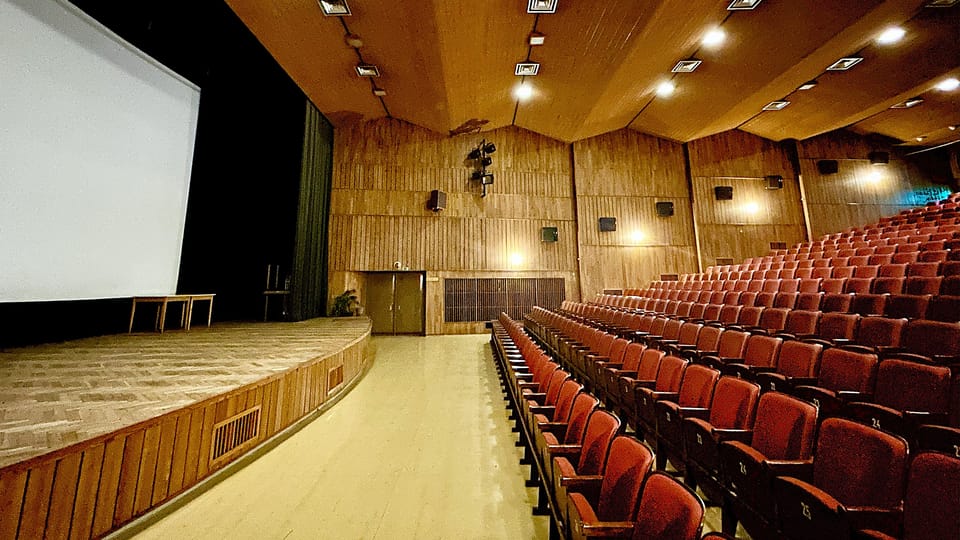
“The idea was to bring life back,” Pavel Bednařík says. “Not just social life, which you can find in pubs, but content-based meetings — people coming together because of culture.”
Early reactions suggest the need was real. Locals have welcomed the space, and there is already interest in renting it for discussions, workshops and community events. For Pavel Bednařík, that confirms that Čekárna fills a gap.
“In difficult times, when people struggle to communicate or feel isolated, places like this help reconnect ties,” Pavel Bednařík says. “And sometimes, that starts simply by watching a film together — and talking about it afterwards.”