Czech project Rekino gives forgotten cinemas a second life
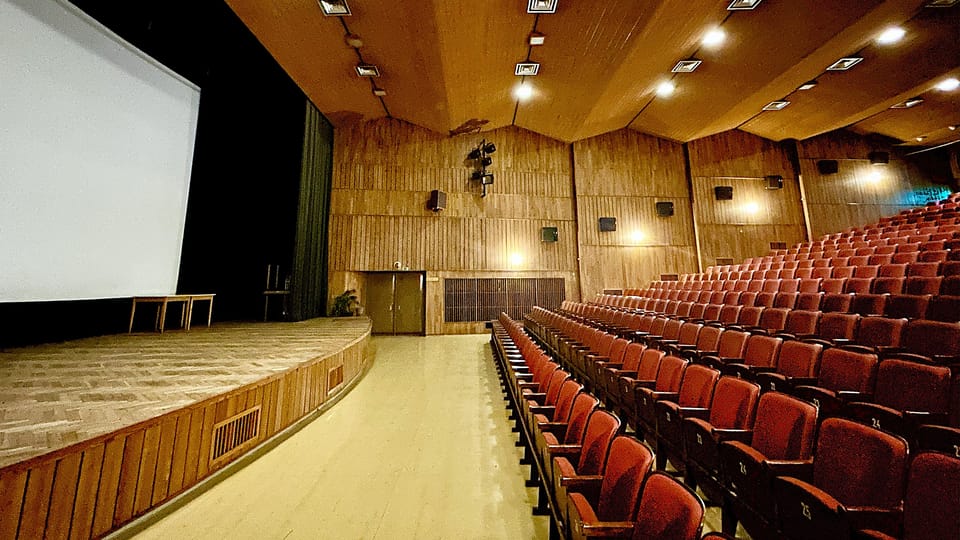
In the second half of the 20th century, cinemas were a staple in nearly every Czech town or village, often serving as the heart of community life. However, following the Velvet Revolution of 1989, many of these cinemas fell into disrepair or were repurposed for other uses. A unique Czech initiative, called Rekino, aims to revive these defunct cinemas, even if only for a single day. I discussed the project with Marie Barešová, the founder of Rekino, and her collaborator Craig Binding.

First of all, how many cinemas actually were there in Czechoslovakia before the Velvet Revolution?
Marie: “There were approximately 4,000 cinemas in Czechoslovakia in the second half of the 20th century, but many of those places were not actual cinemas. They were built for a different purpose or served as multifunctional spaces, so it’s always important to think about the original function of those places."
And out of those places, you said there were around 4,000 of them, how many still serve their original purpose?
Marie: "I would say it’s approximately 600 cinemas, when you include open-air cinemas as well."
You were talking about the time before the Velvet Revolution, before 1989. What happened then? How come so many of these places were abandoned and no longer serve their original purpose?
Marie: "Many of those cinemas had lost popularity, especially in the 1980s, and many municipalities chose to close them immediately after 1989. That was the first step.
"And the second big step in terms of closing cinemas was the transition to digitization. That really was the most harmful thing that happened."

This year, earlier this year, you launched a project called Rekino, which aims to revive some of these cinemas that are now abandoned. How did you get this idea in the first place?
Marie: "I think it began with the fact that I was researching cinemas in the Národní filmový archiv, the National Film Archive here in Prague. As I was traveling around the Czech Republic, I realized how many former cinemas still exist here. Many are abandoned, but not in ruins. So I thought it would be nice to revive them somehow, give them a new life, even if only for one day. That was the initial idea."
“Many of these cinemas are abandoned, but not in ruins. So I thought it would be nice to revive them somehow, give them a new life, even if only for one day.”
And now, almost a year later, how would you define the aim of your project? Have you broadened your goals?
Marie: "That’s a really good question. I think we, as a team, are still looking for the answer, because we are still in the middle of this year’s project. So I think we’ll have a better answer towards the end of the year.
"But one thing I’ve already learned is that I need to take less of an intellectual approach and be more aware of the specific communities, really understand each town or village, what people expect, and how I can approach a particular space.
"Because every space is different, and you cannot come up with one model and then use it everywhere. So that would probably be my answer for now.”

Craig Binding: "Yeah, I think it’s very much in the experimental phase at the moment, which is part of the fun, really. Especially in this phase, you learn how to engage with the public in different ways and what people are expecting. So I think, as Maruška says, the aim may change and shift a little."
If you were more specific, how would you describe the events that you organised there? Because it’s not only about screening a film in an abandoned cinema. I understand that it’s very much about involving the local community as well.
Craig: "Yeah, I think involving the local community is really key to the project. So there are different activities. For example, at Pardubice on Saturday at Dukla, there will be a kids’ corner with some children’s activities.
"There are workshops, and of course film screenings are one of the main focuses. But it’s also about bringing community and memories back into these old buildings."
“I really wanted to invite families, but also older people, because older people remember when the cinemas were open, they have specific memories connected to these spaces, and I find that very interesting.”
Marie: "And also, one of the motivations is to bring together people from different generations. We try to be as inclusive as possible, because typically, when NGOs organize similar events, they aim at young people. So it becomes a kind of hipster thing, which is something I didn’t want to do.
“I really wanted to invite families, but also older people, because memory is important for us. Older people remember when the cinemas were open, they have specific memories connected to these spaces, and I find that very interesting.”

And with so many empty cinemas, with so many places that you have discovered, how do you actually choose the locations?
Craig: "Well, I’m not sure if I can answer this one as well as Maruška can. For me, I notice different places while travelling that catch my interest. But most of this year’s events started with Maruška’s ideas of which places she wanted to contact.

“This year there will be four. From next year, there will probably be more, based on travelling, seeing places, and meeting people."
Marie: "It’s basically about choosing different locations and different types of buildings so that we can experience a Sokolovna, a place that is both a gymnasium and a cultural house. That will be the case now in Pardubice, which has a huge cultural complex built in the 1960s.
“So every space has different characteristics and a different atmosphere, and that’s also what makes it so tempting."
What about the choice of films that you screen? How does that work?
Marie: "The choice of films is also connected to the space. Each space, or even the time of year, creates a different context. For instance, in Český Šternberk, the event took place in the middle of July, so it had a very summery atmosphere. There was a new playground built for children nearby, so we wanted to give the event a summery vibe and chose two films set in summer.

"The event in Pardubice is part of the Day of Architecture festival, Den Architektury, so the main theme is architecture, and, as I said, we are interested in the history of the cultural house. We chose the sci-fi film Ikárie XB1. It’s not directly about architecture, but scenography and architecture are essential elements of the film. That’s why we picked it."
And I know that this is probably not your goal, not the goal of the project Rekino, but still, have you managed to bring any of these abandoned cinemas back to life with your project?
Marie: "It seems that we will be successful with the very last one, with the event coming up in Nové Hrady in South Bohemia. We are in close touch with the representatives of the town, and they would like to reopen the cinema, probably not on a daily basis but maybe monthly. It’s still an ongoing discussion, but they are very motivated. They would like to bring it back to life, so hopefully we will succeed there."
I have to ask you, since you travelled the country and saw more abandoned cinemas than any regular Czech, is there a place that is particularly close to your heart? Do you have a personal favourite?

Craig: "I do. I have two personal favourites, thinking about it now. One of them I visited just this past weekend, in the town of Nové Město na Moravě. There is a cinema there, Staré Kino. When I first went several years ago, I took a photo of it, which kind of kick-started the small Instagram account I run, www.kino.cz. I fell in love with this cinema, a very small red building with a great “kino” sign sticking out of it.
"When I went recently, the sign was gone and the cinema had been repainted. I think they are organizing some literature nights there. So things are happening, but I always think fondly of that place.
"And then there is one in Šternberk as well, which has this wonderful wooden façade. I think it’s closed now, and I don’t know what will happen to it. But for me, travelling the country and seeing these often quite outlandish cinemas is fantastic."
What about you, Marie?
Marie: "I think if I were to choose one or two examples, one of the first that comes to mind is the cinema in Varnsdorf. A new cinema was built there about 60 years ago, but the older one was built in 1910 or 1911, and it was actually the first cinema ever built in the entire Austro-Hungarian Empire.
“For me, travelling the country and seeing these often quite outlandish cinemas is fantastic.”
"It’s this gorgeous post-Art Nouveau building, which served as a cinema until the 1990s. Afterwards, it was used as a disco. It has now stood empty for at least 20 years. I would love to see it in use again—probably not as a cinema, and definitely not as a disco. But saving this building would really make me happy, especially because it may soon become unusable if nothing is done."
Craig, you mentioned your website kino.cz. Can you tell us more about that?
Craig: "Well, it started mostly as an Instagram account, although I do have a blog as well. I travel a lot with my band and also to watch lower-league Czech football, so I’m always somewhere new. I started taking photos of cinemas.
"The first one I remember was in Nové Město, but also Kamenice. I thought they were all so different and interesting. So I did it as a hobby. On Instagram there are a few hundred photos now, though probably fewer followers. And then I started writing about it on the blog and that’s actually how Maruška found me."
Looking ahead, what are your nearest plans for Rekino? We have already mentioned the upcoming screening this Saturday in Pardubice. What else? Where would you like to see Rekino in the future?
Marie: "Well, the next after that is in Nové Hrady, in the cinema that we hope will actually reopen. We already have a couple of ideas for next year. We are still searching for cinemas with historical projectors preserved, because most of the ones we’ve found no longer have their projection booths. So we’re still discussing our options. I won’t mention anything yet—I don’t want to ruin the surprise.”
Is there anything else you would like to mention that I have forgotten to ask?
Craig: "Not from my point of view, just to remind everybody again about Saturday at Kino Dukla in Pardubice. They should come, and Ikárie XB1 will be English-friendly as well—we’ll have English subtitles. So if anybody wants to see it, that’s a good opportunity."
Marie: "Yes, it’s quite special that we can use this historical print with English subtitles. It was developed on Eastman Kodak, which was very rare in Czechoslovakia. I really can’t wait to see this film on the screen, because Dukla has a proper widescreen. Screening Ikárie XB1 as a sci-fi there is going to be a marvellous experience. I’m really looking forward to it."
Craig: "I’d just like to add that, as we said earlier, it’s very much a community project. It’s important to get people involved. So if anyone wants to share memories or ideas, they should get in touch through the Rekino website or social media."