US artist Noah Breuer honours family legacy in Český Krumlov synagogue exhibition

American artist Noah Breuer, whose Jewish ancestors once owned a textile factory in Dvůr Králové, has returned to Czechia with a new exhibition. Created for the restored synagogue in Český Krumlov, the show features 16 large-scale textile prints inspired by his family’s history and Jewish tradition. I spoke with him about the ideas behind the project and the personal connections woven into the work.

We met earlier this year during your Prague exhibition, which was titled Return. Your new exhibition in Český Krumlov carries the same name. Is it a continuation of that project or is it something entirely new?
“I probably should have come up with a fancier new name, but because it's an extension of the original project, it's still called Návrat, and the idea remains the same. I am actually presenting 16 new artworks.”
Why in Český Krumlov of all places? Is there any personal or family connection to the place?
“Yes, my extended family includes people from Český Krumlov who are descendants of the Žalud family. They had a textile and retail store at 41 Latrán Street.
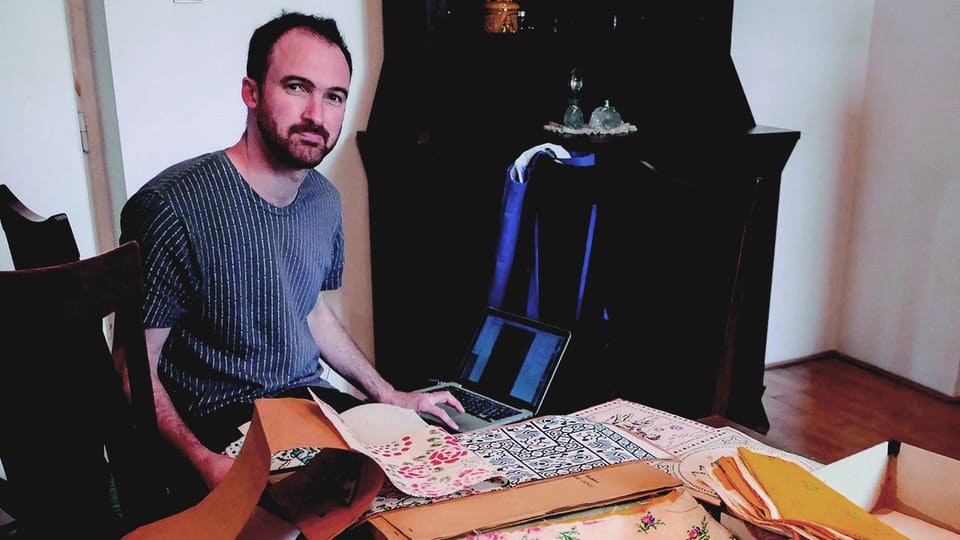
“Ilsa, the daughter of this family, married Karl Breuer, who was the last owner of the Breuer factory in Dvůr Králové. The connection is by marriage, and the two of them had a daughter named Gita.
“This family of three was deported to Terezín in 1942 and died in Auschwitz in 1944. The Žalud family also attended the synagogue in Český Krumlov.
“So this artwork—and the idea of Judaism making a return there—is really the central metaphor of the show.”
And if I understand it correctly, the exhibition is tailor-made for that specific place. How did the location inspire you when you were creating these pieces?
“Yes. I pushed myself to produce a lot of new work quickly, because it's such a beautiful place. As an artist, it's incredibly exciting to have the opportunity to exhibit in a liturgical space like a church or synagogue.

“What I've made are large prints, each about 170 by 120 centimetres. They’re all on linen and wool felt, and all screen printed.
“They use a combination of original Breuer ornamental motifs and images of my own hands using sign language to spell the word return—or návrat, or in German zurück. It’s nice that return, návrat, and zurück all have six letters. That makes it very symmetrical and useful for a repeating pattern design.”
One piece that really caught my eye uses your hands at the end of Torah pointers. Can you tell us more about that work?
“I’d been thinking—somewhat separately from this project—about hands and touch. It ties into themes of fatherhood and sensitivity, but also nonverbal communication.
“You know, the way you speak to a baby is often through your hands, or to someone who doesn’t speak your language. So I thought, okay, I’m going to this country where I don’t really speak the language, but I want to communicate with hands and hand signs.
“And I’m showing the work in a temple, which made me immediately think of the yad—Hebrew for hand—which is the Torah pointer. It’s kind of a prosthetic, really: something you hold to follow the text of the Torah without touching it directly.

“Ideally, you're not supposed to touch the Torah with your hands. So in this work, instead of the traditional Torah pointers with a single finger, I made fabric pieces with six yadim, each one spelling out a word in sign language.
“I also used some of the imagery from the Jewish Museum in Prague as source material for these yad pointers.”
How did you manage to create all these 16 new works in such a short period of time?
“I was supported by a grant from my university, which made a big difference. I was also able to hire a former student of mine, which helped enormously.

“On top of that, I worked with a local wallpaper printer. I'm lucky to live in Buffalo, New York, where there's a place called Red Disc Studio. They have a 10-meter-long table, which means they can print on fabric or paper at that scale.
“They had never printed on fabric before, so printing such a long repeating pattern was a new experience both for me and for them. It turned out to be a really nice fusion of knowledge and skill coming together.”
Related
-

80 years ago: How did WWII end in the Czech lands?
Eighty years ago, the most destructive and lethal war in history approached its end. In this series we map the last stages of the war and its aftermath on Czech territory.