Jewish life under pressure in Europe – but Czechia remains different, says Irena Kalhousová
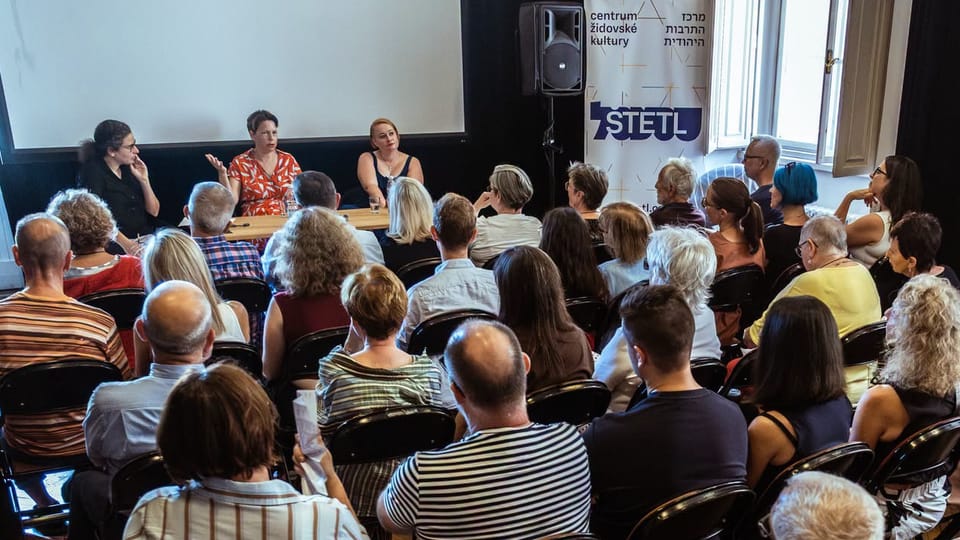
For five days, Štetl Fest brought Jewish culture, history and contemporary debates to Brno and the surrounding region. At a time when the war in Gaza has contributed to growing tensions around Jewish life elsewhere in Europe, Director of the Herzel Center for Israel Studies Irena Kalhousová told RPI's Vít Pohanka Czechia remains something of a “unicorn”.
Jewish events increasingly associated with Israel
In Irena Kalhousová's view, the situation facing Jewish communities internationally has changed significantly since the Hamas attacks of October 7, 2023, and the subsequent war in Gaza. Events with no connection to Israeli politics, she argues, increasingly find themselves drawn into debates and confrontations surrounding the Middle East.
“I think that’s a very unfortunate consequence of October 7 and, of course, mostly what followed, meaning the war in Gaza. Events which have nothing to do with the Middle East or even Israel, and are mostly about Jewish cultural things, became also affected by this.”
The problem, she says, goes beyond criticism of Israel or its government.

“Simply by the fact that one is Jewish, this person is now seen as some kind of representative of Israel, an Israeli government. And even Jewish events, which may be cultural or religious, are somehow linked to Israel and the Middle East. I think that’s a big problem. It’s a huge problem for the Jewish diaspora.” This has also made security a growing concern for Jewish communities in Europe and North America. Yet Kalhousová says Czechia remains noticeably different.
Walking through Brno during Štetl Fest, she pointed to the very existence of a large and openly Jewish festival encompassing debates, performances and cultural events. “I think the Czech Republic is still really kind of a special case, or a unicorn. We have data. We see that when it comes to public opinion, the Czechs still have a positive look at Israel, which is very, very unique.” At the same time, she cautions that Czechia is not immune to developments elsewhere. Attempts to disrupt academic discussions about Israel and the Middle East can be seen here as well. But compared with many other countries, she says, the atmosphere remains considerably less polarised.
Jews as part of the Czech story
Why should Czech attitudes be different? Kalhousová stresses that attitudes towards Jews and attitudes towards Israel should not be conflated. When it comes to Jewish life itself, she believes part of the explanation lies in Czech collective memory.

“We Czechs kind of see the Jewish influence and Jewish presence as something positive. People simply consider Jewish artists, for example writers, as simply Czechs – including, for example, Franz Kafka. The guy wrote in German and was Jewish, and still we Czechs see him as one of the most important Czech authors.” Jewish communities were also historically spread across the Czech lands. Even relatively small towns and villages can have a Jewish cemetery, a former synagogue or other reminders of communities that vanished during the 20th century.
Kalhousová says that after the fall of communism in 1989, many Czechs began rediscovering this forgotten local history. “I find it really almost touching how it’s local people in those villages who are taking care of this Jewish heritage. They try to keep this tradition – not alive, because simply the people are not there – but to remember it.”
She nevertheless warns against idealising the past. The notion that Czech-Jewish relations were always harmonious is, she says, partly a national myth. Czech society has also largely avoided the difficult debates over local responsibility for the persecution of Jews that have taken place in countries such as Poland.
Why Czechs identify with Israel
Attitudes towards Israel have another historical dimension. Kalhousová believes many Czechs see parallels between their country's historical experience and Israel's struggle for survival. Czech collective memory remains strongly shaped by the Munich Agreement of 1938, when Czechoslovakia was forced to surrender its borderlands to Nazi Germany, and by the Soviet-led invasion of 1968.
“We see ourselves a little bit as a victim. Of course, we see ourselves as victims. This is part of our identity. The trauma of Munich is very much part of our identity as Czechs, for good and for bad.” Israel, she argues, has sometimes represented an alternative version of that story: a small state prepared to defend itself.

“I think many Czechs admire Israel because we did not defend ourselves, while Israel is defending itself. And it’s winning. For many Czechs, this is something admirable.”
Kalhousová also points to the influence of two defining figures of modern Czech history, Tomáš Garrigue Masaryk and Václav Havel, both of whom took positions sympathetic to Zionism or Israel. None of this, she stresses, means that Israeli government policy should escape criticism. The opposite is true: events in Israel and the Palestinian territories need to be questioned and debated. But she argues that criticism of a state should remain distinct from attitudes towards Jews living thousands of kilometres away.
For several days in Brno, Štetl Fest offered one indication that this distinction is still largely being maintained in Czechia. Jewish history was remembered publicly, while contemporary Jewish identity and Israel were discussed – sometimes critically and provocatively – without preventing Jewish cultural life from taking place. For Kalhousová, that may be what still makes Czechia a European “unicorn”.
Related
-

Returns to Brno: ŠTETL FEST revives the city’s Jewish stories
ŠTETL FEST returns to Brno with Jewish culture, music and stories, bringing new life to places where much of the city’s Jewish history was erased.






