Rediscovering a lost legacy: American Noah Breuer on his Czech roots and power of art
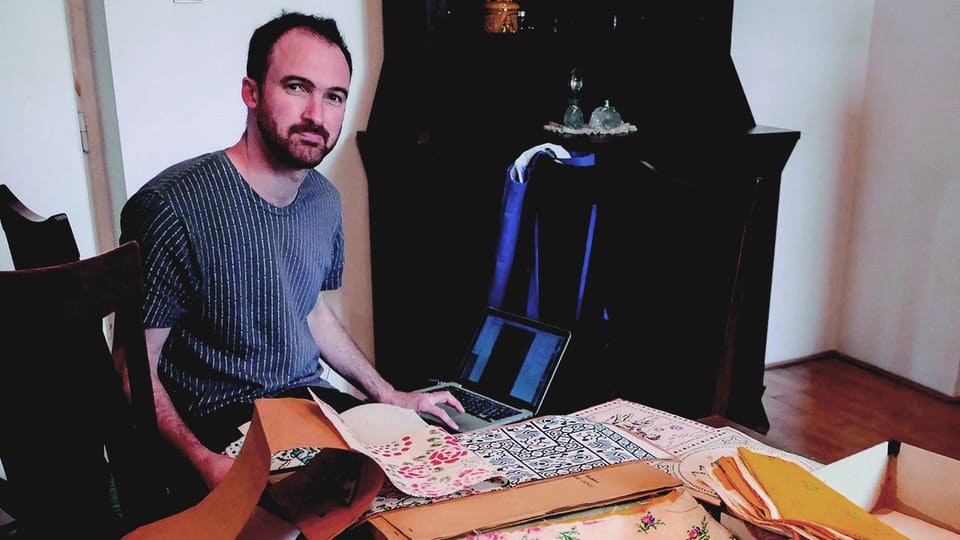
Noah Breuer is an American artist with a personal connection to Czech history. His ancestors owned a textile factory in Dvůr Králové, which was confiscated during World War II, and most of his Jewish family perished in the Holocaust. In 2016, Breuer discovered fabric swatches from the factory in Czech archives, inspiring a series of artworks in textiles, paper, and glass that blend historical motifs with contemporary design. His works are currently on display in Břeclav at the exhibition Návrat (Return), organized by the non-profit Moravian Beauty. During his recent visit to Prague, I spoke with him about his family's legacy and his artistic response to it.
Your family’s textile factory in Dvůr Králové was confiscated during WWII due to their Jewish origin, and most of your relatives perished in the Holocaust. How did you first come to learn about this part of your family’s history?

“Well, this was well known; it was not a secret to me or my father. My father was born in 1944 in Los Angeles, but his older brother was born in 1936 in Vienna. So my father is sort of the first American. So this was not a secret at all about the story and the factory and the connection to Vienna and Bohemia. However, the thing that I didn't know and my father didn't know was that there were any surviving pieces that were produced in this factory.”
Can you tell us a little bit more about your great-great-grandfather who started the family business?

“Carl Breuer was born in Bohemia. He had two sons named Felix and Ernst, and those three created Carl Breuer and Sons. It was a textile-producing company that produced all sorts of printed material, tablecloths, and window curtains - domestic textiles, you call it.
“Not really fancy, but kind of traditional ornamental designs, and only printing because I think that most of the actual weaving of fabric was happening more in North Bohemia. Between 1900 and 1938, they got bigger and bigger. I can't remember the exact statistics at the moment, but they were doing lots of volume by the 1930s and exporting all over Europe.”
What happened to the family after the Nazis confiscated their business?

“My great-grandparents, the brothers of Carl Breuer and Sons, Felix and Ernst, were based in Vienna and Bohemia, but there was always constant communication and travel. After the Anschluss in Vienna, the Viennese family moved to Bohemia in September 1938.
“By November, it became clear that some of them wanted to leave the country. The Bohemian-based Breuer family thought that maybe they would be safe in Czechoslovakia, so they stayed. My grandparents left in November 1938. Everyone who stayed was killed in the camps -about 21 direct relatives. My grandparents moved to Los Angeles and built a new life there.
“Between 1938 and 1941, there was a long, weekly correspondence between my grandfather, Hans, and his father, Felix. Hans was in California, Felix in Vienna. I have copies of all these letters because my grandfather, a stereotypical Viennese-fastidious and organized-kept carbon copies of everything.

“These letters chronicle, at first, everyday life: news of a new grandchild, gossip, jokes. But as it gets closer to 1941, the tone becomes darker. My grandfather desperately tried to obtain visas for the remaining family members, but it was impossible.”
And what happed to the factory?

“After 1939, under Nazi Aryanization, all Jewish-owned businesses were confiscated. The factory of Carl Breuer and Sons was taken over and became Kramer and Effenberger, run by German Czechs. It was repurposed for the war effort, producing all sorts of printed materials.
“One shocking discovery I made during a visit to the Czech textile archive in 2016 was that, at some point around 1940, the factory was used to print the yellow star badges that Jews were forced to wear. And some of the workers printing these badges were probably Jewish themselves.
“Seeing those badges in the archive, knowing they came from my family’s factory, was incredibly powerful and horrifying.”
You mentioned your trip to the Czech Republic in 2016 when you discovered these fabric swatches from your family’s factory. Did you know beforehand that these swatches had survived, or was it a complete surprise?
“A complete surprise. I have to credit my father for finding out about the archive. In his retirement, I asked him to do some additional research because he is one generation closer and has more knowledge of German. Through his research, he found out about the existence of the textile archive in Česká Skalice.

“He told me, "Noah, I've been told there are some surviving Breuer fabric samples there. I don’t know how much. You should go and see." That was in 2014, and I eventually went in 2016. As an artist, I was hoping there would be something usable and inspiring for me. It wildly exceeded my expectations. It was so much more powerful than I had imagined.
“I am a Professor of Print Media at University of Buffalo, and I’ve been to museums all over the world, like the Rijksmuseum in Amsterdam, where you can make an appointment to see Rembrandt etchings up close. But I had never been to a museum where they presented me with boxes labelled with my own family name. That moment in the Czech textile archive - when they brought out six boxes marked "Breuer"- was simply incredible. And it was immediately clear to me that I wanted to create work that responds to it.”
You studied printmaking and traditional block printing. Was this decision connected to your family heritage, or was it a coincidence?
“It’s a pure coincidence. People often assume I studied printmaking because of my family history, but I assure you that my family did not direct me toward being an artist, though they were very supportive. I went to art school at the Rhode Island School of Design, where you can major in photography, printmaking, painting, or illustration.

“I was drawn to printmaking, because I was very attracted to the graphic arts. Perhaps being exposed to European art at a young age played a role. If you believe in cosmic fate, though, once I had discovered these Breuer fabrics, I was well-prepared by my formal training to work with them and republish them in a new way.”
Can you tell us about your process of transforming these historic textile designs into your own artworks?
“The archive contained almost no full samples - just swatches. The company produced tablecloths and similar items, but mostly what remained were swatch books, each showing the same pattern in five different colours.
“There were also printed catalogues, similar to a Sears catalogue, something you can order from afar, allowing customers to order specific designs. For me, the small fabric swatches were nice to touch and see the accurate colour, but the paper catalogue samples were more useful because they showed the entire tablecloth design.

“So I took a lot of photographs and when I returned home, I wondered, "What do I do with this?" Using my print training, I started making screen prints and woodcuts on paper. Soon, it became obvious that I should be printing on fabric as well. This led me to experiment with new materials that I am not trained to work with, like woodblocks on silk and linen, fabric dyes, glass, cast paper, and sculpture.
“A metaphor I like to use, since I am Noah, is that the archive is an ark, and all these artworks are the animals coming out, creating a new, reconstructed species of different kinds of artworks.”
I imagine the process must have brought you closer to your family heritage…
“Absolutely. I’ve been fortunate to visit Europe about ten times. As an American, it often feels like time travel - everything seems so old compared to the U.S. But now, it’s not just historical curiosity; it’s personal. Visiting Dvůr Králové, seeing the factory, walking past addresses where family members lived - it’s not some fictitious Disneyland version of European history. It’s deeply relevant. So to answer our question: Yes. This project has also pushed me to research more about my extended family tree.”

Your artworks, inspired by these old fabric swatches, are now part of an exhibition in the Moravian town of Břeclav. How does it feel to have your works on display in your ancestors’ homeland?

“The exhibition is called Návrat, meaning "return." My father often speaks about going to Europe as a kind of return. My first trip to Europe was at age 10, to bury my grandfather in the Central Cemetery in Vienna - his permanent return.
“I guess it is a way of saying that we belong here. We identify as European Jews living in America, and my artwork has been exhibited in Maine, California, Oregon, and New York. But ultimately, it belongs in Europe. It should return to Bohemia. Right now, it’s in Moravia, but next summer, it will travel to Český Krumlov. That’s why we call it Návrat - a return.”
Related
-

80 years ago: How did WWII end in the Czech lands?
Eighty years ago, the most destructive and lethal war in history approached its end. In this series we map the last stages of the war and its aftermath on Czech territory.