From robot safety to human trust: Jana Tůmová explores how humans and robots can work together
What makes a robot safe? And how can we be sure it will behave as expected? These are some of the questions Czech researcher Jana Tůmová is trying to answer. Based at Stockholm’s KTH Royal Institute of Technology, she studies how formal methods can help make robots safer and their behaviour more predictable. Her journey into robotics began with theoretical computer science in Brno and took her to Boston before she eventually settled in Sweden. Today, her work also looks at how people perceive robots and whether they feel comfortable having them around.
You studied computer science at Masaryk University in Brno, but I know that you originally wanted to study mathematics. What made you choose computer science?

“To be honest, it was mostly peer pressure. Mathematics is really beautiful, but a lot of my friends chose computer science because it offered better career prospects and more opportunities to find a job afterwards. So I went with them.”
What brought you to Sweden in the end, and what made you decide to stay?
“Again, it was a coincidence. I didn't particularly choose Sweden, but there was a postdoc opening to work on multi-robot systems. I had been working with techniques for single-agent systems, for single-robot systems, and it sounded like the next step that could help develop my research further.

“I accepted the postdoc, and that's how I moved here. Then, again, I liked it here. I applied for faculty positions and landed one. And I've been here ever since.”
You started out in theoretical computer science. How did you get interested in robotics?
“That was a pure coincidence. I was working on my research, and we had a researcher from the US visiting us who was interested in applying some of the methods we had been working on to robots, particularly for provable safety and provable task accomplishment.
“While we were talking, it turned out that some of my expertise could be useful. So I visited Boston University, and that's basically how my detour into robotics started.”
What exactly do you work on today?

“I work on something we call formal methods for robotics. Formal methods are techniques that help us with the specification, verification analysis of systems in general. I try to apply these techniques to robots.
“They help make robots safer, more predictable and more reliable, because we have proofs of what a robot does and what it doesn't do.”
You are interested in robots that work alongside people. Where do you think we could see them being used in the future?
“I think the way we see them being used today – as vacuum cleaners or greeting robots at airports – represents the simpler scenarios. These are situations where the robot doesn't really interact physically with humans or with anything heavy.
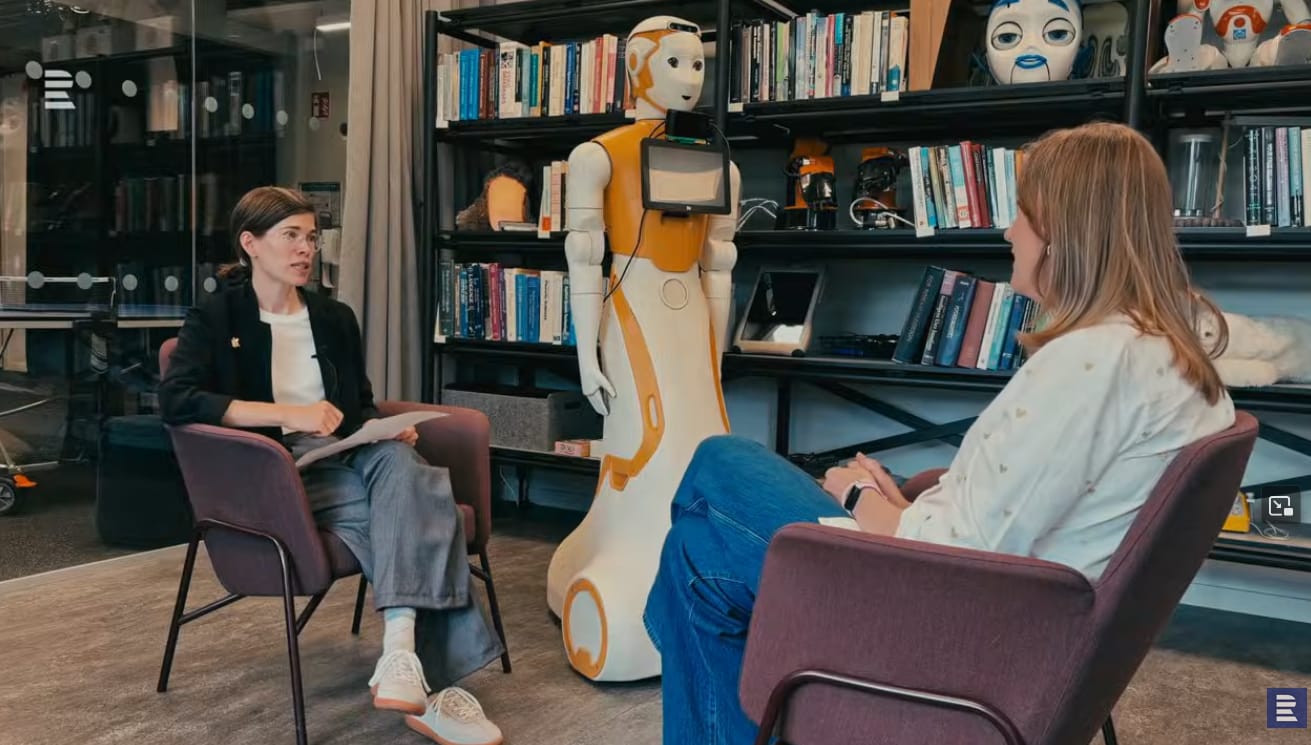
“So I think the question is not so much where we will see them, but where we would like to see them. I would like to see them doing dirty, dull and dangerous jobs. I would like to see them filling the gaps where we lack people, for example because we have a growing elderly population and an increasing number of older people. That's where robots could help.
“So this is what we're working towards. And as a by-product, we get these simple robots that just hang around and don't do much.”
Watch the video for the full interview
This interview was produced as part of a joint project by Radio Prague International, the Czech Centre in Paris, and the Czexpats in Science initiative. The Science Without Borders series, featuring young Czech scientists working in various fields in Sweden, was recorded in Stockholm. It follows previous series of interviews from Vienna and Paris.
Related
-

Science without borders: Meet the young scientists changing theworld (III)
Curious and ambitious, Czech scientists working in Sweden havemade their mark in the international research community. Their workspans a wide range of fields.
-

-

Science without Borders: Interviews with young scientists who are helping to change the world
They are young, ambitious and above all curious. They left their home country to study science abroad. The spotlight is on Czech scientists working in Austria.
Latest
-
Lukáš Fiedler on the secret language of plants
How do plants know how to shape themselves without anyone telling them how? Lukáš Fiedler thinks the answer lies in a powerful plant hormone called auxin.
-
Dagmar Vorlíček on how social sciences shape international policy
Can the social sciences shape international policy? Dagmar Vorlíček believes they must.
-
Hana Marvanová on the unequal power of our genes
What makes you unique? Scientist Hana Marvanová studies parent-of-origin effects. But how did she go from studying anthropology to cutting-edge molecular biology?
-
Shift of power: Luděk Němec on fall of Czech aristocracy in 20th Century
What happens when an elite ruling class suddenly loses its power? Historian Luděk Němec explores the dramatic transformation of the Czech aristocracy in the 20th century.
-
Scientist Zlata Tabachová on improving markets and society
In the next episode of our series Science Without Borders, we go to Vienna to talk to Zlata Tabachová on how she uses math to rethink how society functions.
-
From Brno to the microscope of the future: Jakub Dokulil blends physics, engineering and community
In Vienna, Jakub Dokulil is developing a cutting-edge microscope that tracks molecular movement in real time. For him, science is both an adventure and a team effort.
Pages
- « první
- ‹ předchozí
- …
- 5
- 6
- 7
- 8
- 9
- 10
- 11
- 12
- 13
- …
- následující ›
- poslední »