From robot safety to human trust: Jana Tůmová explores how humans and robots can work together
What makes a robot safe? And how can we be sure it will behave as expected? These are some of the questions Czech researcher Jana Tůmová is trying to answer. Based at Stockholm’s KTH Royal Institute of Technology, she studies how formal methods can help make robots safer and their behaviour more predictable. Her journey into robotics began with theoretical computer science in Brno and took her to Boston before she eventually settled in Sweden. Today, her work also looks at how people perceive robots and whether they feel comfortable having them around.
You studied computer science at Masaryk University in Brno, but I know that you originally wanted to study mathematics. What made you choose computer science?

“To be honest, it was mostly peer pressure. Mathematics is really beautiful, but a lot of my friends chose computer science because it offered better career prospects and more opportunities to find a job afterwards. So I went with them.”
What brought you to Sweden in the end, and what made you decide to stay?
“Again, it was a coincidence. I didn't particularly choose Sweden, but there was a postdoc opening to work on multi-robot systems. I had been working with techniques for single-agent systems, for single-robot systems, and it sounded like the next step that could help develop my research further.

“I accepted the postdoc, and that's how I moved here. Then, again, I liked it here. I applied for faculty positions and landed one. And I've been here ever since.”
You started out in theoretical computer science. How did you get interested in robotics?
“That was a pure coincidence. I was working on my research, and we had a researcher from the US visiting us who was interested in applying some of the methods we had been working on to robots, particularly for provable safety and provable task accomplishment.
“While we were talking, it turned out that some of my expertise could be useful. So I visited Boston University, and that's basically how my detour into robotics started.”
What exactly do you work on today?

“I work on something we call formal methods for robotics. Formal methods are techniques that help us with the specification, verification analysis of systems in general. I try to apply these techniques to robots.
“They help make robots safer, more predictable and more reliable, because we have proofs of what a robot does and what it doesn't do.”
You are interested in robots that work alongside people. Where do you think we could see them being used in the future?
“I think the way we see them being used today – as vacuum cleaners or greeting robots at airports – represents the simpler scenarios. These are situations where the robot doesn't really interact physically with humans or with anything heavy.
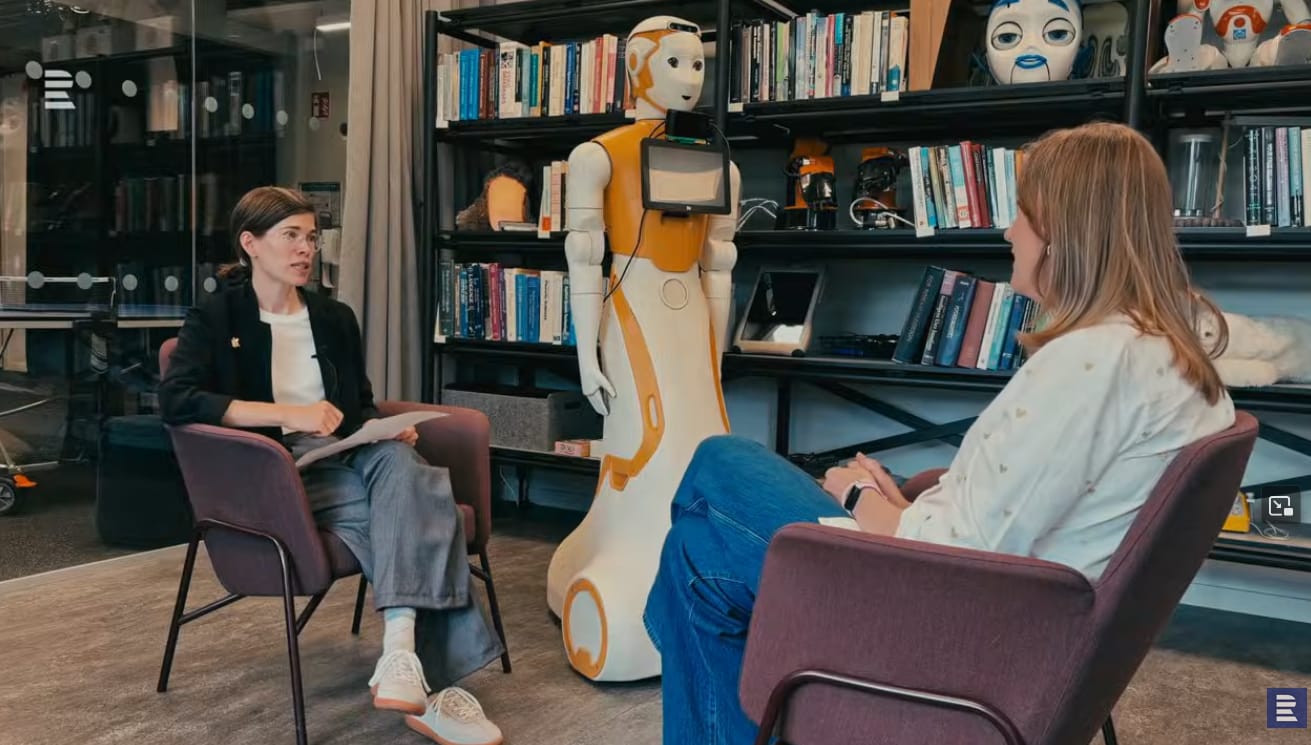
“So I think the question is not so much where we will see them, but where we would like to see them. I would like to see them doing dirty, dull and dangerous jobs. I would like to see them filling the gaps where we lack people, for example because we have a growing elderly population and an increasing number of older people. That's where robots could help.
“So this is what we're working towards. And as a by-product, we get these simple robots that just hang around and don't do much.”
Watch the video for the full interview
This interview was produced as part of a joint project by Radio Prague International, the Czech Centre in Paris, and the Czexpats in Science initiative. The Science Without Borders series, featuring young Czech scientists working in various fields in Sweden, was recorded in Stockholm. It follows previous series of interviews from Vienna and Paris.
Related
-

Science without borders: Meet the young scientists changing theworld (III)
Curious and ambitious, Czech scientists working in Sweden havemade their mark in the international research community. Their workspans a wide range of fields.
-

-

Science without Borders: Interviews with young scientists who are helping to change the world
They are young, ambitious and above all curious. They left their home country to study science abroad. The spotlight is on Czech scientists working in Austria.
Latest
-
Get a bird’s eye view of the Ústí nad Labem Region
Join us on a trip to the Ústí nad Labem Region with its Ore Mountains, the Elbe waterway and the sandstone rocks of Bohemian Switzerland.
-
Simple and delicious potato pancakes
The bramborák, or potato pancake, can be eaten on its own as a quick snack or a delicious side for stew. And they are super easy to make! Here is how.
-
Kulajda: a rich and fragrant mushroom and dill soup
The "kulajda" is a rich, creamy, sour-sweet soup perfect for cold weather. Watch our video to find out how it is made.
-
My Homeland - symphonic poem to Czech nation
The seventh part of our video series on Czech Music Greats is devoted to the cycle of symphonic poems My Homeland by Bedřich Smetana.
-
Explore the Karlovy Vary Region from the skies!
Join us on a trip to the Karlovy Vary Region - famed for its hot mineral springs, spa treatments and annual film festival. Our drone video will guide you!
-
“Czech Bach” Jan Dismas Zelenka
The third part of our video series on Czech Music Greats is devoted to the work of Jan Dismas Zelenka, known as the “Czech Bach”.
Pages
- « první
- ‹ předchozí
- …
- 10
- 11
- 12
- 13
- 14
- 15
- 16
- 17
- 18
- …
- následující ›
- poslední »