

Microphones against tanks: The voice of freedom on the airwaves and the invasion meant to silence it (3)
The second half of the 1960s brought political thaw to stagnant Czechoslovakia and, with it, a breath of freedom that inevitably spread through the corridors of Czechoslovak Radio. International broadcasting, until then a strict and uncompromising instrument of communist propaganda, slowly began to change its tone. Czechoslovakia was opening up to the world, and the airwaves no longer carried only rigid ideological dictates.
The end of censorship and the euphoria of the Prague Spring

The era of intense ideology was gradually drawing to a close. Conditions loosened to such an extent that when the multimedia theater company Laterna Magika appeared at New York’s Carnegie Hall in 1964, its director Václav Kašlík could openly praise his American partners on Radio Prague’s airwaves for carefully considering every detail and edit to ensure that the performance was never dull and constantly gained momentum.

Nevertheless, censorship still held sway within the radio service, and international broadcasting continued to bear the mark of the Cold War. As late as 1966, for example, communist official Anton Korman addressed compatriots in the United States with a passionate explanation that the communist takeover had disrupted their plans in the West and that the rapid collapse of the postwar anti-Hitler coalition had been caused by the Western powers.

The turning point that changed everything came in March 1968, when the Central Committee of the Communist Party approved the abolition of censorship and the Prague Spring fully blossomed. For the first time in years, Radio Prague could broadcast freely. Pavla Jazairiová, an editor in the French-language service for Africa, recalls the period nostalgically as a wonderful time when people in the newsroom could openly and joyfully discuss Alexander Dubček and the idea of “socialism with a human face.”

This new direction generated an unprecedented response from listeners. While compatriots in the United States and audiences across Europe welcomed it enthusiastically, the shift caused confusion and uncertainty in decolonized Africa and Latin America, according to Tomáš Dufka, head of the radio archive. The liberalization of Czechoslovakia, however, terrified neighboring communist leaders. East German leader Walter Ulbricht went so far as to deploy radio jammers against Radio Prague as early as May 1968, something virtually unheard of among so-called “brotherly” socialist states. Bedřich Utitz, then head of the German-language service, retaliated by provocatively repeating Ulbricht’s false claim that there was no censorship in East Germany, adding a sarcastic comment that he was doing so at the request of listeners whose reception was being jammed.


International interest was enormous, and audience figures reached unprecedented highs. The foreign broadcasting department was flooded with letters. One French listener, Paul Marie Lantoine, eagerly asked whether the Czechs would be able to resist Moscow and even requested a copy of the manifesto Two Thousand Words.
The August night under fire

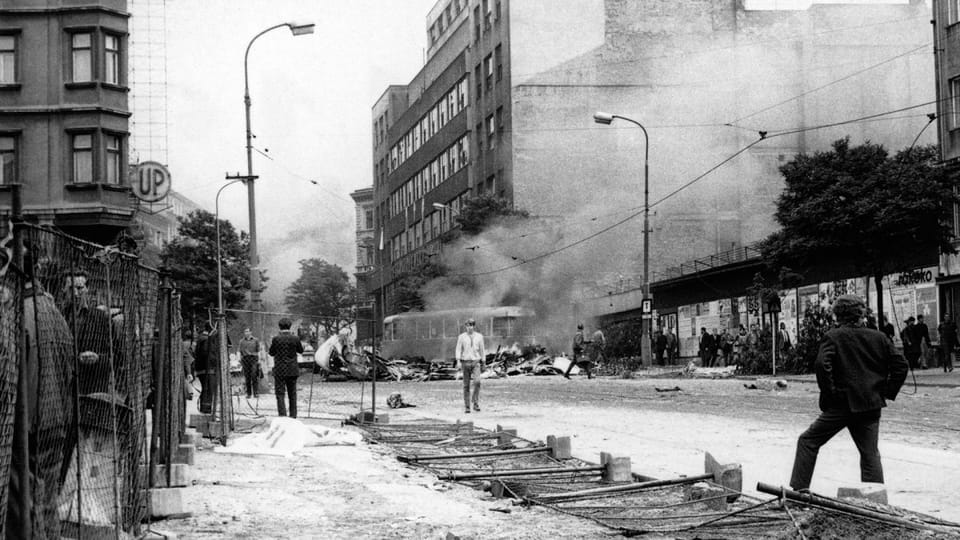
All these hopes were brutally crushed by tanks on the night of 21 August 1968, when massive Warsaw Pact armies entered the country without the president’s knowledge. Radio Prague immediately became a crucial source of information about the invasion for the entire world. Broadcasting was conducted exclusively live, and authentic recordings from those shifts survived only thanks to foreign archives and amateur listeners.

Richard Seemann, then deputy editor-in-chief, recalls how he and young editor Karel Wichs quickly prepared and transmitted the first historic report announcing that foreign troops had crossed the state border.
At first, the editors naively believed that the soldiers would not force them out. Wichs later remarked with a bitter smile that they had even stocked up on alcohol and canned food in preparation for a long broadcasting marathon. Management also contributed to the false sense of security. In a tragicomic scene, director of international broadcasting Karel Hrabal reassured young editors in his office that the soldiers outside were firing only blanks. Moments later, a burst of live machine-gun fire struck the ceiling directly above them, sending everyone diving to the floor before crawling to safety.

The reality of the occupation was felt just as harshly by eighteen-year-old technician Jana Hořínková, who that day saw a dead person for the first time in her life in the lobby of the devastated radio building. By seven o’clock in the evening, the headquarters on Vinohradská Street had finally fallen, and employees were forced to leave.
A secret radio station in Nusle
Yet the free broadcasts did not fall silent, because help arrived from an unexpected source: Italian communists. They secretly operated their own station for audiences back in Italy from an inconspicuous villa in Prague’s Nusle district. As researcher Ulrico Bovo explains, the Italian journalists did not hesitate for a second. They immediately invited the expelled Czech editors into their refuge and generously handed over their microphones.

From the villa, the journalists worked with extraordinary dedication, producing improvised news bulletins in five world languages.
The occupying forces naturally searched intensively for the hidden station, but without success. Bovo recounts an anecdote about an Italian resident of the villa who was terrified when a Russian tank stopped outside. The secret remained safe, however; the soldier merely stepped out to relieve himself at the corner of the street before driving away.

Karel Wichs recalls a far more dramatic episode. When another armored vehicle passed nearby, panic spread through the newsroom and staff attempted to escape through a prepared hole in the fence. His colleague Neff became stuck in the opening, leaving Wichs resignedly waiting for the worst.
When Soviet troops finally vacated the central radio building on 9 September, the returning staff were met with a devastating sight. Everything of value had been looted, and, according to Richard Seemann, the sanitary conditions left behind by the occupiers were so appalling that the entire building first had to be thoroughly disinfected.
According to Karel Wichs, only the office of French-language editor Josef Cincibus escaped untouched. Soviet soldiers had not entered it because, judging by the display of photographs of Marx, Stalin, and Lenin on the walls, they assumed it was a sacred “Red Corner” and therefore untouchable.
Political purges and a new “Leninist youth”
The return to the home newsroom also meant the return of censorship and the harsh beginning of a period known as Normalization. One of the final major demonstrations of nationwide resistance was the funeral of student Jan Palach, who had set himself on fire in protest, in January 1969. Pavla Jazairiová reported on the event from the streets for African audiences and still remembers it as an indescribably oppressive experience filled with a sense of dread, while the radio station played nothing but funeral music throughout the day.

With that moment, the Prague Spring came to a definitive end, and the new communist leadership began a relentless campaign against reformists. Archivist Tomáš Dufka explains that vetting commissions ironically used highly detailed analyses of enthusiastic listener letters previously sent to the international service as evidence in dismissing employees.

The department was transformed beyond recognition. Jazairiová firmly refused to sign a written endorsement of the invasion or submit to pressure to join regime-controlled youth organizations, and she was dismissed. Experienced veterans such as Seemann and Wichs also departed in bitterness.
The professionals were swiftly replaced by a generation fully loyal to the regime. Director Jana Hořínková recalls the immediate influx of newly graduated recruits whom longtime staff mockingly called “Lenin’s New Youth.” Although many of these newcomers initially spoke no foreign languages at all and merely claimed they would learn everything within six weeks, they rapidly became heads of editorial departments. They did not even need to appear before microphones; their role was simply to approve ideologically acceptable content. The independent Italian broadcasts also came to an end.

By 1979, Radio Prague’s international service belonged entirely to reliable commentators such as Karel Šimon, who unhesitatingly told compatriots over the airwaves that all the values of communist morality had been trampled on in 1968. Under strict political supervision, the radio once again became a loyal and unquestioning servant of communist power.
The next real spring—and the long-awaited return of free speech—would not arrive for another twenty years.
Related
-

Prague Calling the World!
From shortwave to podcasts. From coded messages for exiles to a global digital audience. Ninety years of Radio Prague’s broadcasts is a story of constant transformation.
about programme
Czechast, Radio Prague International
Czechast is a regular RPI podcast about Czech and Moravian culture, history, and economy.






