Max Diesing on “33 and a third” years of running Prague indie music store
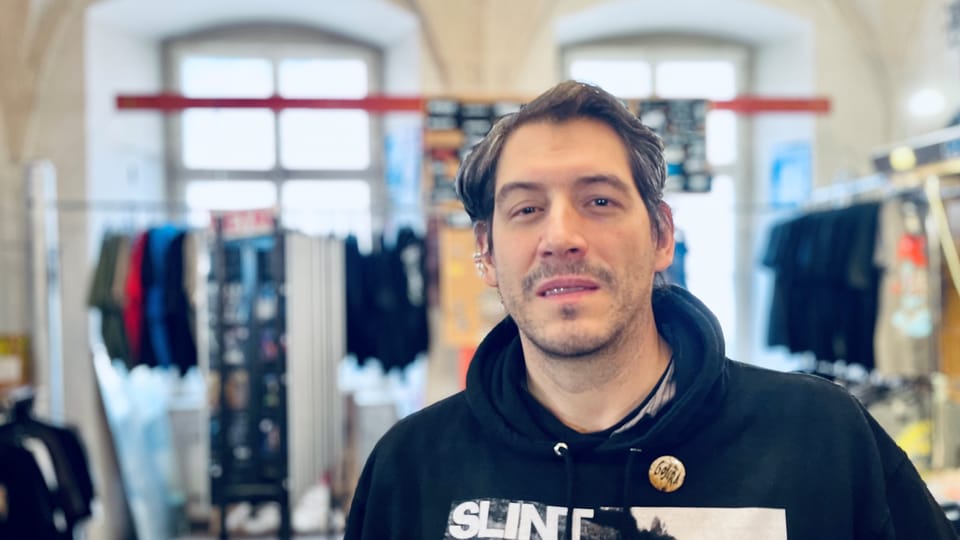
Max Diesing runs Maximum Underground, an alternative music shop located in Prague’s Old Town for many years. In fact the American says he is just about to mark his business’s “33 and a third” birthday as a fixture on the city’s alternative music scene. But what was it like setting up an independent store here just a couple of years after the Velvet Revolution? And what motivates him to keep running the business after all this time? We spoke at the store on Jílská St.
Max, in the summer of 1992 I was here visiting. I was in a commercial music shop and I found a flyer for an alternative music shop that said they had everything on [US independent label] SST and it was on Dlouhá Street. And I went to the shop, your shop, and I thought, Wow. Could you describe the beginnings of your shop here in Prague?
“I guess it’s been the same – always some problems, really. So at the beginning either a) people did not have money, two years after the end of communism, or b) there was no knowledge of the type of music I was selling.
“It was a risk. I just did it basically because I really wanted to open a shop with alternative music – that was my love.
“It was probably stupid at the time, and [laughs] maybe still is stupid, but, yeah, August 11, 1992 – which makes it the 33 and a third years birthday coming up on December 11.”
Looking back, I’m surprised that there was even distribution here for the kind of music you were selling. How were you getting those albums, back in those days?
“Oh, that wasn’t a problem. I got it from the US.
“I spent the summer before I opened the shop calling up all the labels I loved: Touch & Go, SST.
“It was a risk. I just did it because I really wanted to open a shop with alternative music.”
Max Diesing
“Getting distribution was no problem – they were interested in somebody doing something in that part of the world.
“So that was no problem, getting stuff from England or the US.”
Was there a certain kind of goodwill towards this part of the world? I remember bands would come here when they clearly were losing money, just because they wanted to do something for people here.
“Yes, I think there was. I agree with you, also with the bands – that was true.
“And I think for me also there was goodwill, because I was not professional, but nobody is in the alternative world maybe – or they were less at that time.
“So yes, there was goodwill. Not totally, like in lending me money or putting me on credit, yet. But there was definitely goodwill on the part of labels and people.”
In Prague in the ‘90s dance music became a huge thing. There were all these clubs like Roxy and so on. Did that help your business? Or were you involved with that?
“I don’t know how much I was involved.
“I was really turned on, I have to admit, by Prodigy, Music for the Jilted Generation.
“Then I was also getting some ambient labels, like the Planet Dog label from England.

“I got the Artificial Intelligence compilations. Warp was putting out stuff and I was dealing with them already.
“I was turned on by dance music because of the great beat: I love a beat.
“So from 1993, even, I was turned on when that Prodigy album came out and some of the ambient albums came out, the Planet Dog stuff and the Feed Your Head compilations – those were great.”
Beyond your shop, what are your strongest memories of the ‘90s? Of course now it’s a kind of legendary period, but then we were all young in those days.
“Yeah, the ‘90s was really cool. You have to put that bias on it and say, Yes, because it was my younger time.
“But I have to say that there was… again, this isn’t fair because maybe there are just as big crowds as then, but the hardcore scene was huge, when the bands came here.
“Roxy on Dlouhá was packed. Nomeansno was here. They came into the shop and I stayed open until right before the show and people came in.
“The ‘90s was the best for community, for the music.”
Max Diesing
“And there were just crowds then – and it was a good feeling.
“I have to say, because I was more into that hardcore scene, that that was big and very ‘kamarádi’ style.
“That I don’t see any more, but again maybe because I’m older and I don’t go out as much.
“But in the ‘90s I have to say it was the best. Maybe I’m jaded now, but it was the best for community, for the music, for other types of music starting – there was much more community then, and big crowds who wanted to listen to the bands.”
As you say, your business has been running for “33 and a third” years. It’s hard to speak about the development over that long, but in terms of changes I presume the advent of streaming has been the biggest thing in music since you started your shop?
“No. As I said at the beginning, there have always been problems.
“At the beginning people didn’t have money and there weren’t as many people who knew the music, so it was really niche music; it wasn’t big enough.
“Then in the late ‘90s, early 2000s there was recording… In the ‘90s also there were the rental places too – you could rent CDs [and copy them], that was a problem.
“Later on, after that, you could just record CD to CD. You could buy a CD and record the music, and that was a problem.

“There was a guy selling bootleg CDs that he recorded. So he would come into my shop, buy all the hardcore stuff, record it and sell these recorded CDs for one-third or one-fourth the price of what I was selling for.
“Then in the early 2000s, the first decade of the 2000s, it was maybe the best because streaming hadn’t taken over yet. So actually between 2000 and 2009 was probably the best time, because it was between different problems [laughs]. And the people knew the music better.
“Then after 2009 the economic situation turned down very badly. And then I guess the streaming started up in the second decade – and that’s been the current problem.”
Do you use streaming at home at all?
“No, I don’t even have Spotify. I think Spotify damages music totally.
“Spotify is good for podcasts and stuff, but I don’t think it’s a good thing for music – I think it destroys music.
“I do listen to YouTube, only to listen to new music, to get an idea of whether I should buy it and know what it is.”
It seems to me that every year or two I see these headlines about vinyl being on the way back. Obviously a lot of the world’s vinyl is now made in a factory near Prague. Is the revival of vinyl a real thing or is it a hype? Because it’s still relatively very small numbers, right?
“Yes and no. I always deal with small numbers, so small numbers are big numbers for me.
“But it’s already getting old hat, sorry – people have been saying for five years or not longer, Vinyl is getting big, aren’t you doing better because vinyl is selling?

“Yes, maybe now it is. But earlier there was the dance craze in the early 2000s and that was all on vinyl – it had to be. Now it’s not on vinyl, so in fact that’s a minus for vinyl, that all the dance people don’t play it anymore.
“But other people, like home listeners, are buying vinyl for their collections. That is good for music.
“I think vinyl overall has a better sound, that’s my opinion, and it has a better atmosphere about it – you can hold it, it’s bigger than CDs and definitely better than streaming.
“So yes, I think more people are buying vinyl these days, and it has helped me and my business.”
What genres are people buying vinyl in more? I’m guessing metal?
“Yes, metal people are very tribal – very big in the Czech Republic, maybe all over – and they do buy the new releases of metal.
“That’s a thing. I think streaming is bad because people don’t buy the new releases. But the metal people buy new vinyl.”
Typically who are your customers? Are they local people? Or visitors, because you’re in the city centre?
“This might just be me, because I guess other vinyl shops in town maybe have a bigger Czech clientele… And I have to say, and I don’t want to be negative, but I don’t think Prague people buy in shops so much.
“More people are buying vinyl these days, and it has helped me and my business.”
Max Diesing
“So I don’t think I have so many local people – they buy, but they don’t go to shops.
“I get Czech tourists, from other towns, Slovaks.
“So I don’t know, say 50-50 tourists versus locals.”
You mentioned Nomeansno earlier – have you had many touring artists coming in here?
“Oh yeah. And I love them, because they always give me free tickets [laughs].
“Swans’ drummer was here, when Swans played here a couple of weeks ago. Unfortunately I didn’t get a Bob Dylan ticket – I really wanted that.
“But yeah, Pennywise… I think the nicest guy was the singer from In Flames – he was really nice. They’re not a hard, hard metal but a metalcore band and he came and, I was so embarrassed, I didn’t know him. And he bought stuff that was totally not the type of stuff he was playing.
“Even Whitechapel, who are a really hard metal band, one guy came in with his wife and bought some hip-hop and some other bands.
“The band people are really nice, I have to say. I mean, I don’t think you get the big huge bands – although Swans are pretty big. Like Bob Dylan didn’t come around.
“But the bands that I sell, the alternative bands, they go out or their roadies go out or their tech people go out and look around the town and go to shops.”
Your shop obviously is called Maximum Underground. When we first lived here the word underground had certain connotations in the Czech context, because it had just been a couple of years since the end of communism and it really meant something. But today does the word underground still have any significance, do you think?
“Not as much. Even back then, when I decided on it, it was a stupid name because it didn’t even have the word music in it, so sometimes I just add the word music. I’m a totally bad marketer [laughs].
“And I realised at the time that ‘underground’ for Czech people meant something different than for me, because it was more like the Velvet Underground, Plastic People, ‘70s underground, underground resistance to communism.
“That was a different meaning for myself, but still in the same category. I mean for me it was resistance to the mainstream, so to speak, and supporting the underground, the bands that don’t make much money and are doing it for love and fun.
“I realised that ‘underground’ for Czech people meant something different than for me.”
Max Diesing
“And unfortunately now everything is more monetary, monetised, you have to make money from it.
“And people have accused me of monetising the underground, which [laughs] if they knew how much money I make they wouldn’t say.
“But yes, everything now is you have to make money. And underground is… the punk movement was undermined by fashion – you can get Ramones T-shirts at C&A.
“But, you know, underground becomes over ground over time and you move on to other underground stuff.
“So it’s less than what it meant 30 years ago, but it’s still there.”
One thing that struck me coming here was how much it’s in the tourist heart of Prague. How is it for you coming to work every day and going past the trdelník shops and the “Duck Boutique” and God knows what?
“No problem, really. It’s strange, I guess, that I’m in the middle of Prague with all the tourists and the tourist traps.

“But we’re upstairs, and that makes it more difficult because people are afraid to go upstairs in an apartment building.
“I have no problem with it. In fact there are several shops in this area selling vinyl.
“People have said that there seems to be a vinyl centre around this area – within 10 minutes’ walk of here you can get to five or even 10 vinyl shops.
“So it’s not so strange.”
What about this building? I’ve been here many times over the years but only this morning, when it’s empty and quiet, did I notice, Wow, what a building. Obviously it’s a little bit the worse for wear. But do you know anything about the history?
“[Laughs] No, I don’t. Not much. I should really know more about where I’m living one-third of my life.
“The only thing I’ve heard is that it was that it was built in the 1500s or 1600s by a richer family as a townhouse.
“Maybe this big area we’re in was for a ballroom.
“There’s a painting on the wall that got covered up by paint – not by me – which might have had some history to it.
“People have accused me of monetising the underground.”
Max Diesing
“The whole building is marked by the monuments commission, so you can’t do this or that on the outside of the building because it’s a registered monument.”
I really admire you for running this business for so long and for putting so much energy and love and years into it. But how do you motivate yourself to keep doing the same job? Probably, unlike most people I know, you’ve been doing the same thing from the beginning of your time in Prague.
“I have problems always in the mornings, getting myself up, but I guess that’s just me.
“Every morning I say, Jesus, another day, when am I going to stop this, it’s not going the way I want it to go, this is not going in some direction.
“So yes, it is very difficult – but in the morning.
“Then once I get to work and nice people come to the shop…
“Nice people come to the shop and you can half a 10- or 15-minute, or even half an hour, conversation – even about their life, where they live – and I love talking to people.
“That brings me a big love. And I still love the music. I can still listen to Rage Against the Machine, I can still listen to really hard stuff.
“Listen to new music and you will shave 10 years off your appearance.”
Max Diesing
“And I still try to keep up with everything new coming out – very difficult, but I am getting into listening to new music and what’s very new.
“I like to listen to new music – it keeps you young. I recommend that to people who are getting older: Listen to new music and you will shave 10 years off your appearance.
“Music I love and talking to people I love. It is – I’ve said this word four times in a sentence now [laughs] – a big love in my life, having the shop and talking to people about music.
“So that keeps me going.”