“We had crazy things happen constantly”: Matt Welch's Prague years

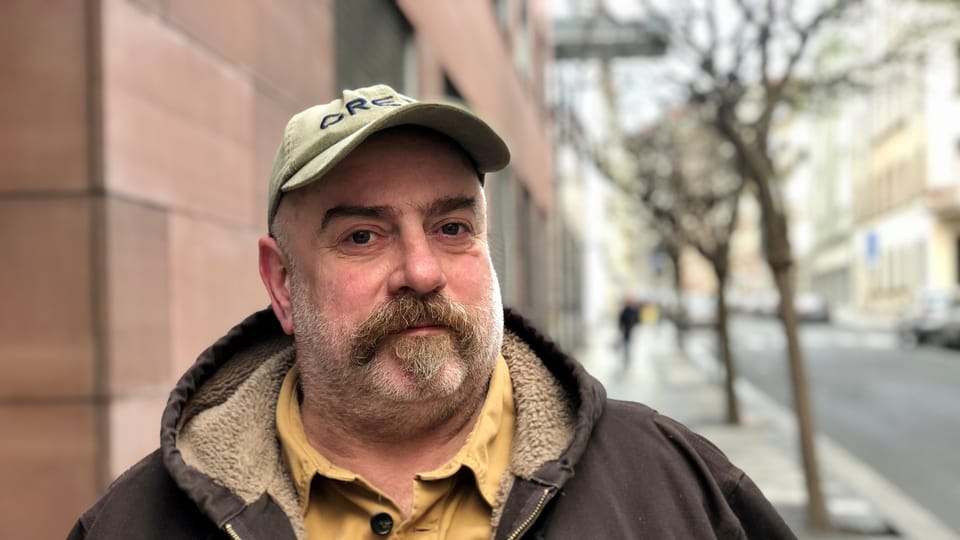
Matt Welch was among the first wave of young Westerners who flooded into Prague in the early 1990s. Today a prominent journalist and commentator in his native US, back then he was one of the founders of Prognosis, Czechoslovakia’s first English-language newspaper. And Welch shared lots of colourful recollections of that formative period of his life from his study in New York.
What brought you to Prague in the first place in 1990?
“I had a job that was going to end in June of 1990 and I knew that.
“I had been kicked out of school but I was still working in a professional capacity at the school newspaper and making some money, but that contract was up in June.
“I didn’t really have any good prospects for my life, going forward, so I had dedicated the Thanksgiving and Christmas break of 1989 to be the time that I would sort of sit and cogitate and imagine my future.

“I was at my dad’s house, in Long Beach, California, and we had on CNN and, let’s see, what was happening in late November and early December of 1989 on CNN [laughs]?
“Well, communism was collapsing and in the case of Czechoslovakia it was being led by people my age. They did it in a non-violent way, partly for the noble cause of wanting to listen to rock music.
“And I thought, Hey [laughs], maybe I’ll take a one-way ticket and end up there.
“I flew out on July 4 of 1990 to Paris and tootled around Europe, backpacked and did all that, and I was in Prague by the end of August.”
You were one of the founders of the newspaper Prognosis, which I guess was the first English-language paper in Prague. What was the idea behind Prognosis?
“A bunch of us who had been at the UC Santa Barbara Daily Nexus – which then was a really great college newspaper, one of the best – and when we were at that paper we were always talking and fantasising about ‘let’s launch a newspaper’, or ‘let’s buy the Goleta Sun and take it over’.
“So there was always that. And a bunch of us were free-floating. The class of ’90 people didn’t really have an idea of what to do.
“There was a recession back home that was hitting newspapers. It was the first time that the newspaper industry really started to take a hit; and it’s been taking a hit every since.
“Anyways, I got to Prague and I couldn’t believe it.
“I fell in with a bunch of great Czech friends who were associated with the American Hospitality Center, which was a cheesy little place on Malé náměstí run by an American and where you could get coffee that, you know, didn’t have coffee grounds at the bottom and international newspapers.
“And all these Czech kids who had been part of the revolution and then came into Prague from the countryside after the revolution – to learn English and meet foreigners and go to school – became my friends.
“I couldn’t believe how beautiful Prague was, obviously how cheap it was too, and exciting.
“So I sent postcards to basically everyone I knew saying, My God, come here.
“I couldn’t believe how beautiful Prague was, obviously how cheap it was too, and exciting.
“Around early November a couple of different tranches of friends who were travelling from Santa Barbara all arrived kind of at once.
“I had been down on a side trip to Yugoslavia and came back up and there notices in Poste Restante – that’s how we communicated with one another, because we didn’t have cell phones or internet back then – or on bulletin boards at the American Hospitality Center saying, Oh my God, we’re in town.
“So we all finally gathered and decided to go to the U Medvídků pub, which is still there, from what I understand, the StB [secret police] pub [laughs], around the corner.
“And all the American Hospitality Center Czechs and all the Santa Barbara Americans gathered and had 75,000 beers and said, Hey, why don’t we start a newspaper here? We don’t know what’s going on and it feels like people would want to know what’s going on.
“And Czechs didn’t really have… There’s a great literary and newspaper tradition – Lidové noviny was great and Respekt was I think the newspaper of the year internationally in 1990 or ’91 – but those traditions weren’t really done.
“So we made some collect calls to our parents [laughs] and asked if they would invest some money into it. And by the end of the evening, on November 7, 1990, we had decided to start our newspaper.”
Was it hard to get it up and running? Say in terms of technology, was the technology a bit behind the West here?
“Well, sure. Desktop publishing had just kind of started a year or two before, and we’d had experience with that, thankfully.
“At the newspaper, my job had been as a typesetter. I ran the unisetter, but then we switched from the old kind of analogue system to a more digital system.
“And between all of us from America we had skills at most everything involving putting a newspaper together.
“So what we did is we would print it out on a printer and then use rubber cement, because we couldn’t find the right wax to put it on these sort of flats.
“And then we'd drive these cardboard flats – like you would in America – to, in this case, the Naše Vojsko, Our Army, printer.

“My God, you’d walk in there and there's all these like babičkas and old guys sitting around kind of glumly working at the army printer with just five trillion super pornographic images all over the walls [laughs]; I can't stress how disturbing it was.
“The rubber cement was kind of hard to work with, but we eventually got a little bit better and got on the wax.
“The hardest part, from my memory – and it felt like it went forever but it only took really four months from idea to the first issue – was just getting all the permits.
“Because, you know, the new stuff hadn’t been built to create the old stuff and so you needed a stamp. You always needed a stamp from somebody, so the Ministry of Finance and probably the Ministry of Tourism and this and that: everyone had to bring their stamp into it.
“At some point I’m sure we paid a guy a bottle of Becherovka or something [laughs] to get the last stamp.
“So it took a while. It was bureaucracy. But looking back, four months – especially in the way that Prague worked back then – it was a miracle that it went so fast.”
How did Czechs view Prognosis? I’m thinking of politicians or officials or even local journalists – how did they respond to you? You must have been young, hippyish and didn't speak Czech, I presume.
“Well, we did and we didn't. We didn't, I didn't, although some of our founders or early members ended up being so good that they ended up being translators and people who are of importance.
“And we also attracted people like Alex Zucker who's a great translator. So we had Czech, though not all of us did.
“We were greeted… Our newspaper was sent to classes, to English teachers, and also was in Czech high schools, generally speaking.

“It would go out to them and we even had a special page for a while that had a news quiz.
“And people liked that it was a different style of newspaper.
“We incorporated some Czech images and feeling into it; we had some really great original art, these wood cuts that were made that looked very kind of Czech, from Czech artists.
“And our photography – we just had these gigantic photographs.
“We had a terrific early photographer named Mark Murko – I'm looking at one of his works on the wall in front of me right now – who in retrospect was not as artistic as Jan Saudek, but you could feel like it was sort of inspired by it.
“It was a refreshing difference the way that we would have many, many, many sources in a story.
“Especially at the beginning we tried not to have a whole bunch of first person, so a lot of Americans and Westerners thought of us as a traditional ‘alternative weekly’ type of field, because we had that.
“But we didn’t want to be as solipsistic as that, because we felt like, Who are we to like talk and write in the first person about this place that we are strangers in and we're trying to understand too?
“I think people appreciated the gesture.
“It was definitely an odd duck. But, you know, we broke stories and did good and interesting things and had an immediate affinity with what was then still called the alternative culture or underground culture; these are just the people that we knew and dealt with.
“So I think from the beginning we had a certain amount of respect, even in the halls of government, and among the kind of ‘post-underground’ culture.”
I was reading that you turned down Alan Levy, when he offered his services. He became I guess the best-known English-language journalist in Prague in the ‘90s.
“Yes. He had written So Many Heroes, which was originally titled Rowboat to Prague.
“He was there in 1968. He had written a lot for The International Herald Tribune and he was just sort of this old guy.
“We had the arrogance of youth, but also the kind of the humility of youth too, which is a kind of an odd combination, perhaps.
“But we really didn’t want to make the story about ourselves and he came into the office just talking so much about himself and wanting to impress more by his clips more than wanting to impress his thirst for knowledge about what was around him.
“He just didn’t fit the vibe, so we said, No, thank you.
“When we started, one of the reasons why we had this stupid name Prognosis [laughs] was that we were determined not to do anything like a traditional newspaper. Not a thing.
“[Alan Levy] just didn’t fit the vibe, so we said, No, thank you.”
“We of course did many things like a traditional newspaper, but if we were going to create something from scratch, we wanted it to be new – we wanted it to be something like no one has ever encountered before.
“Yes, that is arrogant, but also I think arguably it led to some artistic successes and just a real lively spirit.
“He just didn't feel like he was part of that. So he went off and then our main business staff at some point peeled off; they were approached by an investor who liked us, but thought we were too hippie and weird, which was true.
“He wanted to do something more normal and he met with our former business staff and they announced that they were going to start The Prague Post.
“And then they brought Alan Levy as editor.
“And I give Alan a lot of credit. People like to point and laugh. His first column for The Prague Post was very notorious: ‘Prague is the Left Bank of the ‘90s, it’s second-chance city.’

“He just was trying out every slogan, but a lot of them stuck, at least in the perennial – or every single day, actually – articles about young Americans in Prague, or how Prague is this new capital of Bohemia.
“They would always quote the Alan Levy initial article. So he was silly at the time that he wrote it, but it sort of became a self-fulfilling prophecy of the people who read the stuff that was derived from it.
“But So Many Heroes is a fine book and I have nothing but fondness for Alan Levy.”
Evidently Prognosis never made a profit. Why was that?
“Because we were run by terrible hippies. My God [laughs].
“Almost all expat newspapers, of which I'm very, very fond, eventually go out of business. Of course they do.
“Budapest Week started, I think, a week after we did. The Baltic Observer was out there, The Warsaw Voice, all these different papers.
“We had kind of a loose... not really a network, but we did share some stories.
“It’s a tough dollar. You're a strange hybrid newspaper.
“We were in the business of covering transition. We had two different cover stories about Abkhazia, the war there. And we had pieces about the Yugoslav war from, I think, our third issue onward in every single issue.
“We had correspondents in Sarajevo and did all this very serious kind of work.
“Almost all expat newspapers, of which I'm very, very fond, eventually go out of business.”
“And at the same time, you know, we were doing a visitor's guide and this is where you go to see Kafka.
“It’s going to be a hybrid of what people are super interested in knowing and kind of deep thoughts on the tempestuous relationship between Václav Havel and Milan Kundera and these kinds of things.
“But then also some cheap jokes that a 23-year-old might find funny. So it's a strange hybrid and it's hard to make money in that context.
“But we lasted for four years – that's pretty good.”
A lot of international media did these stories about Prague as “the Left Bank of the 90s”, and that kind of fuelled the influx of young Westerners. Were you one of the people who they were interviewing about this phenomenon?
“Oh God, yeah. And one of the ur-pieces of that was a Details magazine story called Wild, Wild East, by Henry Copeland, who ended up being my boss in Budapest.
“And we affected his career in some way, because he went from being a like a bond trader; that was the first piece of journalism he ever did. He spent tons of time with us. And I am the lead of the story, like my long hair flapping in the wind and conservative earring thrown in. I forget what else was in there.
“So people had this very romantic notion.
“When Bill Clinton came to town in January of 1994 we had one of our best issues, that I was probably the most proud of, and we even had a little special insert: a ‘hacks guide to Prague’ aimed at the international journalists who were coming in.
“And there was just a ton of media attention at that point. I think I was on the cover of the Wall Street Journal, the L.A. Times and a bunch of other things.
“So, yes, we were all the source, as were the owners of The Globe and people like this. There was a guy called David Freeling who ran a poetry reading called Beef Stew. There were these stock, like, caricature elements and we were definitely one of them.
“It’s funny, in 1994 I was approached by the BBC World Service. It's like, OK, we want to do a thing about Americans in Prague; we can do a 20-minute piece – that's long in radio – and you can do whatever you want with it.
“I was thinking, OK, now I finally get to be the one to do ‘the young Americans in Prague’ – how am I going to make this different than all the clichés that they're doing?
“And I did a lot of the same clichés [laughs], because by then, you know, the people who were coming to Prague were attracted to those things that were written about at first.
“It's weird to be interviewed by 60 Minutes when you're 23. You get dazzled by the limelight.”
“And they started actually creating a lot of these sort of bohemian artistic ventures. There were English language theatres and poetry magazines and all of this.
“It's weird to be interviewed by 60 Minutes when you're 23 years old. It's just it feels unnatural and you get dazzled by the limelight.
“I'm kind of glad that I went through it back then because at various points in my career in America the spotlight will come on me for a half a second and I've seen people who don't have the experience of doing that lose their heads.
“And now I don't come close to losing my head, because I was able to do that in real time. And thankfully, the internet doesn't remember all of it.”
Where were you hanging out? What were the places you would go to in Prague?
“The first place that I went to was the most expensive place in town [laughs], called Lávka, right on Charles Bridge. Just because it was gorgeous and I didn't know it was expensive, because 20 crowns for a beer is not expensive in my universe, at least until my credit card money started running out.
“I got to know the people there really well. And there was a three-part folk harmony band whose name I forget, but on my first night there they were reuniting with each other for the first time, just in the bar.

“And I became friends with all of them and the guy who runs it, so that was my place.
“The kids at the Hospitality Center would drag me around to places. Constantly Malostranská Beseda. We saw a lot of great bands there, like Jablkoň and Laura and her Tigers about 1,000 times, because I had a big crush on Laura.
“But it was RC Bunkr. It was Akropolis by the time that opened, which was kind of late in my tenure.
“And oh, my God, there was a fantastic place, our favourite probably, which was right on Old Town Square. It only lasted for about six or nine months and it was called U Zoufalců [At the Desperados’].
“It was grim [laughs]. You’d go down into a basement and you were just breathing in raw coal dust.
“And back then, our friends, including Doug Arellanes, who's still out there doing stuff for Radio 1, he would go down to U Zoufalců and he would spin Jane's Addiction and Public Enemy to ears that were not ready for that. And it was great. So, yeah, those were all pretty fun.

“Rock Café – very good. And then eventually our friends helped kind of open up Obecní Dům [Municipal House]. The drummer in my band for a long time [Steve Coulter], one of my dearest friends, is the one who started up Thirsty Dog, which then became immortalized in song by Nick Cave.
“So we were kind of everywhere. And also on the Charles Bridge. I played in a busking band on Fridays and Saturdays on the Charles Bridge forever. And it was just a delightful place to be.”
Is it true you had a Nirvana cover band? And if so, please tell us the name of the band.
“[Laughs] No, thank God. Actually one of the places that we would hang out the most in, at the Obecní Dům, was the [pub] Plzeňská pivnice, with the incredible Alphonse Mucha original fixtures on the walls.
“Our friend Kate, who lives not far from me and here in Brooklyn, ran it. So a bunch of us who are musicians would just go [there] and play.
“Nirvana was supposed to come play in Prague in the fall of ’93 and they had to postpone it because Kurt Cobain had some problems in Rome.
“So [laughs] we did have a New Year's Eve party called Drink Champagne Like Kurt Cobain. It was the Coma as You Are party. I mean, this is the kind of fun we had at the time.
“Yeah, I think some of our friends played in a cover band that night, but I wasn't one of them – I enjoyed it from the audience.”
The reason that I asked this question is because somebody told me that you had a Nirvana cover band with the amazing name of… Vinárna.
“Holy cow. I want to take credit for that because that's hilarious. And no [laughs], I can't.
“I can neither play nor sing like Kurt Cobain. I did try to look like him as best as I could, but that's about as far as I went; we mostly played originals.”
Prague was a pretty wild place in those days. I think we all experienced weird things or found ourselves in weird places. Did you ever go through anything particularly bizarre?
“Many things particularly bizarre, of course. But my perhaps fondest memory is going to the Stalin space in, I think, it was November of 1990, around then, when they opened up the kind of bunker underneath where now the Metronome is and where the statue of Joseph Stalin once stood.
“It was just this incredible labyrinth. Again, you were just breathing in fumes and dust.
“But these guys – who were involved with the Linhart Foundation, these former kind of architects, artists who were always doing really cool things – would just always inhabit spaces that were in between; they were in between communism and state ownership and whatever was going to come next.
“My perhaps fondest memory is going to the Stalin space in, I think, November 1990.”
“And meanwhile, they're like, Let's just go in and do something – let's do a happening, let's do something.
“So you would go there and David Černý had these fantastic sculptures; I think he did a Stalin skull inside there. That's where they started the Radio 1; it was some kind of pirate radio.
“Of course, it was all illegal and [PM] Václav Klaus was like, I'm going to shut this down. And then you look over in the corner and who are they interviewing on the radio? [President Václav] Havel [laughs]. It was just great.
“Stuff like that was happening all the time.
“One of the last memories I have in Prague is the last time I was there, for Havel's funeral; I was fortunate enough to go to both the very solemn occasion up in St. Vitus [Cathedral] and then the great after party at Lucerna.
“I was in the warren of the backstage areas of Lucerna and the Plastic People were over there. And they invited me in, because I know a couple of guys involved with them.

“It was the Plastic People of the Universe, not an insignificant band in the history of the world on some level, and they were like, hey, you want some hash?
“[Laughs] I remember this as like the dividing line in my adult from young life, because if I was a young man I would say the chance of smoking some hash with the Plastic People before a Havel funeral concert is, like, the definition of something I'm going to do.
“But I was like, No, I want to remember this, so I'm cool. And also I don't really like smoking hash.
“So that was kind of fun.
“But no, we had crazy things happen constantly, even like the mundane details of it.
“People like to imagine or think that that it was all romantic escapades all the time. It really wasn't. A lot of life was pretty dreary [laughs], but grimly funny.
“One of the funniest things was that people were not used to private landlord-tenant relationships.”
“One of the funniest things was that people were not used to private landlord-tenant relationships.
“I was in a dozen different apartments at various times and you'd have these guys walk into their homes in, like, a Speedo at 11:30 at night and check in on all these drunk Americans [laughs].
“They’d be like, Bordel! [what a mess] and try to kick you out [laughs]. So we had a lot of a lot of things like that happen.”
You mentioned Havel and behind you on the wall is a poster of Havel. But you're also well-known in the US media as a libertarian. How do you square your admiration for Havel with being a libertarian, because his politics were certainly not libertarian?
“I wouldn't say ‘certainly not’.
“It took me a long time to self-identify as a libertarian, and I only did it kind of grudgingly, when I came back to the country; anytime anyone would ask I would say, I'm a Central European-style liberal.
“I have an affinity with Havel or Adam Michnik in Poland, people who instinctively hate communism, don't think that the state should have a primary role in a whole bunch of areas where it does – and really like toleration and individual freedom and decency. That still speaks to me.

“His writings on communism… and even post-communism; I think some of his underrated speech-craft and writing in the 90s especially – when he sort of thundered against the remnants of a certain kind communist thinking in 1997, going after Klaus in particular and some of the corruption – is some great, actually anti-authoritarian, anti-communist leaning.
“So I don't really see it as conflicting.
“I find myself in a lot of vigorous agreement with Havel, kind of all the way up until towards the end of his life when he was expressing a lot of admiration for Hillary Clinton [laughs], which I don't necessarily share. But whatever, I'm sure I make a thousand mistakes too; not that this is necessarily a mistake.
“So no, I don't see it as that big of a contrast. I should also just point out that you know if you asked the modal American libertarian they would look at me like, Oh, he's not one of us.
“And part of the reason why I'm not one of them is my views that are directly influenced by my time in Central Europe, like collective security arrangements after 1990.
“I have a very bedrock appreciation for the rights of small, free, independent countries to not be subsumed by their neighbours.”
“This is something that I covered a lot in real time and I have a very bedrock appreciation for the rights of small, free, independent countries to not be subsumed by their neighbours and not have their fates decided in private.
“You’re nodding along, because you know exactly what I'm talking about [laughs], as do Czechs.
“So that is definitely something that I feel intrinsically. Not necessarily every American libertarian feels the same.”
I have one more question about ‘90s Prague. Obviously in those days there were many would-be writers around the place, many from your country. Not many of them produced any literature – why do you think that was?
“Literature is hard to do. I would point out that Caleb Crain's Necessary Errors is a really great, if not hugely consequential, book.
“But it describes, in a way that just rang so familiar with me, that milieu of early 1990s Prague. It is a terrific book, I think.
“You know, of the people who were there, there are a lot of very good journalists who came out of that period.
“My dear, dear friend Ken Layne worked both for the Prague Post originally but then, eventually, at Prognosis and helped start Prognosis Radio at Radio 1; that was him and Nicho [Nicholas] Lowry, who's a huge celebrity and the star of a new documentary movie.
“So a lot of interesting people came out of that. Are they exactly writers, exactly journalists?
“Ken Layne is sort of a visionary podcast artist and an interesting guy.
“So I think that our generation did okay. We didn't become Hemingway or anything, but that was always marketing to begin with. And some of the stuff is pretty good.”
You mentioned coming in 2011 for Havel’s funeral. Have you been back many times since you left, and how have you found it?
“I’ve only been back a few times since I left Central Europe, because I lived in Budapest for three years, in 1997.
“I think I've been back to Prague only two or three times. There’s a lot of emotions associated with it.
“I have a lot of friends and a lot of former friends – the relationships aren't always fantastic – and it's a place that looms so large in my life I can't like go there for a weekend, you know.
“So the last time I went was for Havel’s funeral and I've probably only been there three or four times.
“People don't realise that in 1990, 1991, 1992 we didn't know how the story was going to end. There was still a Soviet Union around.”
“One of the times that I went back I remember looking around and trying to figure out, Like, OK, okay something's different, something big is different and I can't figure out what that is.
“It took me a long time. I think it took until actually after I left and I was looking through pictures and comparing them: Oh, all of the coal soot is off the statues and the Charles Bridge and everywhere like that.
“It was so dirty to breathe the air in the early 1990s and it just isn't in the same way. I'm sure inversions are still bad in the winter or whatever, but it's different – it is cleaner, it is richer, it is nicer.
“I'm sure there are bad things that I don't know about, but that was really striking.
“One of my friends once said, and this is even now 15 years ago, You know those little girls that you saw with pink hair on the bridge who were teenagers are now successful business executives drinking wine – and not just the stuff in Dobrá Voda bottles on the side of the road; burčák, the young wine.
“They’re all grown up now and doing well and I love that so much I can't begin to tell you.
“Because one of the things that people don't realise is that in 1990, 1991, 1992 we didn't know how the story was going to end. There was still a Soviet Union around, there was a lot of uncertainty around about things.
“So I'm very glad to see how much better, if still challenging, things are.”






