Kutná Hora, Lidka chocolate, and a story of revival
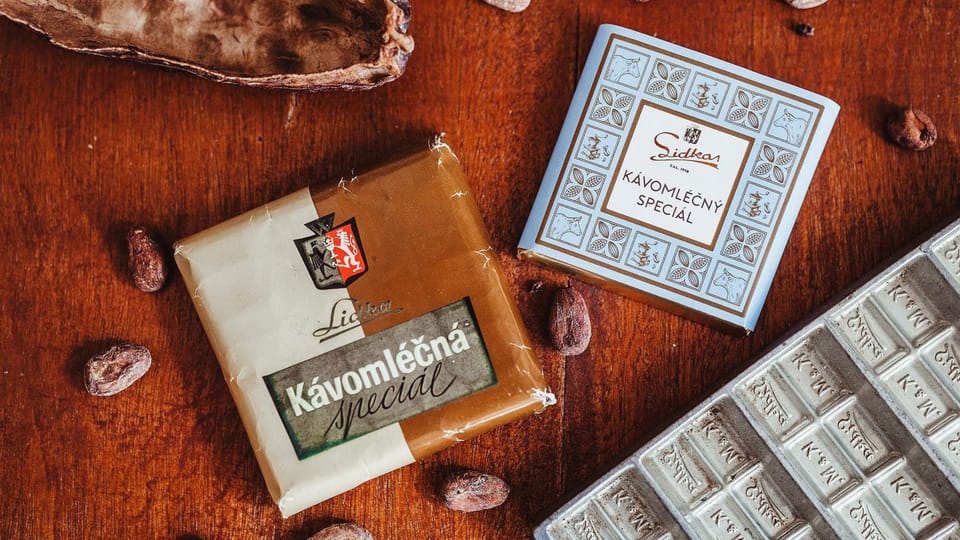
Kutná Hora’s Chocolate Museum may well be the smallest museum of its kind in the world. But the story it tells – of Lidka chocolate, its 20th century rise, fall, and later 21st century revival – serves as a very large mirror of modern Czech history.
It’s not often that a brand disappears only to be revived decades later. But such is the case of Lidka chocolate, a once well-known and much-loved confectionary brand in early 20th century Czechoslovakia that was revived in 2018 as a tiny artisan operation by the Kutná Hora-based husband and wife team of Pavel and Lada Bartoš.

I met up with Lada Bartošová at the Kutná Hora Chocolate Museum, situated at the back of a small store selling Lidka and other Czech artisan chocolates. She explained what motivated her to revive a defunct chocolate brand:
“Initially we just founded an exhibition about the history of this brand. Because it had existed one hundred years ago and we couldn’t believe that there used to be such a famous chocolate factory in Kutná Hora and that today no one knew anymore about this brand. So first we founded the exhibition in the museum. And a few years later we also started to produce chocolate.”

Czech chocolate production harks back to the 19th century, during the era of the Austro-Hungarian Empire. Voluminous Czech sugar beet production made such endeavours economically viable. But the true boom in chocolate production came during the First Republic, following the founding of Czechoslovakia in 1918. Lidka chocolate came about that very same year, courtesy of the Koukol and Michera chocolate and confectionary production facility situated in Kutná Hora, a small historic town just east of Prague.
Martina Brhlíková has been with Lidka for more than three years, selling chocolate and guiding visitors through the Museum of Chocolate.

“I usually first tell visitors about the earliest history of the factory. That production began in 1918 and officially ended in 1958, and so lasted for about forty years. The chocolate was first named after the owners, Koukol and Michera. But since the chocolate was being sold all over the world and the name was quite hard to remember, and hard to pronounce for non-Czech speakers, the owners renamed the chocolate ‘Lidka’ who was the daughter of one of the employees, as a shortened version of the name Ludmila."
Martina pointed to a drawing of little Lidka on the wall of the cramped museum. Lidka was around six or seven at the time.
“The factory managed to withstand the Great Depression and the Second World War quite well. During the first twenty years of their existence they managed to produce over five thousand different types of confectionary, spanning chocolate bonbons and drops, meaning hard sweets, and also caramel sweets. They would come up with four or five new varieties per week, which is kind of crazy.”


And who were Koukol and Michera?
“Zdeněk Koukol was the person who pretty much came up with the idea of making chocolate here in Kutná Hora. He was one of fourteen siblings and pretty much a self-made man, not coming from a wealthy family. As for Eduard Michera, he was an investor and died during the Second World War.”
Lada Bartošová continued:
“The founder of the Lidka chocolate factory, Mister Koukol, was a very active member of the church. So he used the contacts he made in the missionary school. Firstly, he obtained cocoa beans from Africa – mostly Ghana. And later his nephews travelled and purchased cocoa beans in the central and southern parts of the Americas.”
Meanwhile, Martina Brhlíková relayed a myth about the fate of Eduard Michera – one that has been hard to verify given the loss of so much historical documentation from this era:
“During the war, the employees had to make a dark chocolate bar with methamphetamines for the [Nazi] soldiers. And one of the shipments apparently did not get to the desired place and Mister Michera was taken away by the Gestapo and never seen again.”
Lada Bartošová is not so sure about the story of Lidka being forced to assist Nazi troops:
“The original employees said that. But we don’t have that documented – just memories. They in fact told us that the chocolate factory never gave these chocolate bars to the Nazis, and that it was stolen somewhere en route. It is an interesting story, but we just don’t know.”
What about the Czech National Archives? How much has been found there about Koukol & Michera?
“Many things were destroyed, but we found a lot of documents about items that were paid for by the owner of the chocolate factory. Because he supported poor children, and hospitals and so on. So we have those documents.”
Lada also said she had identified some newspaper clippings, and other documents about Koukol and Michera, but not enough to explain several lingering mysteries.
“So most of the history is still from the testimonials of the original employees and from those who remember these times.”

In 1948, after the communists seized power in Czechoslovakia, the Lidka plant was forcibly nationalised, shut down for two years, and then reopened. Zdeněk Michera refused to hand over his recipes to the communists, and soon after fled the country for the Americas:
“He was over 60 at that time. He had already been involved in different business activities before turning to chocolate production and had already built up two businesses. I don’t think he had the energy left to try to create something else. Plus, he didn’t have any capital or money to use in this endeavour. And he died quite soon after emigrating, after just a few years.”
Lada Bartošová explained how the enterprise fell victim to communist-era repressions:
“Eduard Michera’s family stayed in Czechoslovakia, but the communists, as was representative of their behaviour at that time, nearly destroyed the family. His wife was made to work in some chicken factory. And we don’t really know about the destiny of Mister Michera, because nearly all the documents disappeared.”

Were there any descendants of the original owners still living here in Kutná Hora?
“The nephew of the founder of the chocolate factory still lives here in Kutná Hora, and she comes to the museum quite often! But the rest of the family lives absolutely everywhere, because nearly all of them emigrated. And the family of the second owner of the chocolate factory lived not far from here – originally living in Čáslav for some time.”
In 1958, Lidka chocolate production ended in Kutná Hora, shifting the key centre of Czech chocolate production to the also now state-owned enterprise Orion in Prague’s Modřany. Meanwhile, the former Lidka factory in Kutná Hora was transformed into a truck production facility. Today, the main building – once part of a larger production complex – serves as the State Archive of Kutná Hora. Martina continued:
“In the 1970s, Lidka production moved again to another Czechoslovakian chocolate factory, namely Diana in Děčín (in northern Bohemia). And that is pretty much where Lidka remained until 1991.”

In 1991, most Czechoslovak chocolate production was lumped together into a national enterprise called Čokoládovny. Comprising top Czechoslovak brands such as Orion, Diana, Zora, and Opavia, the enterprise ended up being bought up by the confectionary behemoths Nestlé and Danone. Orion then went on to become the Czech flagship brand for Nestlé.
Martina Brhlíková continues:
“They either closed or sold the other chocolate factories. And the brand Lidka was then sold in 1995 to the British Virgin Islands in the Caribbean. But the current owners managed to get it back from there several years ago and since 2018 have been producing and selling Lidka here in Kutná Hora again.”
Lada Bartošová explained exactly how this was achieved:
“It was quite a difficult process. After the Velvet Revolution, Nestlé had bought the Kutná Hora chocolate brands. A few years later they decided that these brands were not of interest to them anymore, so they became available. Of course during the ‘wild 90s’ a lot of interesting business was carried out with the old Czech brands, including with Lidka. So it moved abroad. And we contacted the owners, because originally we wanted to have the brand because the museum was called ‘Lidka’. But they didn’t respond. But I said to myself that I really want this brand, because its place is here in Kutná Hora.”

Lada and her husband waited a few years to see if the owners would renew their title to the brand when it was set to expire. Ultimately, when the registration day arrived, they submitted their paperwork and managed to gain the brand name – not from the owner but from the Czech state to which it had reverted as a former state enterprise.
“There used to be many more centres of chocolate, because before the Second World War Czechoslovakia was really a big producer of chocolate. I think that for some time we were even the third biggest producer of chocolate. [...] But what wasn’t destroyed in the 1950s was destroyed in 1989 when Nestlé and other big companies came along and bought up the entire Czech chocolate industry as well as the confectionary and sweets industry, too.”
Much of this history is relayed via the artefacts inside the Chocolate Museum – with locals even occasionally donating new Lidka-themed items they have found at home. A few minute’s walk away from the museum, I was allowed inside to see the revived Lidka’s chocolate production facilities, no longer employing five hundred people, but rather five people and occasionally more.
“The first thing I notice is some kind of machine where liquid chocolate is pouring out of a tap.”
Lada: “That is our tempering machine. And it is the final stage of chocolate making. It’s because if you want to have shiny, dark brown chocolate, with a good consistency, it needs to be tempered.”
And what is tempering?

“It is mixing and changing the temperatures – you have to lower and then raise the temperature and so on. It’s the time when the crystals of sugar and cocoa butter are combined in the right way so that the final chocolate is in the correct condition.”
And next to that I see some kind of a grill?
“[Laughs] This is a vibration table. Because when you pour the chocolate into the chocolate mould, some residual bubbles remain. So that’s why we put it on a vibration table, so that the bubbles are shaken from the chocolate, ensuring that the chocolate has the proper texture.”
I also see a bowl of something white. Is that cocoa butter?
“No, this is white chocolate, inside a small tempering machine. You can see we have three of them. Each chocolate is made in a different one, because of precautions about allergens.”
And I see some plastic moulds here.
“Yes, all of these are chocolate moulds made from polycarbonate.”
And on the other side of the room are some mixing machines.

“These are melangers [to grind cocoa bean nibs into chocolate liquor – a key stage in chocolate making]. These are for our tasting batches when experimenting with new kinds of cocoa beans and then tasting the chocolate to assess the result.”
So your entire production is based in this one room, as well as another second room which looks like it is used mainly for storage.
“Also inside this room – it isn’t switched on today – is a machine which makes cocoa nibs from cocoa beans. It is called ‘Ninja’ – making small pieces.”
Could you briefly tell us how chocolate is made? What are the basic ingredients and basic processes?
“The basic ingredients are cocoa beans. So first it is necessary to find good cocoa beans. This is the most interesting step. We bring these to the Czech Republic and then choose by hand the best ones to use. We then roast these beans; after that we make coca nibs from the roasted beans. The coca nibs are then put in the melanger, and they are ground up for many, many hours – according to the old recipes, it is done for nearly 100 hours. And we add sugar or powdered milk into the melanger, depending on the kind of chocolate we are making. And after those 96 hours, we create long bars of chocolate, nearly one metre in length. These are then rested for about three weeks. Then we put these bars through chocolate-grinding stones, and we melt them and do the tempering that you saw at the beginning.”
How do you determine if you are happy with a new product? Do you do taste testing?

“Yes, we do taste testing here, and involve our employees. We call them our Oompa-Loompas [a reference to the workforce depicted in Roald Dahl’s famous work Charlie and the Chocolate Factory]. Also, whenever we have a final product, and before designing the final packaging and so on, we bring the bars to the chocolate museum and give free samples to the visitors of the Chocolate Museum, and this helps us to better understand the tastes of our customers.”
And what about the future plans of Lidka and the handful of other small Czech so-called bean-to-bar manufacturers?
“All of us are just small batch manufactures. But it is difficult to make this business model bigger in the current Czech market. So I think that none of use will exceed fifteen or eighteen employees. But we are trying to cooperate together, so all people who come to the Chocolate Festival can taste the output of all Czech bean-to-bar makers. We are there to show that real chocolate is really good chocolate!”
The chocolate festival in question (aka the Festival poctivé české čokolády 2025, or the Virtuous Chocolate Festival) is being held this year in Kutná Hora from October from 24-26, with chocolate-themed events dotted around sixteen key locations across the town.
Related
-

Discover Czechia's regions
With its rich history, stunning architecture and beautiful skyline Prague attracts visitors from all over the world. But there is much more to see in Czechia.
-

The 10 Czech museums you should visit
Radio Prague International has selected 10 Czech museums that you may not necessarily find in your guidebooks.
-

Czech Food Classics
How is the traditional Czech lager brewed, what is special about Czech bread, how many kinds of dumplings do Czechs have and what is a typical Czech dessert?