Katie Perkins on bringing real US-style bagels to Prague with Bejgl

A new bagel shop, simply named Bejgl, has been making waves since opening recently in Prague’s Vinohrady district. It was started by American expat Katie Perkins, who spotted a gap in the market for authentic US-style bagels – and set out to fill it herself, despite unexpected challenges.
My first question, Katie – why bagels?
“I guess because they’re something that’s unique and that’s quite an institution in the US.
“They’re so ubiquitous with a casual lunch or casual breakfast, and while they’re around in Prague, there were no good bagels around.
“When I first moved here 25 years ago there was Bohemian Bagel and they were a massive institution. Then they left the market and in their place now Marks & Spencer has bagels and there are bagels at [supermarket chain] Albert, but they’re not what I would call a real bagel.
“There are also some other bagel shops in Prague, but a true bagel is – the thing that I really missed – something that is first boiled.
“After you first warm them, they’re boiled in a semi-alkaline bath, so you put some baking soda, some barley syrup in the water, and it gives it a really thin crust, like a Bavarian pretzel. And then it’s baked.
“So this sort of texture was something that I was missing.
“As my background was in editing journalism and then I started editing books, I was sort of waiting for projects to come and in the meantime I was baking more and more; I just had larger pockets of free time on my hands.
“I started experimenting more with bagels. They were difficult, and that was the thing that made them most interesting.”
You say that they’re difficult and that genuine bagels aren’t really available here. How has it been finding ingredients?

“That was a huge research project, because bagels, historically, are European.
“They were from Poland, from the Jews in Poland who had been blocked by the guilds from being bakers. So their solution was to boil the product first, and then to bake it.
“When they went to the US in the mid-1800s, they were used to making a rye bagel product, and rye was not very easy to find in the US at that time.
“So they pivoted. They started using the available wheat – and it became a completely different product.
“What I didn’t know before I got into it is that the wheat that’s common in the US is different – it seems obvious once you find out – than the wheat in Europe.
“The European wheat is a different variety and it just absorbs less water, so less hydration.
“Bagels themselves are already what’s called a ‘hard dough’ – so it’s a really low hydration dough. It’s set at 50 percent hydration, or mine is 40 percent.
“So for my bagels, the hydration comes mostly from the sourdough, so it’s a pre-ferment mostly of the flour, and then it gets a little bit hydrated.
“But none of the recipes for American bagels translate to Europe, simply because the flour reacts differently to water.
“And there aren’t a lot ingredients. There’s flour, water, salt, barley malt syrup and barley malt powder.
“So it’s pretty basic and that interaction between the flour and the water is key, and figuring out how to manipulate it to the texture that I wanted was more difficult.”
So you had to adapt local flour, so to speak, rather than importing flour from America?
“Exactly. Importing from America would be ridiculous.
“There are a lot of bakeries here that do import from France or from Italy, which do have different flours. But those are better for baguettes or for bread, and we’re doing something else.
“And I really wanted to stick to the Czech market if I could. So, yes, through a lot of testing I found one flour that’s consistent.”
How familiar are Czechs with bagels? Obviously, they’re not particularly exotic, but still they are different from, for instance, Šumava [classic sourdough] bread.
“People are surprised that they’re both chewy and dense and yet also moist.
“Like I said, bagels are now everywhere, like in Albert and Lidl – but they’re a different type of product.
“Typically you wouldn’t be able to pick up a real bagel with your hand and just take a bite out of it – it’s too chewy.
“And in fact you wouldn’t want to make a stacked sandwich with it, unless everything was super hot.
“So we do make a stacked grilled pastrami sandwich, which is super popular, but everything is hot and it’s easy to eat.
“Otherwise if it’s cold, like our salmon lox sandwich, it’s served open-faced, like chlebíčky.”
You opened very recently. Already are you seeing best sellers?
“For sure it’s the pastrami sandwich. I would say the local markets loves their salty meat. It’s been huge.
“Close behind is the salmon lox, and then we do some vegetarian versions, as well.
“Also we do a ham and eggs breakfast one, and one with sekana, which is a common local product.”
Somebody told me at the weekend there was already a line out the door of people queuing for bagels. Are your customers more Czech or international?
“It seems like half and half actually.
“And I don’t know why but we were wildly unprepared for the overwhelming enthusiasm and support that we saw.
“We were both surprised and [laughs] trying to keep up with the demand.
“Each week we’re pivoting a little bit, learning from the last week and trying to meet the customers where they’re at.”
Related
-

Kutná Hora chocolatiers travel to London to collect ‘chocolate Oscars’ medals
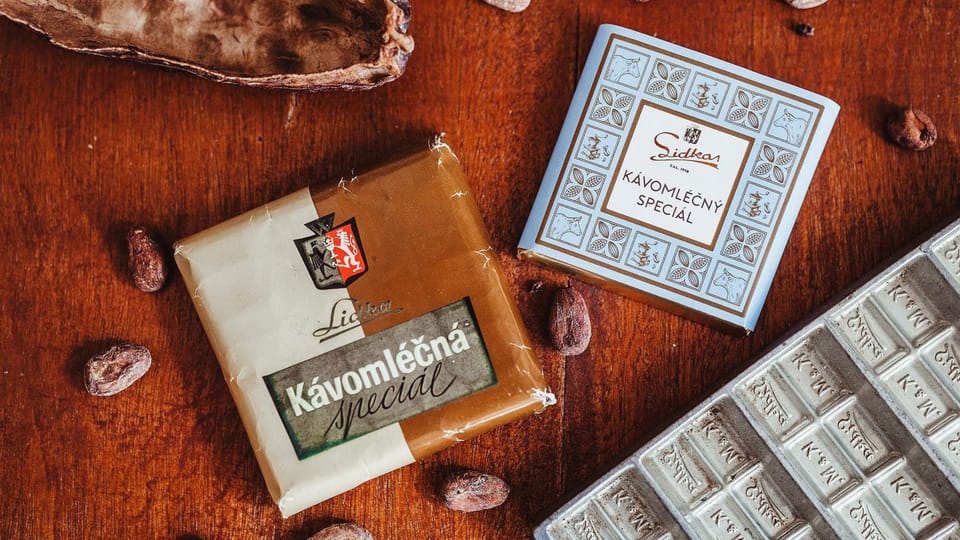
Chocolate-makers Lada and Pavel Bartoš from Lidka in Kutná Hora won three medals at the Academy of Chocolate Awards. I spoke to Lada Bartošová about the winning chocolates.
-

Meet the maker of the Czech cronut – the crobliha
Inspired by the hit hybrid pastry the cronut, Lukáš Vašek’s bakery has brought it to the Czech Republic as the crobliha – and is constantly sold out.