Katherine Kastner on fascinating Czech family history – and building one of Prague’s top independent galleries

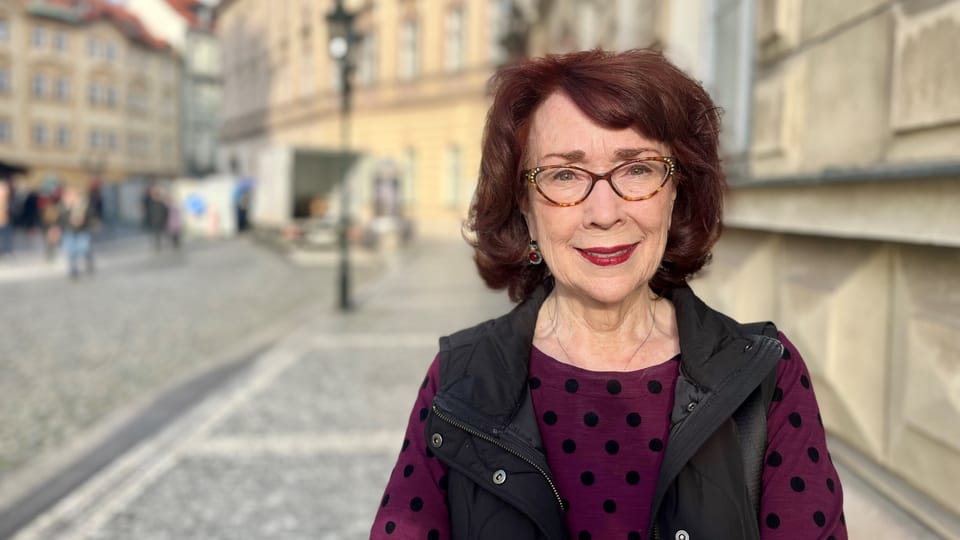
US-born Katherine Kastner is co-owner of Hunt Kastner, an independent Prague gallery that has helped develop the international careers of many Czech artists. Kastner herself has deep Czech roots: Her grandmother was related to Karel and Josef Čapek and in the 1980s she regularly visited Prague, where she was introduced to the local art scene through relatives, and notable artists, Pavel Brázda and Věra Nováková. I spoke to Katherine Kastner, who is known to all as Kacha, at our Prague studios.
You have fascinating Czech roots. Your grandfather worked with the Czech government in exile in London during the war and your grandmother was related to the Čapek brothers.
“She was indeed – she was their niece.
“My grandfather not only was with the Czech government in exile in London during World War II – he was with the government in exile in London after 1948.
“And when he died in New York he was still affiliated with the Czech government in exile, as much as you could say that it existed.”
There was a Czech government in exile under communism?
“Yes. You know, never give up hope [laughs] – there’s always going to be someone holding the flag.”
I have never heard of this.
“Well, I’m not quite sure that anybody has. As a matter of fact he was living in a Y in New York – the YMCA – so that’s where I guess governments in exile go to die.
“And he was a lovely man, and a great Czech patriot.
“My grandfather not only was with the Czech government in exile in London during World War II – he was with the government in exile in London after 1948."
Katherine Kastner
“My grandmother was a fascinating woman. Not only was she a daughter of the Čapeks – she was certainly a very interesting and intelligent person in her own right.
“She was very well-known, during her time, as a journalist. Also a fierce opponent of communism, as well as fascism.
“She was in jail during World War II. She stayed behind during World War II because at that time a lot of people thought the Germans wouldn’t retaliate against families of government people who went into exile – we all know that wasn’t the case.
“After she left in 1948 both my grandparents were put to trial in absentia but my grandmother was sentenced to death in absentia, because she such a strong opponent of the communist government – and they actually were more afraid of her because she had a very good way with words.”
You mentioned your grandfather living in the Y in New York. How did your grandparents get on when they moved to America?
“It was a process. My mother was actually the very first person to move to the States in the family, which was my mother, her sister and her parents.

“My mother was caught crossing the border in February 1948, when they were all sort of leaving together with some other people.
“They had split up in the woods and my mother and the people she was with got captured. My mother got taken back to Prague and got put in jail.
“Her grandmother Helena Čapková, who was the Čapek brothers’ sister, vouched for her and then spirited her across the border into Vienna.
“My mother eventually went to London, where she met up with my grandfather, who was there at that time.
“Then she moved to Paris, where my grandmother was, and then she actually went to the US, with the Herbens; the Herbens were quite a well-known family who were affiliated with Lidové noviny at that time.
“So my mother was the first one to emigrate.
“My grandmother worked for Radio Free Europe for many years, in Germany, and my grandfather was in London and then went to D.C. with the government in exile.
“Then, as I said, when they put the government in exile out to pasture [laughs] they sent him off to New York and the Y.”
And your mother was a teenager when she left this country?
“She was 17 years old.”
How did she describe that whole period of her life?
“Just as life, I guess. That’s what she knew.
“After she left in 1948 both my grandparents were put to trial in absentia but my grandmother was sentenced to death in absentia."
Katherine Kastner
“You know, when it’s a part of your family’s history you don’t really think about it as being any different from anyone describing growing up on a farm in Iowa, or something. It just is who you are.
“I would say that my mother had a great sense of humour and she always says, In any times of hardship, you have to have a good sense of humour – that’s a good way to get over it.
“But she had very much a get on with it attitude.”
And she called you Kacha?
“Everyone calls me Kacha.”
Did you have much Czech at home growing up, from your mother, or from your grandparents?
“Unfortunately, no. We never lived in the same city. Other than a short time in London and a short time in Paris, the whole family never lived together again.
“My grandparents didn’t live together, my aunt was sent in a special school, in London and eventually in the US.
“That was a bit of a tragedy – the family split up for good and everybody went their own ways for various reasons.
“I remember meeting my grandfather. I do not remember meeting my grandmother; I think I was one year old when she died.
“We had a few Czech words that were part of our family vocabulary, but my mother didn’t teach us Czech growing up.
“[My mother] she really didn’t want to end up like some of the Czech community, where they would just sit around and complain, saying how good things had been.”
Katherine Kastner
“My father was a US Navy pilot and we were in the US; everybody speaks English.
“She said it just didn’t make sense. It would have just been an alienating language that nobody other than the children would speak.
“I also think she was quite young and it was important for her to assimilate.
“One thing that she did say is that she really didn’t want to end up like some of the Czech community, where they would just sit around and complain, saying how good things had been.
“As I said, she very much had an attitude to life of let’s just get on with it.
“So I didn’t speak Czech but I was known from an early age as Kachenka, which then changed to Kacha, and that’s what I’ve been as for my whole life.”
When did you first come to this country?
“In 1970. I was 10 years old. I came with my mother and my sister.
“My grandfather had just recently died and one of his last wishes was to be taken back and buried in the family cemetery in Kojetín.”
Also you came here quite regularly in the 1980s, I was reading.
“I did. After 1970 I came again on my own in 1980. I was studying in Paris and I came in the summer for a week or two.
“Then between ’82 and ’84 I was living in Vienna and I used to come a lot.
“Then I moved to New York and there I was travelling a lot to Europe for my job.
“So whenever I could I would come and visit. I was quite close to our family here.”
How was it visiting from the West?
“Well back then Americans were very popular [laughs]. That took a dive in the ‘90s, when we sort of invaded.
“And of course I was quite exotic at the time. I have a cousin Káča Trlifajová, who is a year older than I am so around my age, and that was also fun because I had someone my own age to hang around with.
“The family ties are quite strong, so as I said I enjoyed coming to visit.”
Your mother’s cousin was the very well-known painter Pavel Brázda and he was married to another significant artist, Věra Nováková. Did you spend time with them?
“Yes, they were very important people for me. I always had an interest in the visual arts, but thanks to them and their contacts it was sort of obvious that I’d immediately become involved in the visual arts when I came to the Czech Republic.”
Was it the time case that you were here around the time of the revolution? Or during it?
“I came here for a visit in 1989, in October, with some friends of mine from New York and Paris.
“They had said to me, Next time you go to Prague, tell us because we’d really like to go – we’ve never been to a communist country.
“So I said, OK, I’m going in October and if you want to join me please do.
“That turned out to be October 28 [anniversary of Czechoslovak Declaration of Independence; in 1989 it saw anti-regime demonstrations].
“I remember one of my friends was flying in from London and she arrived at Soběslavská, which is where Brázdovi lived – it was Helena Čapková’s original family house.
“Everything was in uproar. Pavel and Věra had been among the people arrested and put in buses and then bussed off and then let off around midnight.
“Everyone was trickling back, full of euphoria. And my friends, to this day, still remember that with such awe – that they came during a revolution, a velvet revolution, thank goodness.”

Did it feel inevitable that you would move here after 1989?
“I think so. I was always one of these Americans that are drawn towards Europe.
“At that time I had already been living in New York for eight years and I was already thinking about going back to work in Europe.
“Then the revolution came, so for me that just kind of became an obvious jump to come here.”
What were you doing during your initial period in Prague?
“When I look back on it now [laughs]… I just came. I just kind of packed up and came.
“When you’re young you can do anything I guess – you don’t really think about what you’re going to do, you’re just, like, I’ll figure it out.”
But you were working for NGOs or something? Is that right?
“I was. I guess my first job was with Ženské domovy in Smíchov, which was a cultural centre. It only existed for one year: It was a concert hall, exhibition space, it had poetry readings.
“That was my first job. I ended up mainly working for non-profits with an arts-related bent.”
Two decades ago you and Camille Hunt created the Hunt Kastner gallery. What was your vision when you set it up?
“I think our vision at the time was to provide another kind of platform that didn’t exist for visual artists in the Czech Republic. To do exhibitions but also something that would be a little bit more sustainable economically, both for the gallery and also to provide an economic base for artists.
“At that time, having worked in so many non-profits, I was seeing there was so limited money; everybody was working for minimum wage and the artists were basically working for free.
“There had been some commercial galleries, some private spaces that existed, but they tended to open and close and open and close.
“[In 2005] the market was sort of non-existent for the contemporary art that we were interested in working in.”
Katherine Kastner
“We at that time felt that we should try to set up a private gallery that was a little bit based mainly on a Western model, in terms of representing the artists over a longer period of time – not just showing and selling, showing and selling, but helping them build their career and also trying to get them some international recognition.
“Because we also realised the Czech Republic is very small. The market was sort of non-existent for the contemporary art that we were interested in working in.
“But I think at the same time we also didn’t have any super great expectations, because it was a time that was a little bit of a desert.
“Institutions weren’t really functioning really very well. There were a lot of small non-profit spaces but it was just artists showing to artists.
“As I mentioned earlier the collector market was very small. It was basically collectors going into artists’ studios and buying things very cheaply. And figurative painting.”
How did it go in the first few years?
“I would say it was very hard. I definitely wouldn’t want to do it all over again [laughs]. I look back on it now and I think, Oh, thank goodness.
“We started with very, very little. I remember our first year budget was half a million [crowns] for everything. And there were maybe two sales in the Czech Republic, and they were both to expats.”
Were you seen as kind of outsiders by the local art community, or buyers?
“I don’t think so. It depends what you call the local art community.
“We were quite well known. I had been working with Czech artists for a long time. And Camille was also known. So I think, certainly by the artists, we weren’t considered outsiders.
“But in the beginning, and we knew this – we didn’t go in thinking we had everything figured out, or were in a strong position necessarily – what we didn’t know were the collectors.
“So I think maybe the collectors who didn’t know us saw us… But I think collectors at that time, and institutions also, just didn’t know how to deal with private galleries.
“In the Czech Republic life is lovely, so people here don’t necessarily feel the need to make an effort to reach out across, say, borders.”
Katherine Kastner
“There was a sort of suspicion overall – not necessarily because we were foreigners, but just generally that a private gallery, a sales gallery, was something to be maybe kept at arts length.”
When you talk about helping Czech artists to develop their careers and to make a bit of a splash internationally, how do you that?
“First of all you have to reach out. You have to proactively reach out.
“And I think one of the problems in the Czech Republic is life here is lovely, so people here don’t necessarily feel the need that they have to make an effort to reach out across, say, borders.
“But we knew that this was going to be necessary.
“And we started by going to art fairs. That was what you did then, and you still do to this day: You go to art fairs.
“It’s like a trade show really – it’s not any different from a trade show.
“You go out there and you meet as many people as you can in the profession and you present your goods: your artists, your artists’ work.”
Who have been your most significant artists?
“All our artists are significant, all for their own reasons. It’s like all children are special.
“I think it also depends – over 20 years things have changed.
“We started with a group of artists who were born in the ‘70s. At that time they were our contemporaries – they were young artists and we were a young gallery, and that made a lot of sense.
“And thanks to our artists, like I said, we had success more or less from the beginning.
“But it’s a long haul. It’s always building up, developing a sustainable gallery over a 20-year period.
“Now these artists who we started with are already the older generation. They’re in the schools, they’re teaching the younger generation and they’re already uber-established. And it’s interesting to be part of that process.
“But we work with artists all the way from… I think our youngest artist is Dominika Dobiášová, who’s from Brno and I want to say she was born in 1994 or 1996… all the way up to, we started maybe about 10 years ago working with a much older generation of artists, artists that are maybe not even alive any more.
“Most recently we had an exhibition and we were presenting work by Olga Karlíková [1923–2004] and were also showing Zorka Ságlová [1942–2003] and Dalibor Chatrný [1925–2012], because we feel it’s really important to sort of provide the full context, not just of one generation but what defines the Czech cultural scene.”
I must confess I don’t know a lot of the names of the artists you work with, but I do know at least one: Eva Koťátková. She’s very well-known internationally, right?
“She is very well-known internationally.
“Quite young, I think right after she graduated, she received the Chalupecký Award, but at the same time she also was invited quite soon thereafter for the Lyon Biennale.
“These international curated exhibitions abroad are such important platforms.
“Eva also had the benefit that she started working with an international gallery in Berlin, Meyer Rieger.
“Another reason why we wanted to build a really strong Czech gallery was that up that point if a Czech artist wanted to have some success internationally, they really had to be represented by an international gallery.
“We thought this was really a shame, that we should really have Czech galleries out there presenting Czech art as well; it’s not just about supporting Czech artists, but it’s also about the fact we can do this – Czechs don’t have to depend on foreign galleries for their success.”
This year for the first time you took part in the Art Basel main galleries section fair – how significant was that for you?
“Yes, it’s significant. It’s considered quite a step up. To be part of the galleries section really takes sort of staying power – you really have to prove yourself over many years of programming and showing.
“So in this sense we do feel like we could kind of give ourselves a pat on the back, that we managed to make it that far [laughs].
“So many galleries don’t – we started off in a younger group, we started in Lista [art fair]. If I look at a lot of the artists that we showed in the very beginning, when we started doing art fairs and started in Basel and Lista, so many of them [the galleries] don’t exist anymore.
“At the same time, I would also say that it’s not necessarily as important a part of our programme as our exhibitions or other fairs or our work with our artists.
“It’s nice to be there – and I think Basel’s still a really important platform – but it’s just a small percentage of what we do, the work we do.”
I was reading also that sometimes you are reluctant to sell to some would-be buyers, for instance Russians.
“Well, we try to be very thoughtful about where we sell the art. We also do this in discussion with our artists and every artist is different.
“Some of our artists don’t want their work to go to a certain type of collector, even to a certain place, though it might not be personal and it might not be political.
“We always have a discussion, if it’s an institution, or is this a person who we want to sell to?
“We want to place [our artists’ work] in some place that we know is going to be safe and it’s not going to disappear into a black hole.”
Katherine Kastner
“We want to place it in some place that we know is going to be safe and it’s not going to disappear into a black hole.
“In the art world every decade, or maybe half decade, there’s some boom.
“It was the Russians more 10 or 15 years ago – they were all over the place and they were buying art. Then it became the Chinese. Now it’s moving to the Middle East.
“I’m not saying that these regions are not good collectors who are really doing good things or taking good care of the art, but you want to be careful that it’s not going to end up in a black hole, that the collector’s not going to end up going bankrupt, putting it out to auction, or you’re just going to lose control of it completely.
“So we do very much want to know who we’re selling the art work to.”
Will artists sometimes prefer to see their work going to institutions than to individuals?
“Absolutely.”
Because of prestige? Or the fact people will see it?
“Again, because it’s there. The institution’s going to take care of it. It’s not going to end up at an auction house or just disappear into an attic.
“And yes, hopefully it will be shown to the public. That’s the idea.”
What are some of the most prestigious museums where your artists’ work has ended up?
“The Tate. And the Pompidou. The Pompidou has actually been actively collecting Central and Eastern European art, the Tate maybe a little less so. MOMA collects. Some institutions in Chicago.
“But I think most heartening is that Czech institutions have started collecting. This has only started in maybe the past five years.
“This is really, really important. We work with Czech artists and their work is going into the Czech institutions.”
My final question – what does future hold for Hunt Kastner?
“We’re just going to keep going on. Nothing is static, you know.
“Sometimes I wish that after 20 years you could just put things on auto pilot, but like in many areas things are always developing, you always have to rethink things, new things are coming, new ways of doing things are coming.
“We have a super great team now, which is really important, and we’re just going to keep doing the best job that we can.”






