Barbora Baronová, the “punk” publisher putting art before financial stability
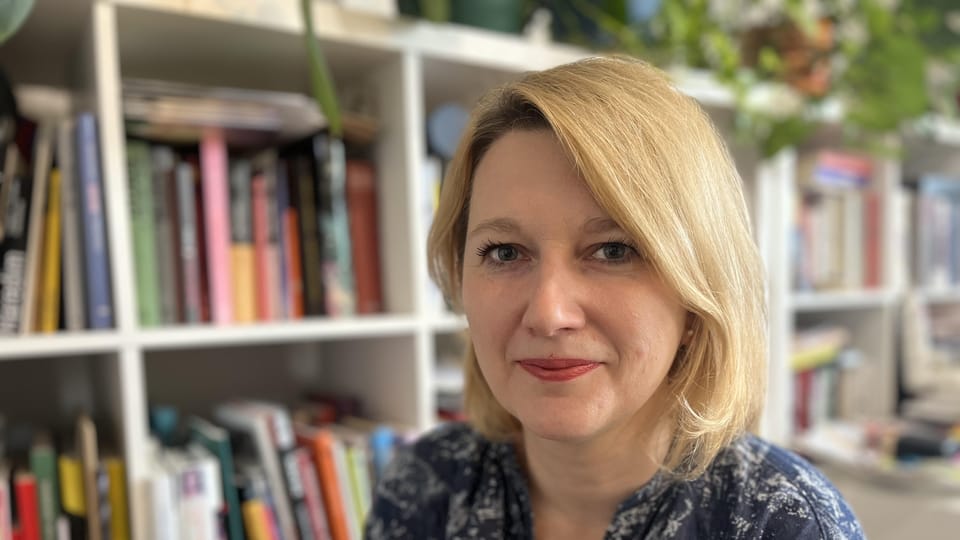
Barbora Baronová runs Wo-men, an independent publishing house based in Prague. Since 2012 the company has brought out works by such names as photographer Libuše Jarcovjáková and dancer Miřenka Čechová – and earned many admirers for its striking designs. As Baronová explains, she literally puts everything she has into Wo-men, which is a true labour of love.
Your mother was a librarian. How much do you think that shaped your future life?
“It’s a very interesting question, because I have just finished my new book, where I even say that books are a safe space for me.
“Books are a safe space for me.”
“All my childhood I was growing up amongst books. It was really a very natural environment for me.
“And maybe this is also the reason why I do books – I write them, I publish them – because it’s something very natural to me.”
You describe yourself as a literary documentarian. I’ve got to confess I don’t know this term – what is a literary documentarian?
“Actually I invented this term.
“I was doing my PhD on books that are kind of non-fiction and the thing is that the term non-fiction doesn’t fit all the types of books that are dealing with real things and facts and stories.
“So I was looking for a term that would fit better with what I do. Because I do literature, I do non-fiction, but usually I experiment with the text a lot.
“And for me a literary documentary is something like a film documentary but the medium is not film but books or literature. Therefore I use this term.”
Thirteen years ago you set up the publishing Wo-men. Why is it spelled that way, with a dash?
“You know, sometimes you have to decide about a name or something in a hurry.
“That was my case. I didn’t think about the name of my publishing house at all [laughs] – we just needed a name in, like, 20 seconds.
“I never bought a flat because all the money is now in books.”
“And why is there a dash? It’s because I was thinking the books I do are not only for women, they’re for men too.
“Today I would maybe put there ‘+’, that it’s women+, that it includes everybody.
“So it was just a bad idea in a quick decision process.”
What was the reason you formed the company so quickly? What was your motivation all those years ago?
“To tell you the truth, I never wanted to be a publisher. It’s just one big mistake. But I’m successful in what I do so I keep doing it [laughs].
“I always say if I was good on skis, I would do skiing.
“We were doing a book about unmarried women with the photographer Dita Pepe and we wanted to publish it somewhere.
“We approached three or four big publishers and they said, Are you crazy, this book is too artistic, nobody would buy it, etcetera, etcetera.
“So I just withdrew my savings, which I was saving for a flat – and I never bought a flat because all the money is now in books [laughs].
“Every other month I’m thinking, OK, I don’t want to be a publisher any more, I’m too stressed.”
“But it was just a coincidence. I thought I would publish one book and that’s it. So then this crazy name of this publishing house appeared.
“You know, from time to time I published some book because I thought it was a nice artistic practice.
“But the thing is at some point we received an award for publishers. I think it was 2016 and it was [top Czech literary prize] Magnesia Litera.
“And then I realised, maybe it’s not just artistic practice, maybe it’s really publishing [laughs].
“So I just keep going. And every other month I’m thinking, OK, this is enough, I don’t want to be a publisher any more, I’m too stressed, it’s so demanding, I want to be an artist.

“But I can’t stop – it’s like an obsession [laughs], or I don’t know.
“I really consider publishing as a beautiful tool to spread interesting ideas. It’s an amazing way to have a voice, or to help other people to have a voice.
“It’s a beautiful means of art.
“So it’s very difficult to stop doing it, even if I’m always grumbling about the fact that it’s too difficult and I really should focus on the one thing that I consider the most important in my life and that’s documentary work, documentary writing.”
It seems to me that you have a kind sense of mission, from the way you’re describing publishing. Also I saw one line from you where you said that books can help to “cultivate the nation”.
“Yes. I really believe it.
“I was always making jokes when I was younger that one day I’ll sell my publishing house and become a rich old woman [laughs].
“But then I read a book by the Australian publisher Susan Hawthorne called Bibliodiversity and it really showed me how the book is an important tool in society that can make the world better.
“I really believe books are an amazing tool for having a resilient society, especially in today’s world.”
“By reading books you can really get to the perspectives of other people, especially when you do and read non-fiction books.
“And I really believe it can create a change in society.
“I’m always very angry that countries, even our country, don’t focus more on supporting art, books, etcetera, because it’s such an important tool.
“It’s a political thing, you know.
“This year I visited a festival in Ukraine, the Arsenal book fair, and you could really see how books are such an important tool for Ukraine to spread things, values, ideas.

“It’s amazing soft power, to get the attention from abroad for example.
“I hope that we don’t need to have a war to understand that the book is such an important thing and instrument in society for making democracy stronger.
“I really like the term that Alice Koubová, the Czech philosopher, brought out – the resilience of society.
“I really believe that books are an amazing tool for having a resilient society, especially in today’s world.”
I was reading also that some of your book projects can cost up to one million crowns to get off the ground. How do you fund them? Or what is the situation regarding support?
“I’ve got a little privilege in the fact that I’m not a mother. I think I can behave a little bit more in a punk way.
“I’ve got a little privilege in the fact I’m not a mother. I can behave more in a punk way.”
“I’m investing every little small amount of money, every penny goes to books, so I’m investing in books.
“Because you can’t live from books in the Czech Republic.
“There are only a few people who can live from writing or publishing books.
“And I prefer to do art than business, so it’s a bit my problem.
“I don’t have any properties. I don’t have a car, anything. I just invest everything in it.
“So it’s a kind of suicidal behaviour, but I can afford it because nobody is dependent on me.
“In the Czech Republic we have some funding. Sometimes I get money from abroad but the amounts are… I don’t want to say ridiculous, but in terms of money it’s five percent of your budget.

“For a long time I was doing books very slowly. I published two or three books per year, so the cash flow is enough to sponsor new projects.
“Now for the first time, after 13 years, I really want to start publishing more books.
“Because I’m getting more and more to very interesting books that I really want and need to publish, because I consider them very important: books about Ukraine, documentaries from Ukraine, or projects about self-defence, etcetera.
“So for the first time in my life I’m even going to have a loan from a bank, because I really want to push this cash flow a bit.
“So it’s a punk thing to do books.”

You have worked with some very interesting people. For example, you published one of the books [Miss Amerika] by Miřenka Čechová. Also Libuše Jarcovjáková, whose book [My Black Years] you published before the big exhibition in France that changed her profile and kind of changed her life.
“I have to say I’m a bit privileged in terms of meeting interesting people.
“This is big luck. You have to be, I would say, even hyper-sensitive to sense the talent of people.

“I got to Libuše, for example, by pure chance. She was recommended to me by another woman, her former student.
“What was interesting was I got to her archives and I had her as the heroine of my book Intimita [Intimacy] – and then I really tried to push her to publish her photos and diaries.
“With Miřenka, she approached me and when I saw her, when I met her, I was sure I wanted to work with her.
“Because what is also interesting maybe – I’m not sure if all publishers are doing it, and I think most of them aren’t actually – I consider publishing books as teamwork, as collaboration with amazingly talented people.

“When I do books I spend with those people two, three years, sometimes even five or six, on a project, so I’m also choosing projects, or writers or photographers or graphic designers, based on our abilities to collaborate and the capacity we have or don’t have to create something unique.
“It’s about being open, to almost anything.
“I’m choosing people who are also a bit punk, to tell you the truth [laughs].”
For you design is very, very important. Often your books are nominated for the award for “most beautiful book of the year”. Why do you place so much of an emphasis on the book looking like a piece of art?
“I like this question, because when we started to work with Dita on our first project – I already mentioned this book about unmarried women – she said such an important thing.
“She said, We are working on this project for four years and we don’t want to just make an average book – if we put such an effort into creating it, why don’t we also put the effort in also in terms of the appearance of the project?
“I said, OK, that’s a very good idea – and I love to follow this idea.
“And after many years I realised it’s a kind of bonus for this book in that you also get attention.
“In the Czech Republic we have around 15,000 books published every year and it’s very difficult to get attention.
“But when you do something that’s more like art in terms of design, or if you really put an effort into how it looks and you can see the love put into the book, I think it’s something that people are interested in.
“And I think it’s a kind of advantage for the book, when you also put effort into not only the content but also the form.”
When it comes to selling your books, do you have particular niche distributors you work with? Or how do you reach the people who want to buy your books?
“Through my life I’ve had to do a lot of business decisions.
“For example, because we don’t have a fixed price of books I had to withdraw from the major distribution.

“But I have started to collaborate directly with shops. It’s very time-consuming, it’s very demanding, but it’s the only way today how I can reach people who are interested in different types of books.
“Also because I studied journalism and mass communication, and I was working for a long time in the advertising business, I learned a lot of good skills in terms of how to catch the attention of people who might be potentially interested.
“So for example I started an art newsletter – it’s already maybe 12, 13 years since I started it – and there is a big group of several thousand people who are following me.
“I do like a public diary, so it means when you receive my newsletter you read what Barbora is doing, what other artists are doing, where we are going, what we are talking about.
“It’s like the ‘back story’, or I don’t know how to describe it better, so there is a lot of gossip [laugh] about the books are being written and produced, etcetera.
“I think people like it and I’m creating a kind of bond with them. They are looking into my kitchen, literally [laughs].
“I travel a lot to different book and literary events. I talk with people. I’m trying to have this direct relationship.
“And I think they see that I do books with passion.

“Sometimes I think, How can this person be interested in this specific subject? But they say, We love your books, we are big fans, so we need even this book – and one day I’ll offer it to somebody, or I’ll have a collection of your books.
“So it’s very different, I think, from mainstream projects. I really live the book, if I could describe it this way.
“Many people consider publishing more as a production thing. But I think it’s a very creative thing, it’s about meeting interesting people, collaborating with amazing people.

“I’ve got a very beautiful relationship with people at the printing company. I try to have a super nice relationship with bookstores, etcetera.
“So for me it’s my environment.
“And when you asked me at the beginning about the libraries, etcetera, I try to create this safe space within this – I try to create a ‘book ecosystem’ where I feel safe.
“So, maybe you feel it, I’m really passionate about it [laughs].”
Given the name of your publishing company and the fact that you often focus on gender issues, I wanted to ask you about feminism in Czechia. For example in America they talk about it now being the fourth wave of feminism. Is there any way we can make an analogy with Czech society? Where are we with feminism in this country?

“It’s a very complex question, actually.
“There were amazing people like Pavla Frýdlová and Jiřina Šiklová who were really involved in our Czech feminism in the 90s.
“There was a lot of misunderstanding through the years.
“With the lawyer and activist Šárka Homfray we published the book Proč jsme tak naštvané?, Why Are We So Upset?, which is about feminism.
“It’s full of key studies and cases showing how we are treated as women.

“You know, how can we talk about any wave of feminism if we have elections and there is again only, I don’t know, 20, 25 or 30 percent women on the candidate lists?
“So on many levels we are very far away.
“How is it possible we still don’t have this Istanbul Convention [on violence against women; Czechia has not yet ratified it]?
“We have to deal with so many specific issues. And if I am to answer a question about feminism in the Czech Republic, I am sad. I’m very sad. I’m not satisfied.

“And it comes with the misunderstanding that feminism is about rights for women, but feminism is about the same opportunities for women and men.
“So I’m still not satisfied with what’s happening in the Czech Republic.”
Do you see any reasons for optimism, any green shoots?
“I have to think long about it [laughs].
“Yes, there are, like, little issues. There is a new thing, for example, that girls are going to have sanitary products for free at schools.
“It was such a long fight for it, you know. I think this is a very positive step, but there still one million other issues we are still dealing with, like the pay gap.
“Actually a few years ago I was at one conference where I was talking about women in the publishing business.
“After my talk there was one publisher from Africa who told me, Compared with Africa, why are you complaining?
“If I am to answer a question about feminism in the Czech Republic, I’m very sad.”
“I said I’m still complaining because for example when I’m selling books man is approaching my stand and asking me, Where is your boss?
“He’s asking about the guy who is behind it all, because he can’t believe that the books I’m producing are something that a women could produce.
“So this petty level of behaviour.”
Even when your company is called Wo-men, people will ask a question like that?
“Yes.”
Related
-

-

Prague Talk - EP59: Libuše Jarcovjáková
Photographer Libuše Jarcovjáková documented her own turbulent life, and minorities such as homosexuals and Romanies, in the final decades of communism in Czechoslovakia.
-

Miřenka Čechová: If my parents had known one percent they would have taken me out of ballet school
Miřenka Čechová is an internationally acclaimed performer, director and choreographer known for combining dance and physical theatre. In her recently published…