Czech astronaut Aleš Svoboda prepares for ISS mission: what makes a good astronaut?

Czech fighter pilot Aleš Svoboda is preparing for a mission to the International Space Station, marking an important step for Czech participation in European space exploration. Belgian astronaut Frank De Winne, a former head of the European Astronaut Centre, was directly involved in his selection. He told Czech Radio science reporter Martin Srb why he believes Svoboda possesses the qualities needed for the demanding assignment.
Belgian astronaut Frank De Winne, a veteran of two space missions and a former head of the European Astronaut Centre, was directly involved in Aleš Svoboda's selection. De Winne, who currently serves as ESA's ISS and Terrae Novae Programme Manager, told Czech Radio that he remembers meeting Svoboda during the selection process.

Why Aleš Svoboda stood out
Svoboda's background as a fighter pilot was an advantage, De Winne explained, particularly because spaceflight requires the ability to operate complex equipment, process information quickly and follow procedures under pressure. "He's also used to following instructions, used to working under leadership, which is very important in astronautics. As you know, when you fly to the space station, you're operating in a capsule in a very dynamic environment, which is a little bit like a fighter aircraft."

The two men share a background in military aviation, but De Winne stressed that being a pilot is by no means a prerequisite for becoming an astronaut. ESA also recruits scientists and medical doctors, provided they have practical experience in their respective fields. "What we are looking for in astronauts are people that have, first of all, proved themselves in their young careers, people that have a certain ambition, that have a certain capability to learn, that can work in teams."
The emphasis, he explained, is on individuals who can apply their knowledge in demanding operational situations. Astronauts are not simply researchers observing experiments from a distance. They must operate spacecraft, handle equipment and perform scientific work themselves.
From basic training to a specific mission
Svoboda was selected as a member of ESA's reserve astronaut corps and has since completed the basic training provided to reserve astronauts. According to De Winne, this gives them the general knowledge needed to work aboard the International Space Station. The next stage, however, is considerably more specialised and will prepare Svoboda for the tasks he will actually perform during his mission.

"The part that is now coming is what we call the mission-specific training, because of course then you train for your mission. You know exactly which experiment you're going to do. You know exactly which spacecraft you're going to fly. You know exactly your role on board of the spacecraft."
De Winne was not personally involved in organising Svoboda's basic training and therefore declined to assess his individual performance in detail. He nevertheless pointed out that all the astronauts in the group had successfully completed the programme and received their certificates. His advice to the Czech astronaut for the coming months is to concentrate above all on the demanding preparations ahead, even as public interest in his mission grows."There can be a lot of things that can distract you from the mission when you're in training. Of course, you have a lot of requests from the public, PR, interviews, but the main part is, certainly before the mission, to focus on the training, to focus on the mission at hand."
Astronauts are not individual heroes
Perhaps the most striking part of Frank De Winne's message concerns the popular image of astronauts as exceptional individuals embarking on heroic adventures. Having himself spent time aboard the International Space Station, he believes this perception overlooks the hundreds of scientists, engineers, technicians and other specialists whose work makes every mission possible.
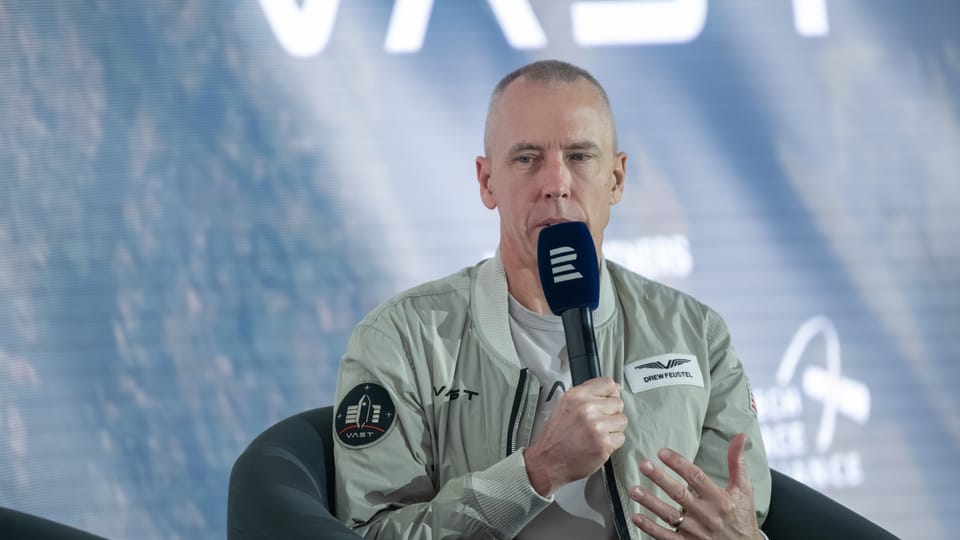
Astronauts may be the public faces of space exploration, but they carry out experiments on behalf of scientists, test technologies developed by industry and represent a much broader international effort. De Winne believes this is something every astronaut, including Aleš Svoboda, must understand. "But as an astronaut, it's very, very important to realise that the mission is not about you. The mission is not about Frank De Winne. The mission is not about Aleš Svoboda. The mission is about the science, the programme, the technology, the education, the inspiration. And for that, you need an entire team."
For Svoboda, the months ahead will therefore be about more than mastering spacecraft systems and scientific experiments. They will also require learning to rely on the people supporting him on the ground and preparing to represent their collective effort in orbit. De Winne's final advice is simple: trust the team and remain focused on the mission. That, he believes, is the best way to make the Czech astronaut's flight a success.