Battle over Czech public television and radio funding: strikes, protests and political divisions

The Czech government's plans to abolish television and radio licence fees have triggered strikes, demonstrations and a heated debate about the future of public-service broadcasting. Following a controversial parliamentary vote in the early hours of October 24, thousands of people gathered in Prague to protest against the proposed changes. In this episode of Czechast, Vít Pohanka brings together the views of leading politicians, Czech Radio Director General René Zavoral and demonstrators on Wenceslas Square.
READ ALSO
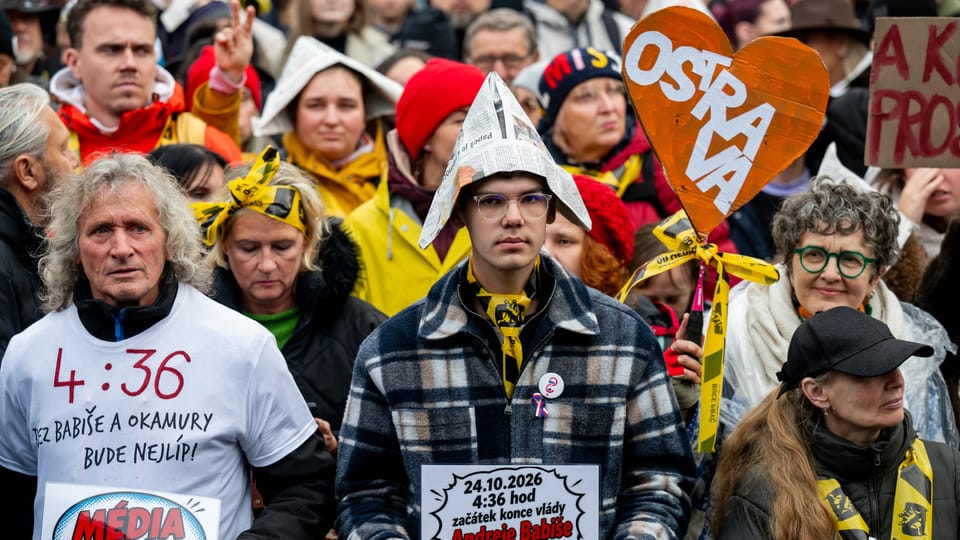
The Czech government's plans to abolish television and radio licence fees and replace them with funding from the state budget have provoked a wave of opposition, including a strike by public-service media employees and demonstrations in Prague and Brno. Critics warn that the proposed changes could undermine the independence of Czech Television and Czech Radio, while the governing coalition insists it is fulfilling its election promises. The controversy intensified on October 24, when the coalition led by Prime Minister Andrej Babiš (ANO Party) pushed the legislation through its first reading in the Chamber of Deputies following an all-night parliamentary session. The vote took place at the unusually early hour of 4:36 a.m.
The proposed changes would also bring substantial reductions in funding for both public-service broadcasters. On November 3, employees of Czech Radio and Czech Television staged a strike, while thousands of demonstrators gathered on Prague's Wenceslas Square to express their opposition.

Government defends its plans
Tomio Okamura, Speaker of the Chamber of Deputies and leader of the Freedom and Direct Democracy party (SPD), told Czech Radio that the strike had barely affected him personally. "To be perfectly honest, I didn't notice the strike, because I haven't watched Czech Television for about fifteen years, and I don't listen to Czech Radio. So I'm not a user of these services," Tomio Okamura said. Tomio Okamura argues that opinion polls show considerable public opposition to compulsory licence fees. However, surveys also suggest that many Czechs are reluctant to see public-service broadcasters financed directly from the state budget.

When confronted with this apparent contradiction, Tomio Okamura suggested that licence fee payments could become voluntary. "I have absolutely no problem with making licence fee payments entirely voluntary. If that's what the majority of citizens want, then let people pay voluntarily," he said. Tomio Okamura also rejected concerns that state funding would necessarily expose public-service media to political interference. He pointed out that other independent institutions, including the courts, the public prosecution service and the Supreme Audit Office, are financed from the state budget.

Prime Minister Andrej Babiš has meanwhile suggested looking for inspiration in northern European countries, some of which have replaced traditional licence fees with tax-funded systems. Speaking to commercial broadcaster TV Nova, he said the new arrangement should guarantee stable and predictable funding. "I simply want to come up with a proposal under which the money wouldn't come directly from the state budget. It has to be predictable and fixed, so it would effectively become mandatory expenditure," Andrej Babiš said. However, the governing parties have yet to agree on a specific funding model. Tomio Okamura has already made clear that SPD would oppose any solution involving a new tax. "If this took the form of introducing a new tax for Czech citizens, a new tax to finance Czech Television and Czech Radio, we would certainly oppose it," he said.
Czech Radio warns of cuts to programmes and staffing
Czech Radio Director General René Zavoral says the proposed legislation could have serious consequences for the broadcaster's operations. Speaking in an English-language interview during the strike, René Zavoral said that more than 75 percent of Czech Radio employees and collaborators had joined the industrial action, forcing stations to replace much of their regular live programming with documentaries, music and archival material. He warned that the proposed funding arrangements could reduce Czech Radio's budget by approximately 15 to 20 percent. "We would have to consider reducing regional broadcasting and original production. There would be cuts to investigative journalism and reductions in many services we provide to our audiences," René Zavoral said.

He added that the broadcaster would also have to consider the future of its symphony orchestra and other artistic ensembles, while reductions in services would inevitably affect staffing. René Zavoral strongly rejected claims by Prime Minister Andrej Babiš that Czech Radio's management was unwilling to negotiate. "It's very difficult for me to say this, but he lies. He lies," René Zavoral said. According to René Zavoral, representatives of Czech Radio and Czech Television have repeatedly expressed their willingness to discuss the future funding system with government politicians and independent experts. However, he described an earlier meeting with the prime minister as a one-sided encounter rather than a genuine discussion. "It wasn't a dialogue. It wasn't a discussion with me or with the director general of Czech Television. It was a dictate," he said.
Although René Zavoral maintains that the best solution would be to withdraw the legislation, he acknowledges that the government has sufficient parliamentary support to push it through. If the legislation is adopted, he says public-service broadcasters will seek additional legal safeguards, including a requirement for future changes to their governing laws to be approved by both chambers of Parliament or by a qualified majority.
Demonstrators fear political interference

At the demonstration on Wenceslas Square, Vít Pohanka spoke to people of different ages and backgrounds, many of whom expressed concerns about the potential consequences of changing the funding system. A master's student at Charles University, who introduced himself as Kocian, said he was particularly troubled by the parliamentary procedure and the absence of guarantees protecting public-service broadcasters from political pressure. "The law doesn't give us any assurances that, for example, if Czech Television reported something the government didn't like, it wouldn't be punished by having its funding cut the following year," he said.
Two secondary school students from Prague, Nikola and Adéla, said they had come to demonstrate because they believed young people should defend democratic institutions. "We have a voice, and we should use it for as long as we can," one of them said. The students also referred to developments in neighbouring Slovakia, where changes to public-service broadcasting have generated controversy. Another demonstrator, Tonda, argued that public-service media must remain independent of both government officials and wealthy private owners. "We need to show that we care, and that we're not just letting it happen," he said, explaining why he considered demonstrations worthwhile even though the governing coalition commands a parliamentary majority.
A scientist attending the demonstration also defended the existing licence-fee system. He acknowledged that several European countries finance public-service media from public budgets but argued that such arrangements require strong legal safeguards and thorough public discussion.

More protests planned
The controversy is unlikely to end with the first parliamentary vote or the November 3 strike. Another major demonstration has been announced for November 15 at Letná Plain in Prague, a location associated with some of the largest political gatherings in modern Czech history. With the governing coalition determined to abolish licence fees, public-service broadcasters demanding stronger guarantees of independence, and demonstrators preparing to return to the streets, the debate over the future of Czech Television and Czech Radio looks set to continue.
Listen to this episode of Czechast for the politicians' statements, the full English-language interview with René Zavoral and largely unedited conversations with demonstrators on Prague's Wenceslas Square.
Related
-

-

After Hungary, Poland and Slovakia, is Czechia's public broadcasting independence at risk?
In this edition of Czechast, we examine the Czech government's controversial public media funding reform and the protests it has sparked in Prague and Brno.
about programme
Czechast, Radio Prague International
Czechast is a regular RPI podcast about Czech and Moravian culture, history, and economy.