Surveillance, poetry and the coming of freedom: British writer Jim Potts recalls his years in Prague

Jim Potts is a poet, writer and filmmaker who worked for the British Council for 35 years, serving in many different countries the world over. In the years between 1986 and 1989, he was head of the British Council in Prague, in what was a groundbreaking period for Czechoslovakia leading up to the Velvet Revolution and the fall the fall of communism after four decades of totalitarian rule. On a recent visit to Prague Jim Potts visited Radio Prague and shared some of his memories of the time.
Mr. Potts, as a writer, you are obviously a keen observer of what goes on around you. When you arrived in Prague in 1986, what did you see?

“Well, I came in April with the family, my wife and two children, and it was a bit grim coming over the border then, you know, so I was a little nervous when I drove into Prague, not quite knowing where I was going. The atmosphere didn't seem particularly welcoming after coming from West Germany. We had an apartment in Francouzska street at the time, and it was a very elegant apartment, but it was above a butcher's shop, a very big and very noisy butcher's shop so it took me some time to adjust. I would say the first three or four months I was a bit wary, you know, not sure, because you get briefings that you mustn't do this or mustn't do that, but gradually I really came to love Prague. I thought it was fabulous, and I think even in those days when the buildings hadn't been restored and...”
It had a haunting beauty, didn't it, even in the grey years?
“It had a haunting beauty, yes. I really grew to love it, and so did my wife.”
You have been described as “a representative of Britain in countries both friendly and hostile”. I assume that pre-1989 Czechoslovakia would have been perceived as hostile, at least from the regime. What was life like here for you? I read that you were closely followed by agents.

“Well, I managed some years later to come back and study all the StB files, and there was, I think, 1,400 pages of rather boring stuff, actually. Including guest lists and things like that. But, yes, it was more outside Prague that they had reports of cars following you and so on. But if I went to a book store or to a record shop, there would be a note about what I'd bought ...”
So you noticed people around you who were interested in you?
“Well, I didn't, because I wasn't looking for them. I was aware probably there would be microphones and things like that. But the records they kept were much more detailed than I would ever keep in my own diary. So it was actually very useful to read it all. I had help, obviously, interpreting them, because they were written in Czech or Slovak and not always perfect photocopies. But I was able to photocopy them. And I'm still rather amused about things like the handwriting analysis that they requested on the basis of a report on an art exhibition I’d written. And they deduced all sorts of things about my personality from the way I wrote certain letters and things like that.”

They were probably looking to see who you were meeting with and so on. Given the close scrutiny, were you able to form real friendships at this time, beyond the acquaintance stage?
“Certainly. Certainly I was. And I've been able to catch up with a few friends just now. But unfortunately, quite a few have died since then, like Jan Vodnansky, the singer. Lots of my friends are sadly now dead. But I caught up with Ivo Šmoldas, just two days ago, and had a good chat to him in Café Slavia on Narodni trida. So that was wonderful - after 36 years. I don't forget friends and I think we made a lot, actually. People were happy with what we were doing. And I made friends, you know, even with the officials at the ministry of culture or education, on a certain level. And then there were what I would call writers, semi-dissidents, not necessarily the main political dissidents, because they were being more closely watched. But we made friends with a lot of writers, filmmakers and artists. Some of them became good friends. And sadly, I never seem to have time to catch up. And I only have an old Czech phone book from that period, which is not very helpful these days.”
Were you able to learn a bit of Czech when you were here? They say Czech is a very difficult language to learn…
“Well, it is. And I'm rather proud that I passed the diplomatic intermediate level, but I think I've forgotten pretty much all of it. But I've got a new energy now to do lingo and other things, you know.”
Mr. Potts, you've lived in Greece, Corfu, Ethiopia, Sweden. You have traveled around the world and lived for longer periods in different countries. How did you find the Czechs? Were you able to relate to them, to our sense of humor, for instance?
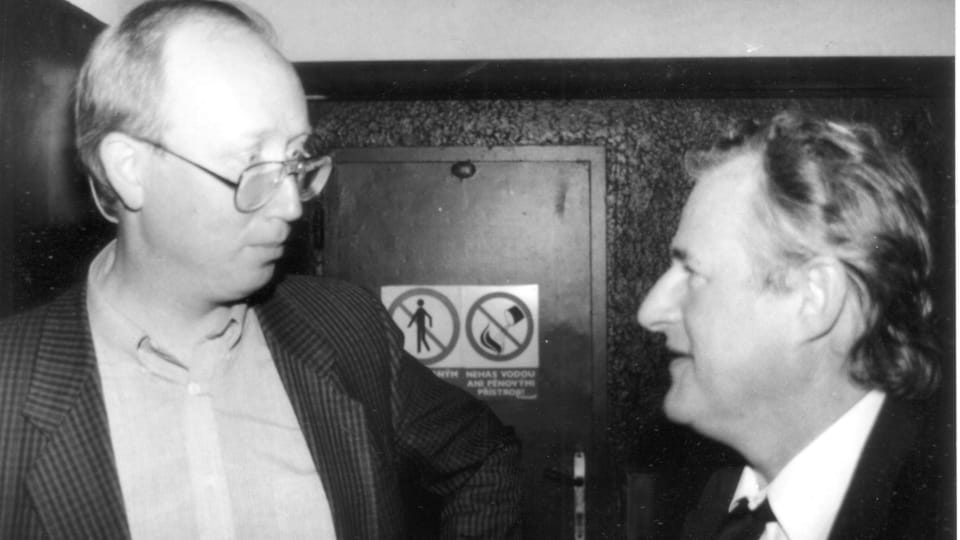
“Very much to the sense of humor. Even now, I have friends here who make me laugh constantly. I think - well, it's the one country - out of all my six or seven postings - that I remember more vividly. That may be because it was a more difficult place politically. I think the first StB report I read suggested that I be followed, because they thought I might be an enemy of the Czech people. Absolute nonsense, you know. But I guess that when the communist regime sent cultural attaches abroad, perhaps they were like that. I think that after three years, having assumed that I was up to no good, they realized that actually I was just a normal British council officer, perhaps rather boring and that it was a bit of a waste of time following me. But, you know, it takes them a long time to realize that.”
We said you were here between 1986 and 1989, the years leading up to the Velvet Revolution. Did you feel that change was in the air? Could you tell that something was happening?
“Well, I could, I think, but I was not as confident about it as some Czech friends I've talked to now. They all thought the country was ready for change. I don't think the foreign diplomats realized that. But, I mean, it was likely to happen because of what was going on in Poland and Hungary."
It was quite late here, wasn't it, surprisingly?
“Yes, yes it was. And it was a fairly frozen sort of atmosphere. I was here till November 1989, although technically my job finished in October. But I was asked to do a big tour of all of Eastern and Central Europe to see what the English teaching needs might be in the future. So I did a big report on that. And I was back in Prague in November. I was in East Berlin on the day that the Wall came down and when I came back to Prague, people were rattling their keys in Wenceslas Square. I remember Professor Stanley Wells gave a talk, a lecture at the Academy of Sciences. And then and all of the protesters were there, you know. So that was November 17th, 18th, 19th.

“Certainly we were able to do much more in the last year or two that I was here. We had an English language resource center in Jungmanova Street. And people would always come in to collect the BBC World Service Program, though even that was a bit risky, I imagine, because they would have been watched. And one or two artists clearly had problems. You know, the Third Eye Center in Glasgow wanted to have an exhibition of a young Slovak artist. And he came to the office with slides of his work. And obviously somebody reported him and his collection of works was seized in Slovakia. So it could be risky for people if they came to us.”
You certainly saw history in the making. Did anything surprise you about the way communism was toppled, about the Velvet Revolution?
“I don't know that I had a particularly sensitive awareness. I could see students being beaten with batons by the communist police in Narodni trida. So they were still trying to repress things quite late, the protests and demonstrations. So one couldn't be sure that it would change. But I was aware of Charter 77 and I'd read a lot of Czech writers in exile and talked to people here. So, I mean, I was pretty well informed from the literary sort of point of view, I think.”
You also met Václav Havel. How did that come about?

“Well, I think I first met him possibly at the house of the American cultural councilor. Then he opened the new British Council when it took over the offices of the former East German Cultural Centre, which was in Narodni street, I think. And I met him again in Australia when I was director of the British Council in Australia. And he came out there and we had quite a long chat in the pub and he signed my books and we talked. I can't claim to have been, you know, a close friend. I was much closer with friends of his than with him personally. And actually he was always either in prison or being tried or in his home under house arrest or something.”
But I believe that some Czech friends of yours translated some of your poems and he signed one of the samizdat copies, right?
“Yes, yes. Actually, the three translators also signed it, Pavel Šrut, Ladislav Verecky and Ivo Šmoldas, who I saw the other day. They once asked me if they could see a few of my poems and I shared them. I didn't know that they were doing a secret little edition. And they arranged, I think, in October 1989 for me to do a reading at what was then the Karel Capek bookshop, in, I think, in Jugoslavská, not far from here. But, you know, a lot of people came there, including Miroslav Holub. It was quite a distinguished little gathering.”

So what were the poems inspired by? Were they about this country?
I think that most of the Czech ones are actually in here. I can read you a couple. This is the very first poem that I wrote when I arrived in Francouzská Street, in 1986. It is called “First Impressions of Prague”:
Being above a butcher's shop
makes Prague seem built of ham:
smoked Gothic,
pork Baroque;
Dvořák in a bloody apron
I was always interested in the fact that Dvořák's father was a butcher and that he himself had been an apprentice. So it struck me as an unusual sort of combination. And if I could read one more, this was from August 1988. It is called Right of Way, and it quotes a line from Shakespeare's The Tempest called “All in Bohemia's Well”:
Tell them, you're sure
all in Bohemia's well…
that everyone is equal here,
that education is enjoyed by all,
regardless of race, of class, or creed –
except the class of ’68 and of course, their children,
or, of course, their children's children,
or Christians, Chartists, Gypsies, Jazzmen…
Justice, too, enjoyed by all!
You're free to walk through the public woods –
but not across the border.
You know, I wasn't being hostile, but I was just observing. And then I have one about the activities of the Communist secret service. This is a much more recent one, called Persons of Interest. I wrote it after I'd read the StB files on me, and realised that there was something called EZO, which was Evidence zájmových osob StB, a database of people followed by state security.
They're all there in the archive,
Persons of Interest to the State Secret Police,
blocked or unblocked, they're registered there,
collaborators or enemies. Who can tell? Who now cares?
Some innocent names added by agents
who filed made-up reports each day for the boss.
Nobody knows which side they were on,
those Persons of Interest, dead or alive.
The archive's online. You can search for a name,
for a family member, for a neighbour to blame.
“So that was not really very poetic, but it was just an observation. About the StB files that were online. You could find out all sorts of things online about who was making reports on you in their codename, and things like that.”
This was a big issue after the revolution, when people could access the files on them. Speaking of the StB files how do you feel about how Czechoslovakia and later the Czech Republic came to terms with its communist past?
“Well, I don't know. I once had contact with Pamět Naroda and obviously they've done a very good job recording all sorts of interviews and testimonies about the time. Now, the people I meet seem to be sort of quite relaxed retrospectively, and I don't think there's any kind of vindictive desire to trash people or to persecute them. But, on the other hand, if you discover that somebody close to you, a trusted person, said something very hostile you're not going to be terribly fond of them. I think standard reporting, you know, just saying fairly innocent things that you were required to say or report, that didn't bother people too much. But if there was a real stab in the back or an exaggerated report, that must have been difficult to come to terms with. “
What about learning the lessons of the past, so to speak?

“Well, I was head of East and Central Europe Department in London for three years after serving here. So I went to virtually all the countries, you know, as far as Georgia and Ukraine, because we were opening small offices or big offices across the region, because there was a demand for English, basically. So I had a chance to compare. Some of the countries changed course. You know, they became more right, less pan-European in their attitudes. I think on the whole, though, people seem to have adjusted pretty quickly. You know, I would have found it very difficult if it hadn't been for the help of seminars and all sorts of training programs that were offered, like the British Know-How Fund, helping people become more familiar with the market economy and systems like that. But I think Czechs seem to be very confident, and I think it's a wonderful country. When I came back soon after that, I thought it was a bit Wild West-y in the 90s. I wasn't quite so keen on that, to be frank. I don't like seeing casinos everywhere and all the other types of things. But, I think it's a very mature republic now, and it's a wonderful place to visit.”
One final question. What did you take away from your time here?
“Well, Czech music, Czech literature, Czech film, obviously. Dvořák and Janáček -wonderful music, that I love. Čapek right through to contemporary writers. So yes, Czech literature, poetry, music, people like Vladimir Merta’s music in the old days, Janáček, Jan Vodnanský, Zuzana Ružičková , Petr Eben. I went last night to the St. James Church and there was an organ recital. I had been there 36 years ago. You know, I remembered the church and things like that stay with you for a lifetime.”