Rare medieval Madonna goes on display at Prague’s St Agnes Convent

The Madonna from Havraň, a rare medieval sculpture of the Virgin Mary, has gone on display in the Convent of St. Agnes of Bohemia in Prague. The National Gallery acquired the object three years ago, and it has since undergone careful examination and restoration.

The wooden statue is believed to have been carved in the 1360s or 1370s, during the reign of Charles IV, King of Bohemia and Holy Roman Emperor. The sculpture depicts the Virgin Mary seated on a heavenly throne with the baby Jesus resting on her lap, surrounded by three angels.
It was discovered by a private owner, covered in dust in his attic, and in 2022 it was purchased by the National Gallery for 4.5 million crowns. Restorer Markéta Pavlíková and her team then devoted three years to bringing the 95-centimetre-tall sculpture back to life.

“It must originally have been beautifully polychromed, judging from the fragments that survived. She had silver garments and accessories and a golden cloak.”
Before the restoration began, the statue underwent detailed examination, says Ms. Pavlíková:
“We examined the wood using dendrology and identified it as very high-quality linden. CT scans showed that the wood is completely sound. As for the paint, when we first received the statue it had been overpainted with poor-quality basic colours—red, green, yellow, blue. During our research, we discovered at least three to five previous paint layers beneath these.”

Some of the original features are missing today, including part of the Virgin Mary’s right hand and part of her dark wavy hair at the crown of her head. According to Ms. Pavlíková, this was likely the result of later artistic alteration.
“She originally had a crown carved directly from the same piece of wood as the sculpture itself. She also wore a veil, which covered part of her hair and draped down to her chest. It was probably cut away and replaced with a metal crown. And the child Jesus received a metal crown as well.”
In the 19th century, the sculpture was located in the Church of St. Lawrence in Havraň near Most, which is where its present name comes from. The house in which it was later found in the attic apparently once belonged to Sudeten Germans, whose property was likely confiscated by the state under the Beneš decrees.
Adéla Pavlíčková, curator of the National Gallery’s Old Art Collection, notes that this carving belongs to a significant group of sculptures known mainly from northern and north-western Bohemia.
“This is exceptional because that region preserves a high concentration of sculptures from the 1360s and 1370s, the time of Charles IV. It represents a layer of art outside the St. Vitus Workshop, beyond the main imperial focus. The Madonnas from this region are exceptional because they were probably created in Prague, and because their patrons often came from the wider imperial circle or imperial court.”
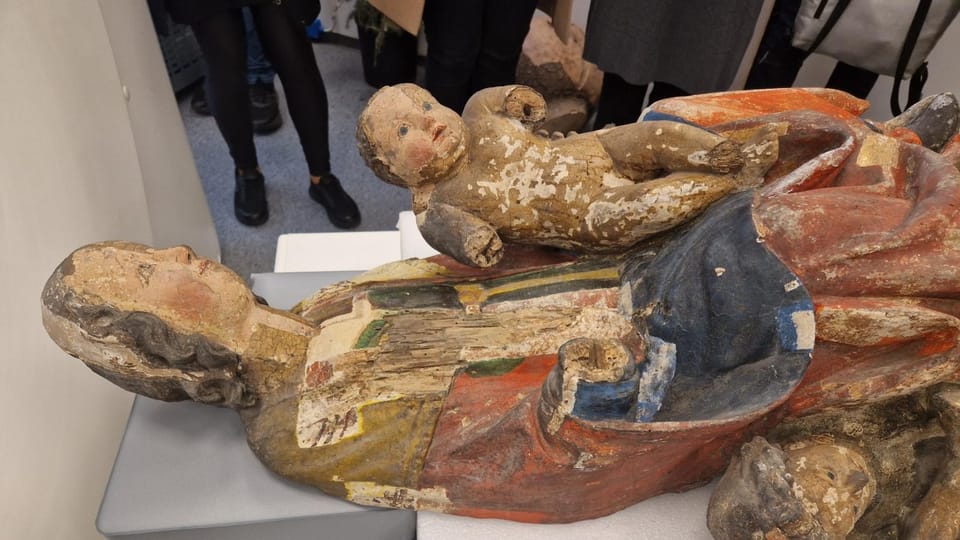
The statue is also distinctive because the angels hold musical instruments.
“We know of music-making angels from the Italian, French, and English traditions. They often appear in scenes of celebration, where the Madonna is honoured and accompanied by angels playing sweet music. In this case, the music-making angels may be understood as figures lifting up the Heavenly Mother at her Assumption.”
Visitors can now admire the results of the restoration in the National Gallery’s Convent of St. Agnes, a medieval complex that houses key Gothic paintings and sculptures from Bohemia.