Ostrava Zoo: home to 451 species, including some extinct in the wild
Ostrava Zoo is home to over 6,000 animals from 451 species. Around one-third of these species are classified as threatened and seven are already extinct in the wild. The zoo not only helps to protect them in their natural environment, but breeds endangered birds and animals that are returned to the wild.
The early beginnings of Ostrava Zoo date back to the 1950s, but it was decades before the humble project developed into the modern zoological garden that it has become today. In 2004 the Zoo joined the World Association of Zoos and Aquariums (WAZA) and financial investment from the city of Ostrava ushered in a phase of rapid development. Today Ostrava Zoo is not only an animal park, but also a thriving botanical garden.

It is home to over 6,000 animals from 451 animal species. Around one-third of these species are classified as threatened and appear on the International Union for Conservation of Nature (IUCN) Red List. Seven are extinct in the wild.
František Příbrský, head of the Zoo’s In-situ Conservation Department explains the broad scope of the zoo’s activities:
“I am the head of the In-situ Conservation Department and our goal is to support, choose and develop in-situ conservation projects all around the world. That's specifically my work. But as regards conservation in general, Ostrava Zoo is doing much more. For example, next to supporting projects all around the world financially or by the time invested by our staff, we are, for example, breeding endangered animals and providing them for reintroduction back to the wild. There are more than 800 animals that we already provided to be released back to the wild. In addition to this, we do a lot of educational projects.”
Can you mention some of the animals that Ostrava Zoo is helping to save? Maybe we should first explain the difference between “in-situ” projects and “ex-situ” projects.
“In-situ means protecting or somehow focusing on the animals that live in their natural environment. So, for example, the Kukang (loris) program is focusing on conservation of lorises in Sumatra because they are from Sumatra. Or, for example, the raccoon langur, one of the 25 most endangered primates, which is endemic to Vietnam, so we support the project protecting them in Vietnam. We are helping to save antelopes, the Derby Eland in Senegal in their natural environment and there are many other such projects. So in-situ, it means that we are helping them in their own environment. On the other hand, ex-situ, means helping them "away from the natural location". For example, through conservation breeding. So, if in the zoo we breed tigers or rare pigeons, then it's breeding ex-situ, out of their original habitat.

Ostrava Zoo is protecting some animals through breeding and some animals in the nature. For example, in Vietnam, next to the Delacour’s langurs, we protect the critically endangered Tonkin snub-nosed monkeys, we protect Sunda pangolins in Indonesia, endangered songbird species from Indonesia. Then also Goodeid fish from Mexico, which had become extinct in Mexico. And now the universities together with zoos and scientists are releasing them back into Mexican rivers. We are helping with many projects. I would mention the Yellow cardinal, a bird species from Argentina. We are helping them through cooperation with the Temaikèn Foundation, which promotes the conservation and restoration of biodiversity in Argentina.
“We are also helping protect corals in the Philippines, together with an NGO called Vesta Panglao Conservation. This NGO is restoring and protecting coral reefs. Corals are also animals, so it counts. So those are some of the birds and animals that we protect in the nature. And by breeding in the zoo, we are helping ex-situ. We have good breeding programs for chimpanzees, Silvered langurs, Diana monkeys. And there are also a few species which we are providing for releasing back to the wild. One of the most successful projects is the reintroduction of the Bearded Vulture in the Alps. Then, for example, we are providing the Northern bald ibis to Spain for releasing. And in the past we also provided lynx to be released in the wild in Slovakia.”

In addition to its own breeding successes, Ostrava Zoo plays a role in coordinating international conservation efforts. Right now its specialists coordinate the European Endangered Species Programme (EEP) for chimpanzees as well as for livebearing fish from the family Poecilidae.
Jana Pluháčková, is chief zoologist at Ostrava Zoo and presently also coordinator of the European program for Chimpanzees EEP – an ex-situ program managed by the European Association of Zoos and Aquaria. She explains what her duties and responsibilities are.

“I became EEP coordinator five years ago and my responsibility is to look after the captive population of the chimpanzees within the EASA, which is the European Association of Zoos and Aquariums. Of course, I'm not the only person doing that, that would be too much for one person. I have two great vice coordinators, one assistant and a whole species committee, which are colleagues from different zoos that are like a board of trustees. Whatever decision we make, we need their approval or their opinion. So, to sum it up - we recommend transfers of individual chimpanzees, we also give advice on behavioural issues, if the animals are in a group, and if a new facility is going to be built, we are responsible for checking the safety of the building and of course suitability from a welfare point of view. So we do all of that.”
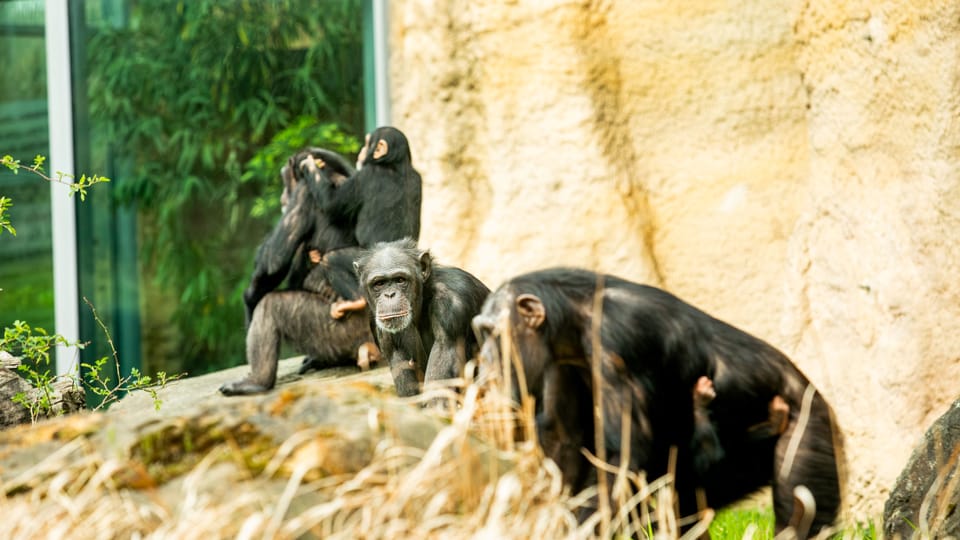
At Ostrava Zoo Jana Pluháčková’s primary concern is the zoo’s own chimpanzee pavilion. She takes us around, points out individual members and explains the hierarchy and social workings of the group.

“We have ten chimpanzees at the moment, two adult males, five females and three young males from age two to five. These chimpanzees are going to stay in our group and will create the basis of our next breeding group. That is the way that chimpanzees live in multi-male, multi-female groups; with the males staying and the young females migrating and changing within the groups. That is the natural way. Our group is a bit special because our two males come from quite difficult backgrounds and their history is complicated. One of them comes from a bachelor group in a zoo in France and unfortunately he doesn't know how to mate. He would like to, but he doesn't have that skill. And the second one comes from private breeders, so his situation was even more complicated because when he arrived he basically didn't know how to build a nest or what a vegetable is. He was looking for spaghetti and a toilet. So there was a lot of socialization work to be done. Colleagues from the Italian zoo where he was before started working on that and the rest of the socialization took place here in Ostrava. Luckily now he is able to mate and he is part of the group so everything works fine. One male is the leader, the alpha male, and the second one is the breeding one. So everything works fine.”
The EEP aims to conserve viable captive populations of specific subspecies by managing breeding and population health to minimize inbreeding and maintain genetic diversity. Jana Pluháčková explains how she makes decisions regarding the distribution of individual chimpanzees in European zoos.

“It's not a very complicated process, but of course it is influenced by several aspects. One of them, the primary one, is the genetic aspect. That means if the animal is already over-represented in the population, if she or he is related to the given group, what the inbreeding coefficient of that potential offspring is going to be and if we need offspring from this combination. So this is the genetic part, but then we are also very cautious about the psychological aspect, because chimpanzees are very social animals and the process of being introduced to a new group can be complicated. You need to know what you're doing, it needs your attention. You need to consider if the individual is mature enough to leave the natal group and also if the receiving group is suitable for new incomers, if the animal with its character is going to fit into the given group and whether they will be well accepted or if there could be some difficulties.

“If it concerns a young female, we also have to pay attention to whether she has some breeding experience. Not her own, but if she has witnessed breeding in her natal group. It may be necessary to bring her to a group where she can get some know-how on that topic and only then can we let her breed. So there are several aspects, the genetic and psychological one are the main ones, I would say.
“Of course each facility has got its limits, which we need to respect. I think that our facility is big enough for 15 chimpanzees, not more. What we would like to do within the EEP as a rule is that the minimum group should be 3 to 5. That means 3 adult males, 5 adult females and their young, which we consider a normal social unit - the smallest one, of course. That should be the minimum.”


With its in-situ and ex-situ programs, Ostrava Zoo is making a significant contribution to the preservation of genetic diversity and the long-term survival of species under threat. I asked František Příbrský, head of the Zoo’s In-situ Conservation Department what he considers to be Ostrava Zoo’s biggest success in recent years.
“I think the biggest success is in how the zoo has changed during the last 20 years. (I'm not from Ostrava actually, so I'm not saying it because I'm a super Ostrava patriot.) Everyone who visited Ostrava Zoo 20 years ago and now, say that it's a totally different zoo. From every point of view – in that it is not only a zoo, but also a botanical park, in its approach to animal breeding. It is very professional. We don't cuddle the animals, we don't take the babies from their mothers, because it's not natural. We have big natural groups of primates. And we let them to live how they live in Nature with all the pluses and minuses it entails. The breeding is perfect. The area is perfect. And also, support for conservation in situ is growing. I truly think that Ostrava Zoo is one of the best in the Czech Republic, and I would even say one of the best in Europe. So I think this is the biggest success. Not only one thing, but overall, how the zoo has changed during last 20 to 30 years. It is amazing.”
Within its conservation projects, Ostrava Zoo breeds seven species that are already extinct in the wild: the Teuchitlán shiner (Notropis amecae), the Monterrey platyfish (Xiphophorus couchianus), Meyer’s platyfish (Xiphophorus meyeri), the yellow skiffia (Skiffia francesae), the Vietnamese sika deer (Cervus nippon pseudaxis), the Père David’s deer (Elaphurus davidianus), and the Socorro dove (Zenaida graysoni).
Related
-

Protecting endangered species: stories from Czech zoos
Czech zoos are more than just a place to observe wildlife, they play a crucial role in protecting endangered species.