“Not just the oldest”: Jan Bumba on how Prague's Charles University stays modern
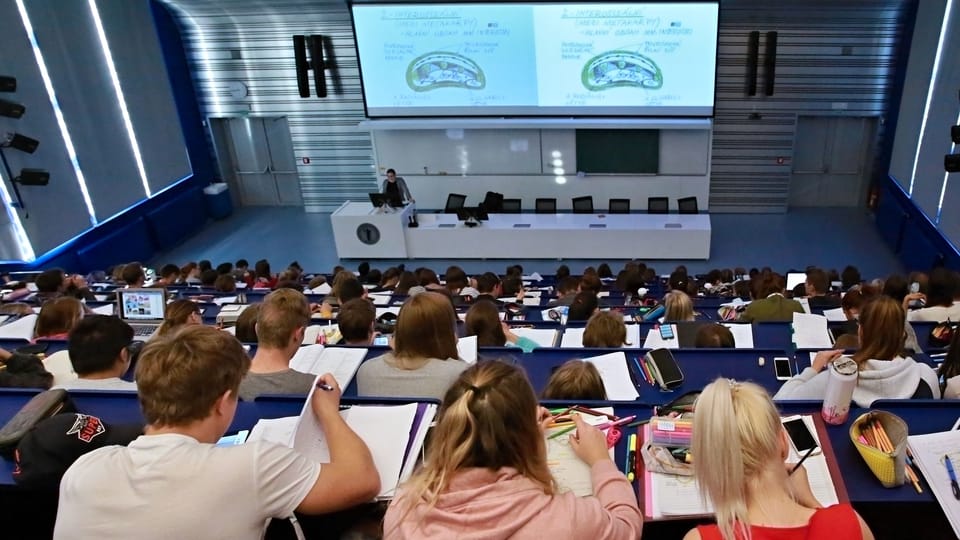
In a wide-ranging conversation for Czechast, Charles University spokesperson Jan Bumba explains how a 700-year-old institution works to stay modern and international. He reflects on his switch from journalism to academia, the realities of rankings, and the draw of studying in Prague. Bumba also acknowledges dormitory shortcomings and why improving student housing is now a key priority.
From the newsroom to the Rectorate
Charles University’s spokesperson Jan Bumba has spent just a few months in the role after a 25-year career in radio and print. In our interview, he describes why he changed paths, how the university balances history with innovation, and where student housing still needs work. Jan says the move from journalism to a university post was driven by curiosity and the need for change — but his love for radio hasn’t faded:

“It’s new and I’m still learning after these three-plus months, so it’s hard to sum up. It was a very personal decision. I’m still in love with radio — the studio, the microphone, interviews — that hasn’t changed. But I’d been in the same position for 11 years. At least from time to time, you need a sabbatical or something like that.”
Earlier in his career, he also tested the world of print at Hospodářské noviny — and the contrast with radio shaped his view of media work:
“I wanted to experience something new. I started in radio and thought it would be a good idea to try something different, so I went to the newspaper Hospodářské noviny (the Economic Daily). It was a very useful experience — one I’d recommend. I believe it’s healthy to change positions from time to time. The main difference was the rhythm. Print is much slower, while radio moves quickly. On the other hand, in print you spend more time on a single topic, do more research, and the work feels more meticulous.”
Beyond Prague: size, scope, and international links

With 17 faculties and more than 50,000 students, Charles University stretches beyond Prague into Hradec Králové (medicine and pharmacy) and Plzeň (medicine). Bumba stresses that internationalisation — from Erasmus exchanges to partnerships with Sorbonne and Heidelberg — is key to both research and teaching.
Rankings, he notes, can be misleading because methodologies vary widely and include criteria not directly related to teaching or research. What matters most, he says, is keeping the university a living institution that students and academics genuinely want to join.
The dorm reality: enough beds, mixed quality
Prague’s appeal is unquestioned, but housing remains a pressure point. Bumba is candid about both capacity and quality:

“It’s an area that needs attention. There are generally enough beds, and applicants usually get a place. But some dorms are quite basic. The university is aware of this; many people are working hard to improve conditions, and modernization is underway. To be honest, a colleague who works with international students told me that about 90% of complaints are about dormitories. Almost no one complains about the studies — students are very satisfied academically — but housing can be a struggle.”
Why study at Charles?
Bumba’s pitch to parents and students abroad is straightforward: breadth of programmes across 17 faculties, top-level research in several fields, and the chance to live in one of Europe’s great cities — or in two smaller, quieter university towns. Add EU mobility and Erasmus options, and the university aims to make the oldest also one of the most forward-looking in Central Europe.

Charles University (quick facts)
- Established: 26 January 1347 (papal bull); most Czech sources cite 1348 as the founding year
- Faculties & locations: 17 faculties across Prague, Hradec Králové (medicine, pharmacy) and Plzeň (medicine); urban, multi-site campus model
- Size: over 51,000 students (32,000 undergrad; more than 9,000 postgrad; 7,500 doctoral); 4,000 academic staff; 4,000 administrative staff
- Alliances & affiliations: 4EU+ European University Alliance, Coimbra Group, EUA, Europaeum, UNICA; extensive Erasmus and global partnerships
- Rankings (snapshot): QS World =265 (2026); THE 401–500 (2024); ARWU 301–400 (2023); QS Europe 79 (2025); consistently #1 in Czechia across major tables
- Historic milestones: Medieval university (opened 1349) → Charles-Ferdinand University (1654) → split into Czech & German universities (1882) → present-day university since 1945; ceremonial center at Karolinum in Prague
Related
-

-

The five best universities in Czechia
Why is Czechia a good choice to study? Will you get a high quality education? Is the study program available in English? Find out in a new mini-series on Radio Prague Int.
about programme
Czechast, Radio Prague International
Czechast is a regular RPI podcast about Czech and Moravian culture, history, and economy.






