Czech military must prepare for prolonged war, but lacks the funding, says former army chief

The Czech government is due to discuss a new military development strategy looking ahead to 2040, which identifies Russia as a major security threat and calls for substantial improvements in the country's defence capabilities. But former chief of the Czech general staff Jiří Šedivý (now CEVRO University) warns that planned funding will not be sufficient to meet those ambitions. Speaking to Czech Radio, he said years of underinvestment have left the armed forces struggling to meet NATO requirements and prepare for a prolonged military conflict.
A more dangerous security environment
The updated Concept for the Development of the Czech Armed Forces to 2040 reflects what military planners describe as a deteriorating security environment and a growing risk of armed conflict involving NATO countries. The document, which the government is due to consider on Monday, November 2, identifies Russia as a direct threat to Czech security. According to former chief of the Czech general staff Jiří Šedivý, this assessment is justified by developments over the past decade. "Russia's aggressiveness has been increasing year after year and effectively culminated in its aggression against Ukraine. So I think describing Russia as our principal enemy is entirely appropriate," he told Czech Radio.
READ ALSO

Šedivý said the need to strengthen NATO's eastern flank had been recognised for years, but Russia's actions had made the threat much more immediate. The consequences for Czech military planning are considerable. The armed forces must now prepare not only for limited operations but also for a prolonged, high-intensity conflict. "This means, for example, that the Czech Armed Forces must prepare for a very intense conflict that will last for an extended period, and in which nuclear weapons or other weapons of mass destruction might also be used. That was not stated so explicitly in the past," Šedivý said. Such a scenario would require more soldiers, a different organisational structure and substantially larger stocks of ammunition and other military supplies.
Czechia falling behind its allies
The new strategy sets ambitious goals for military modernisation. These include completing a heavy mechanised brigade, beginning the modernisation of a medium brigade, strengthening air defences and improving command-and-control systems. It also raises the target for professional soldiers to at least 32,000 by 2030, compared with 30,000 under the previous strategy. The active reserve is expected to expand to 15,000 personnel after 2030.
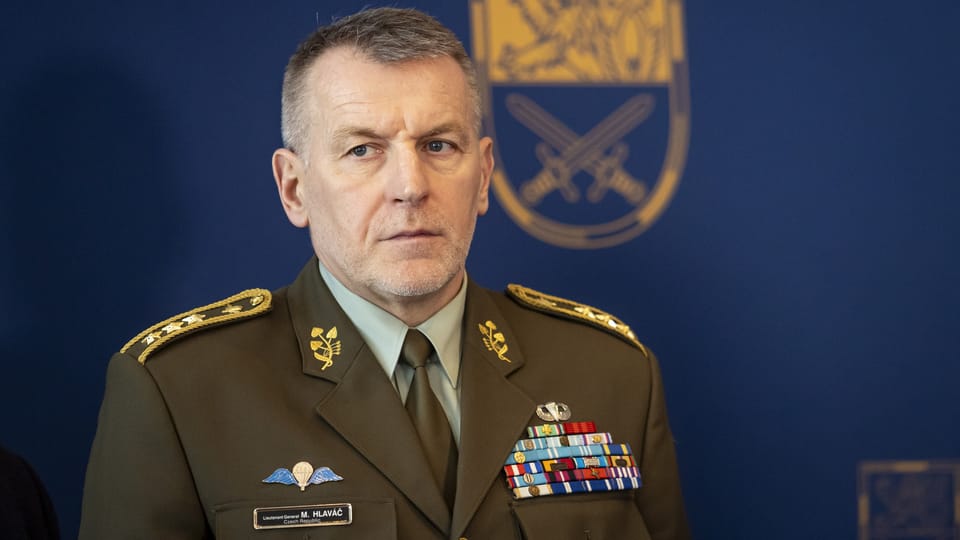
But the Czech army faces significant shortfalls in meeting NATO capability requirements. Figures cited during the interview suggest that as much as 70 percent of the required capability development remains unfulfilled, while some areas are five to ten years behind schedule. Šedivý believes that if a major military confrontation became imminent, Czech politicians would probably reconsider their approach to defence spending. Without such a change, however, Czechia could find itself playing only a supporting role within NATO. "But if the situation remained as it is, we would effectively be an army, or a country, that would always merely supplement the capacities and capabilities of others," he warned.
Among the most serious shortcomings, Šedivý identified underfunded ground forces, insufficient mobilisation capabilities and a lack of military infrastructure. Numerous barracks, training grounds and other facilities were abandoned or dismantled during previous decades. The military also needs to invest in unmanned systems and protection against drones, technologies whose importance has become particularly evident during the war in Ukraine.
Defence funding remains the biggest obstacle
The proposed strategy envisages defence ministry spending of at least two percent of GDP through 2029, followed by a gradual increase to 3.5 percent by 2035. However, until 2030, much of the available funding will be committed to existing procurement contracts, particularly for combat aircraft, air defence and the heavy mechanised brigade. The strategy acknowledges that this will limit progress in other areas. The heavy brigade, previously expected to be completed by 2030, is now scheduled to achieve full operational capability between 2031 and 2035.

For Šedivý, the central problem is that the military needs substantial investment immediately, rather than gradual increases over the coming decade. "That is the biggest problem. With spending at two percent and then increasing by just a tenth of a percentage point or so each year, those budgets are not sufficient to cover the enormous shortfall that has accumulated in the army's development over many years," he said.
He stressed that responsibility for the situation extends across successive Czech governments, regardless of their political orientation. For many years, politicians gave priority to other areas of public spending at a time when an immediate military threat appeared unlikely. Russia's actions against Ukraine in 2014 and its full-scale invasion in 2022 fundamentally changed that calculation.
Ammunition shortages and long delivery times
Another serious concern is the availability of ammunition and other essential military supplies. According to the new strategy, existing stocks of certain categories of military equipment and ammunition would be sufficient for only a few days of combat. Replenishing these supplies is becoming increasingly difficult because many NATO countries are attempting to expand their military stockpiles simultaneously, while Ukraine continues to require large quantities of ammunition and air-defence missiles.

"Even though defence industry companies are working on this, delivery times are extremely long because demand is so high, coming from practically every NATO country," Šedivý explained. "The idea that we could decide this year to purchase missiles for air-defence systems and receive them next year is completely unrealistic."
The new strategy therefore presents the Czech government with a difficult challenge: preparing the country for an increasingly demanding security environment while addressing military shortcomings that have accumulated over decades. For Šedivý, the question is whether the political commitment and financial resources will be sufficient to turn those plans into actual military capabilities.