Rare 2,000-year-old Celtic bronze duck found along ancient Amber Road

A miniature Celtic bronze figurine of a duck more than 2,000 years old has been discovered in a field near the village of Tučín (Olomouc Region) by an amateur archeologist. The figurine was unearthed along the route of the Amber Road, the ancient trade route linking northern and southern Europe.
Amateur archaeologist and collaborator of the Museum of Comenius in Přerov Miroslav Komínek has made most of his discoveries with the help of a metal detector. The little bronze duck, measuring just over two centimetres in length, caught his eye without one.
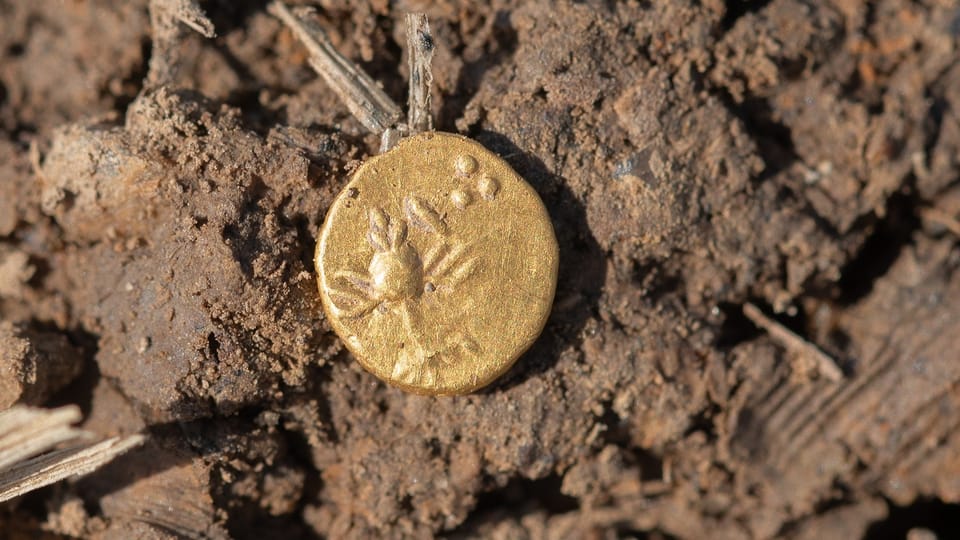
"It was partly a matter of chance. The little duck was lying on the surface, so it was clearly visible even to the naked eye. I'm happy with every find, but this figurine is simply delightful," he told Czech Radio.
Archaeologist Zdeněk Schenk says the miniature sculpture is remarkably well preserved.
"It is indeed a Celtic bronze animal figurine beautifully executed. The miniature is 23 millimetres long and weighs just under ten grams. It has bulging eyes and an elongated beak ending in a distinctive widening. At the end of its teardrop-shaped body are engraved grooves symbolically representing tail feathers. It is one of the finest examples of this type of bronze animal figurine found in the Moravian Gate region." Schenk said.

Similar finds have been unearthed in the past along the legendary Amber Road stretching from Poland through central Moravia to Lower Austria.
These objects, most commonly made of fired clay or bronze, served prehistoric communities as amulets or ritual items. They depicted animals such as horses, wild boars, bulls or water birds. Other clay and bronze animal figurines have been found in these areas, including the well-known bronze sculpture of a bull from the burial site at Brno-Obřany.

This latest find of the little bronze duck is being studied and experts are divided over the object's original purpose.
"It may have been a symbolic object, perhaps even a toy. Most often, however, these figurines formed part of a larger object, to which they were attached," Schenk explained.
The bronze duck, together with other discoveries from the Tučín area—including a Roman silver denarius—will be presented to the public on a new educational trail that the village plans to open later this summer.
Related
-

Olomouc Region
This region’s assets include the university town of Olomouc, the fairytale landscape of Bouzov, the spa Karlova Studánka with the cleanest air in Central Europe.
-

Exhibition highlights South Bohemia’s Celtic past
A new exhibition highlighting the Celtic history of South Bohemia is currently underway in the South Bohemian Museum in České Budějovice.






