Archaeologists uncover hundreds of Celtic coins and jewellery in western Bohemia
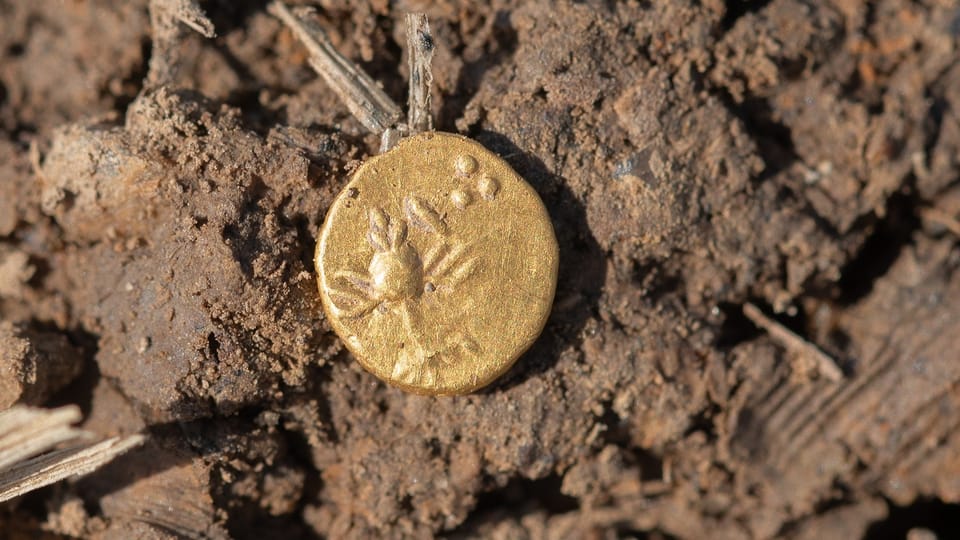
Archaeologists in western Bohemia have announced a remarkable discovery: around 500 gold and silver Celtic coins, along with gold and bronze jewellery, dating from the 6th to the 1st century B.C. The find is considered extraordinary not only in the Czech context but also on a Central European scale.

The first clue came in 2021, when an amateur archaeologist using a metal detector unearthed a fragment of a golden coin from the 2nd century B.C. in a field in the Pilsen region and reported it to the authorities.
Because such coins are rarely found in this area, the discovery immediately drew attention and prompted a detailed survey of the site, says Pavel Kodera, head of the Museum and Gallery of the Northern Pilsen Region in Mariánská Týnice.

“It turned out that the site contains a large number of primarily small metal objects, very interesting artefacts, mostly coins but not only coins. There are gold ingots, small chopped pieces, even raw gold in flakes and lumps. Other finds include gold earrings, fragments of bracelets, and similar items.
“What is particularly remarkable is that the site is spread across a field that has been cultivated for centuries and continues to be cultivated today. Research is therefore dictated by the agricultural cycle of the farmers managing the land and could only take place after the harvest, before the field is sown again.”

Although the coins are tiny—most measure between 7 millimetres and 1.5 centimetres—their images are striking, says Mr. Kodera:
“The images are essentially works of art. Their interpretation touches on mythology and Celtic thought, providing a glimpse into the mind-set of the people living here at the time. What can be safely identified are depictions of horses, boars, the sun, and symbols of Celtic deities. Many of the coins were modelled after Hellenistic coins, so some show portraits inspired by Greek coins.”

While Celtic settlements have been identified elsewhere in Czechia, many of those sites were plundered over the centuries, leaving archaeologists with only fragments. This site has remained intact, and its location is kept secret. That makes it exceptional not just in Czechia but also in Central Europe, says Mr. Kodera.
“Essentially, it is a place where Celtic civilization operated over a very long period—several centuries—but we do not know exactly how. We don’t know whether it was permanently settled; there were practically no settlement structures found that would indicate permanent habitation.

“We don’t know whether people visited once a year or several times a year for trade, religious purposes, or both, or if it functioned regularly, for example as a daily marketplace. Evidence suggesting a marketplace includes the presence of the coins, which were apparently handled, lost, or possibly offered as part of a ritual.”
Local archaeologists are now working with experts from the Archaeological Institute of the Czech Academy of Sciences in Prague. Using modern isotope methods, they hope to determine whether the gold was of local origin or brought in from distant markets.
Part of the treasure is currently on display at the Museum and Gallery of the Northern Pilsen Region in Mariánská Týnice, in an exhibition titled Unclear Report on the Celts in Northern Pilsen.