Voices of Dead Languages: Jan Bičovský on bringing ancient languages back to life

What did languages that disappeared centuries, or even thousands of years ago, actually sound like? That is the question linguists at the Faculty of Arts of Charles University in Prague are trying to answer. In the Voices of Dead Languages project, they have reconstructed how several ancient languages may have been spoken, including Old English, the language of the epic poem Beowulf. To bring these voices closer to modern audiences, the team also used artificial intelligence to generate faces for the speakers presenting the reconstructed languages.
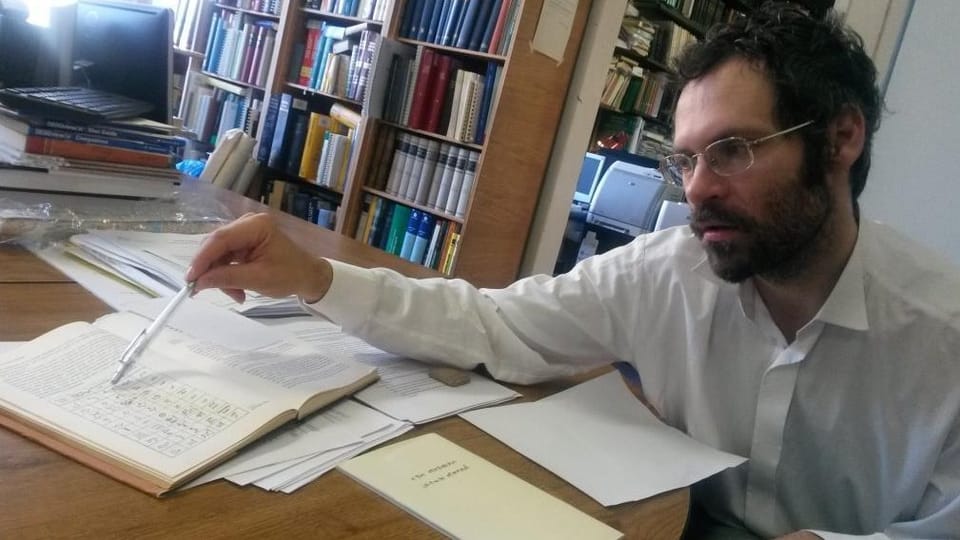
I spoke with Jan Bičovský, a historical linguist at Charles University and one of the project’s initiators, and began by asking him what gave him the idea to start the project The Voices of Dead Languages.
"Well, the enterprise of finding out how those languages sounded is really something hundreds of years old. People were trying to figure out what the original pronunciation of Latin was centuries ago.
“We just wanted to spread the news that this is a fascinating topic to work on and that actually we do have specialists on that right here in Prague.”
"So the idea was rather that you have those subjects mostly studied at our faculty, where you have people dealing with Ancient Greek and Sanskrit and all those interesting little languages. And we just wanted to spread the news that this is a fascinating topic to work on. And that actually we do have specialists on that right here in Prague.
"It really started with attempts to bring alive certain ancient texts from different languages, which in some cases is easier than in others. For example, you have people who are basically able to read Old English without a problem at our faculty. But then you have languages that have not really been much read aloud simply because the tradition died out.

"So there is a great difference between, say, Old English, with modern English still being spoken and a continuous tradition since then, and languages like Akkadian, Babylonian, or Hittite, where we simply do not know. Then you have languages like Old Chinese, where it is very difficult to figure out what the pronunciation might have been.
"So that was the idea. And then a colleague of mine thought, why not use AI to put faces on that? At first it was just the recordings, and then the faces. That made it even more interesting for people, to see the AI impression of Socrates, Plato, or Homer."
Could you take us through the process of reconstructing a language? What kind of evidence or sources do you rely on?
"Well, we rely on texts, obviously. Those are in different writing systems, from different periods, different genres, and so on. It is a very complex situation, much like today's situation with Czech. There are so many different ways Czech is written down.
"Frequently what survives is maybe one percent of everything that once existed, and that survival is mostly due to chance. So we work with chance material.
“The important thing is that languages do not evolve in a random fashion from generation to generation. They remain similar in many respects, although not exactly the same.”
"The important thing is that languages do not evolve in a random fashion from generation to generation. They remain similar in many respects, although not exactly the same. You know that your grandma probably does not speak exactly the same as you do, and people always complain that younger people mispronounce things. But that is language change, not wrong habits.
"So we can rely on that. Languages that are related, like English and German, or Czech and Slovak, or French, Italian, and Spanish, show regular similarities. If you compare them, you can see patterns. That is what allows you, when you speak Italian, to recognize Spanish as something like a strange kind of Italian.
"This ability is actually built into our brains. Linguists simply make a more sophisticated use of that basic instinct. We have methods that allow us not to jump to conclusions."
You made recordings of reconstructed languages. Which languages were they?

"Well, I cannot really remember all of them. I think there were around twenty languages in total. Old High German, Old English, Gothic, which is the earliest Germanic language, obviously Latin and Greek, Old Church Slavonic, Akkadian, the language of Babylon and Mesopotamia.
"We also did Old Chinese, I think, and several others. Some of them are really reconstructed in the sense that we have no access not only to living speakers, obviously, but not even to descendants in linguistic terms.
"So with Akkadian, for example, the language is completely reconstructed. But with Latin, even though we do not have Caesar (or rather Kaisar, as he was probably pronounced), we still have to rely on the evidence of the period, our intuitions, and linguistic typology.

"Latin is actually reconstructed in many aspects as well. You have to study the grammar to figure out what the grammar is. With Czech or English you do not have to do that to the same extent, you can simply ask someone on the street what the plural form of something is."
Which of the languages did you personally record?
"I think I recorded Ancient Greek because someone else was not available at the moment, although we do have specialists for it. I also recorded Vedic and Avestan, and I did a sort of reconstruction of Proto-Indo-European.
"I do not think that one has a face in the collection, though. After all, we do not know what Proto-Indo-Europeans looked like. They themselves are reconstructed. So it was partly a bit of a joke, to see how far we could go with this."
Do you remember any of the texts you read?
"I read the beginning of the Odyssey. Anyone hearing it would probably disagree on many points, because it is a metric text. It is meant to be sung, really, and I cannot reproduce it exactly the way it would have been performed.
"I was actually quite surprised to discover that Boris Johnson can recite Homer from memory, not just a few lines, but long passages. And he performs them almost like a drama, with Achilles and Agamemnon quarrelling over a woman. That was quite interesting. We do not really have politicians like that here…"
When we hear these recordings, how close are they to what the language really sounded like?
"We do not know. Those languages did not exist at a single moment in time. Is the Latin we reconstruct the Latin of Caesar’s time? Earlier? Later?
"And would every speaker of Latin have spoken exactly the same way? Obviously not. Our belief is simply that what we reconstruct would have been recognized as the language.

"But there are things like intonation, which are very important in learning any language. If you have the wrong intonation in English, even if your pronunciation is correct, you will immediately be recognized as a foreigner.
"We do not know what the intonation of Latin was. That is not something you find in the texts. The same goes for things like speed. Some languages are spoken very fast, modern Greek, for example. So there are many small details that we simply do not know and probably never will know."
You also created AI-generated images of the speakers. How accurate are those?
"First of all, it was not my work. It was done by a colleague of mine. And there was really very little concern for historical accuracy. I think it was basically a matter of asking the AI: give us the best you have.
"So of course any historian or archaeologist would say that there is no way that person looked like that or wore that kind of hat. But it is meant for the public.
"The point is that you can show something that may be wrong on several levels, but once you get people interested, you can invite them in and say: you can also help make it right. You can participate in the project."
The project is part of the Library of Languages platform, which aims to raise awareness of smaller languages and support their study. How many of these languages can people study at Charles University today?
"As separate study programs there would be dozens of them. But you also have many specialists who focus on particular languages.
"If someone is really interested, they would certainly be happy to help you learn it. For example, we have people who teach Arabic, but they can also explain how Moroccan Arabic sounds compared with Iraqi Arabic.
"You also have scholars who know Ancient Greek but can explain how Koine Greek in the first century would have sounded, or how Byzantine Greek developed later.
"So altogether there are probably dozens more languages that people here could teach or speak about. You might not be able to enrol in a full degree program for every one of them, but within specialized courses you can learn them."
Can you tell us more about the Library of Languages platform?
"It began as a way to raise awareness that the Faculty of Arts actually had more languages taught at one point than Harvard University. We thought that was something worth talking about more openly. So we asked ourselves how we could spread the news.
"The idea was to create a platform called the Library of Languages, suggesting that you could come here and explore languages almost like books in a library. We started organizing festivals and activities around languages, especially for the European Day of Languages, but also other events.

"Still, we hope to do more with it in the future, because it is not only dead or dying languages that are interesting. Living languages are fascinating as well.
"Unfortunately, the school system, here and elsewhere, does not always support the natural curiosity that children have about languages. We want to show people that language is something fundamental to being human, and that it is worth paying attention to."
Do you think Czech could one day face extinction like the languages you study?
"For Czech to disappear, something drastic would have to happen, some strong political or cultural pressure causing people to shift to another language. Something like that almost happened two hundred years ago, so it is not impossible.
"But if the question is whether Czech might become a dead language the way Latin is sometimes called dead, then that is a different matter. Latin is not really dead. It lives on in the Romance languages.
"So the real question would be whether modern Czech might be considered a dead language in a thousand years, when linguists of the future look back at it the way we look at medieval languages today."
Are you planning a similar project reconstructing how Czech sounded centuries ago?
"Yes, we would like to do that. I think part of the reason some politicians can easily manipulate ideas about cultural identity is that people do not always have a strong awareness of where they come from or how similar they actually are to others.
“That is an ongoing project called the Faculty of Arts. So one of the goals of the Faculty of Arts is to teach people about culture and history, and to encourage curiosity about them.
"It would certainly be fun to hear someone like Jan Hus speaking in his version of Czech. That kind of time travel could help children understand how people lived in the past.
“Of course languages continue to change. Things that we consider mistakes today might become interesting features for linguists in the future.”
"But of course languages continue to change. Things that we consider mistakes today might become interesting features for linguists in the future."
As a linguist, are you worried about how Czech children speak today?
"Certainly not. If I were a purist, that would not be the linguist part of me speaking; it would be the Czech national identity part of me. I'm not worried. The bad standards of today's kids will become the highest standards of educated people in a hundred years. The standard of modern Czech that we consider the best we have today would have been looked upon and frowned upon by speakers 300 years ago.
"It's an ongoing process that actually means the language is alive. And yes, they're borrowing words from English, just as they were borrowing words from German and other languages before. If you opened a page of Czech text from even the best writers, like Čapek, and asked people to tell you which of the words are really Czech or Slavic, they wouldn't have any idea.
"Take the word muset, “must,” in Czech. That's a borrowing from Germanic. Děkuji, “thank you,” that's a borrowing too. There are so many borrowings that we simply don't recognize as borrowings anymore.
"And of course, some of the very fashionable words that kids are using today will be gone within a generation, because some other new fantastic expressions will replace them. So, you know, this is happening in every language at any point in time. And it's very interesting for a linguist to watch that happen.
"If you approach it with an open mind, and you don't feel threatened in your identity, as many people perhaps do, you'll see it's a fascinating thing evolving right in front of your eyes."
Related
-

Czech-developed computer translator CUBBITT “reaching quality of human professionals”
A team of scientists from Charles University and the University of Oxford have developed a new computer translation programme called CUBBITT.










