Unprecedented blow-up in Czech politics: President versus foreign minister
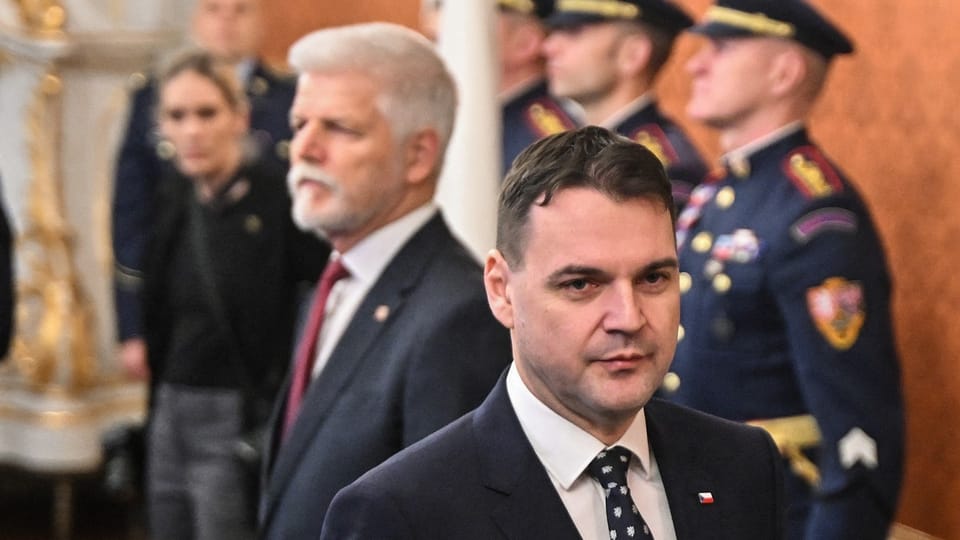
Growing tensions between the Czech president and foreign minister erupted into a massive row on Tuesday, when President Pavel accused Minister Macinka of political blackmail, while the latter said the head of state was violating the constitutional order. The prime minister has called for calm.
The storm broke when President Pavel called an impromptu press briefing to report an attempt to blackmail him by the country’s foreign minister and head of the Motorists’ party Petr Macinka. Mr. Pavel said that, after resisting long-term pressure to appoint Filip Turek environment minister, he had received text messages, via his advisor, from Foreign Minister Petr Macinka, which he described as “extremely serious” and which in his view constituted an attempt at blackmail. Pavel said that given the gravity of the situation he had decided to publish the correspondence in full.

“Last night I received two text messages written by the foreign minister, the contents of which I consider to be extremely serious. Therefore, I have decided to publish them in full. I view the text messages as an attempt at blackmail. I find this unacceptable and absolutely intolerable in our democratic conditions.”
The text messages released were sent by Petr Macinka late on Monday night to the president’s adviser Petr Kolář. In the messages, Macinka says that if the president fails to appoint Turek environment minister, the decision would have serious consequences.
“I understand that the president will not allow himself to be blackmailed, but politics is about compromise, if one wants to have any influence. Either everything will be possible, or nothing will be possible. All it takes is one signature…,” Macinka says in one of the text messages, adding that the president’s time to turn the tide would “run out on Wednesday”.
The minister mentions an upcoming trip to Brussels saying that he “needs to know where he stands” and if his request for Turek’s appointment is not granted he would act accordingly. He moreover indicates that he has the backing of the prime minister and his other coalition partner SPD in this matter.

At a press briefing of his own later in the day, Foreign Minister Macinka explained what “consequences” he had in mind. He said that on the mentioned trip to Brussels, he would speak with NATO Secretary General Mark Rutte to inform him that the Czech delegation at the July NATO summit would not be led by President Petr Pavel, but by Prime Minister Andrej Babiš.
Mr. Macinka said that he does not consider the communication with Prague Castle as blackmail, but as a legitimate means of political negotiation.
“My position is based on the fact that the president is acting outside of the constitutional framework through his approach to the appointment of the government. He has also shown contempt for the will of the Chamber of Deputies, which I feel the need to defend. In view of this, I believe that at the upcoming NATO summit, our country should not be represented by the president, but by the prime minister.”
Asked whether the prime minister was aware of the content of the text messages he had sent, Mr. Macinka said that that was not the case.

The affair caused a hue and cry in Parliament, where the opposition parties spoke of “mafia-style political practices” and called for Macinka’s immediate dismissal from the government. They demanded to know if Prime Minister Babiš and the Motorists other coalition partner –the SPD, were aware of the pressure that was being exerted on the president and called for the government to denounce such practices.
Clearly unhappy about the scandal, Prime Minister Andrej Babiš told reporters that Mr. Macinka’s style of communication in the said text messages was “unfortunate” but he did not consider it to be blackmail. He called for calm, saying emotions needed to subside for normal communication to be restored between the government and president. And he invited the two officials to the negotiating table. The president’s spokesman issued a statement saying the head of state would only meet with the prime minister.
Under Czech law, the country’s foreign policy line is fundamentally determined by the government and coordinated with the head of state, who is the chief commander of the country’s armed forces. To what extent that cooperation can be renewed –if at all- remains unclear.
Speaking to reporters, the president said that he would not be intimidated. “I will continue to be guided first and foremost by the constitution and the best interests of the Czech Republic,” he said, adding that he had reported the matter to the police and had submitted the messages to lawyers to assess whether they constitute the criminal offense of blackmail.