“Rybovka” across generations: the traditional Czech Christmas Mass and the Jan Neruda Grammar School choir

Nothing brings you into the Czech Christmas spirit quite like the Rybovka — at least according to members of the Jan Neruda Grammar School choir in Prague. Despite its name — “ryba” means “fish” in Czech — the Rybovka has nothing to do with fish. Instead, it is a piece of music named after its composer, Jakub Jan Ryba, who in the 18th century wrote a Christmas Mass that is still sung across Czechia every year.
The enthusiasm the Rybovka continues to inspire was palpable during this year’s performance by the Jan Neruda Grammar School choir at Prague’s Rudolfinum concert hall. The choir is a special ensemble that operates year-round and each Christmas brings together generations of current students and alumni to sing the Rybovka, formally titled Česká mše vánoční (Czech Christmas Mass). Composed in 1796, it is now almost 230 years old. Choir conductor Petr Bärtl offered his view on why the Rybovka has become such a powerful symbol of Christmas:

“In my opinion, it is precisely this strong tradition, passed down from generation to generation since its origin at the end of the 18th century, that has carried it through to the present day. It has become a symbol of Czech Christmas alongside carp, the Christmas tree, and the midnight Mass, during which it is performed in most churches.”
I also asked choir members what makes the Rybovka stand out for them personally. Most agreed that performing the Mass each year signals the beginning of Christmas, encouraging them to slow down and take in the atmosphere. It allows them to spend time with friends and family. Honza, one of the choristers who has been singing with the choir for around twenty years, said:
“The piece is genius, really. It’s very traditionally linked to Christmas, and the lyrics carry some deep thoughts too. It marks the beginning of Christmas — a moment of gathering. And maybe it has more Christmas spirit than walking through busy streets where everyone is rushing. It’s a moment of calm, of coming together, celebrating, talking…”
Janek, another long-standing choir member and its manager, added:
“J. J. Ryba ended his life in a very tragic way, which stands in stark contrast to the message of the Rybovka. I think the piece is ultimately a great celebration of life.”

Indeed, although Ryba’s Christmas Mass is full of optimism and hope, his own life was often unhappy. his remarkable diligence as a composer, music was neither his primary vocation nor his main source of income; he earned his living as a schoolteacher. Of his vast output of around 1,100 works, only around half has survived, with the Rybovka overshadowing much of his other, largely unknown work.
As the father of seven children, Ryba faced serious financial hardship, as well as deteriorating physical and mental health later in life. Ultimately, the optimism of his music could not prevent him from taking his own life.
The Jan Neruda Grammar School Choir
What makes the choir’s performance of the Rybovka particularly special is that it reunites both current and former members. This year, around 130 performers shared the stage at the Rudolfinum. The choir, which has existed for some 30 years, has built a substantial alumni network and has become what it describes as a “multi-generational family.” Max, a new member who is still a student, described the experience of joining such an ensemble:
READ ALSO
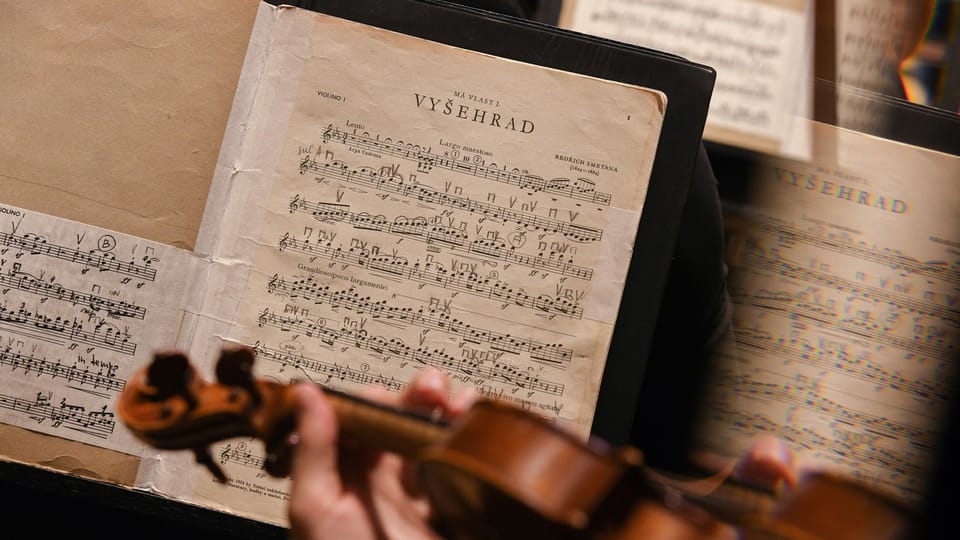
“It’s really about adapting — not just to new music, but to new people. Not everyone is the same age; most of the singers are adults with their own lives and jobs. It’s a completely new group to interact with. Being intergenerational has many benefits — older singers bring deeper voices, but the whole community is more diverse, which gives it more weight, in my opinion.”
Longer-standing members emphasised the friendships formed through music and their gratitude to Bärtl, who continues to inspire the choristers. Asked what holds the choir together in such a unique way, he replied simply:
“I’ll be very brief. It’s because we like each other and because we enjoy singing. Age doesn’t matter.”

The choir was founded in 1994 from a few classes at the Jan Neruda Grammar School, where Petr Bärtl had been teaching music since 1990. The choir quickly began giving concerts and entering competitions, with strong motivation to continue.
“I’m not sure how far it has progressed exactly, but I believe the original idea has been fulfilled. Over the past 30 years, more than 300 singers have been part of the choir, enriching their lives — I hope that doesn’t sound too grand. The fact that today more than 100 singers aged between 15 and 40 stand together on stage at the Rudolfinum for the Rybovka speaks for itself,” Bärtl commented.

The tradition of singing the Rybovka at the school dates back to the late 1960s. Under Bärtl’s baton, the choir performed it for the first time in 1995 at St Nicholas Church in Prague’s Lesser Town — the very district where the school, one of Czechia’s oldest grammar schools, is located. Since then, performances have taken place in various venues, including the Rudolfinum — first in 2015 and, including this year, six times in total. Bärtl explained the significance of the venue:
"Performing in the Rudolfinum is, of course, an extraordinary experience, difficult to describe. It's a hall where top musicians and conductors from around the world perform. It is the home of the Czech Philharmonic, our famous orchestra. So the atmosphere of the place certainly elevates both the performers and the audience."
The Rybovka itself
So what does this symbol of Czech Christmas actually sound like? Alongside the choir, the performance includes an orchestra — in this case, made up of alumni of the Jan Neruda Grammar School — an organ, and four soloists.

In terms of structure, the Czech Christmas Mass retains most of the attributes of a Latin Mass - for example, it is divided into nine parts, many bearing the traditional names of the Mass ordinary (Kyrie, Gloria, Sanctus, Agnus Dei, and so on). Yet, the text and musical setting give it more the character of a Christmas Nativity play. Bärtl explains:
“Its content resembles a folk nativity set to music, telling in Czech the story of shepherds going to greet and bow before the newborn Jesus. Ryba drew inspiration from Czech folk carols and transformed it masterfully into the artistic language of the Classical style. The fresh melodies, energetic, often dance-like rhythms, transparent harmonies, and heartfelt expression — especially in the lyrical passages — make it a unique and timeless musical gem.”

Playful yet devotional, the work’s lyrics range from passages of religious devotion (such as Agnus Dei, with the line “we now commend ourselves to Your protection”) to charming exchanges between the choir and soloists about who will bring which instruments and gifts to baby Jesus' crib (such as in Credo or Communio).
What particularly set this year's concert apart for many was the organ-accompanied performance of Narodil se Kristus Pán (Christ is Born), a Czech Christmas carol sung at the very end, when the entire Rudolfinum rises to its feet. Choir member Janko described its place in Czech Christmas tradition:
“It’s a Czech classic — almost like a national anthem. Everybody stands. It’s a Christmas hit, something like All I Want for Christmas in America.”
The carol, however, has been sung in the Czech lands long before Mariah Carey’s 1994 hit, as it likely dates back to the 15th century.
Sadly, this may be the Jan Neruda Grammar School Choir’s final Christmas performance of the Rybovka with Petr Bärtl as its conductor. He plans to retire at the end of the next school year and reflecting on this, he said:
“I feel joy, and nostalgia — but also hope that singing and our friendships will continue. If a new choir is formed at our school, I would wish it what ours has had: unity, enthusiasm, patience, and joy in music.”
To hear Ryba’s Christmas classic and learn more about the choir, you can listen to the full feature.
Related
-

Czech Christmas
Radio Prague International has prepared a selection of articles on Christmas traditions for you.