Petra Kupská, the Entrepreneur Teaching the World How to Cook Like Czechs

Petra Kupská is an entrepreneurial Czech mum-of-two from the northern Czech town of Chrastava near the Polish-German tripoint. Her English-language website, Cook Like Czechs, has become a hit for many people around the world interested in Czech cuisine, particularly those with Czech roots.
“One of the best Czech summer foods are these fruit dumplings. I made these dumplings with wild blueberries that I picked earlier in the forest. Now for a little instruction..!”

Cook Like Czechs is a treasure trove of information on Czech cuisine. It offers dozens of recipes in English – conveniently broken down into categories such as mains, desserts, soups and appetizers – as well as video clips illustrating the cooking process.
It’s a family effort, and the brainchild of Petra Kupská, a fifty-year-old mother of two ravenous teenage sons. Back in 2022, during the covid pandemic, Petra had a lockdown-inspired brainstorm – to bring Czech cuisine to the world. I met up with the entrepreneur at her home near the northern city of Liberec. She recalled the impact of the lockdown:
“Restaurants were closed, and we needed to eat. And I had two teenagers at home, which meant that I was in the kitchen almost from morning to evening anyway. And what to do? Because I had to cook at home anyway, I devised a family project with my sons, especially my eldest son (Honza), and said I would cook Czech food, and my son will translate the recipes into English. I would then publish these on a website, so we created Cook Like Czechs. Initially, it was just a hobby, but then after some time – four, five, six months – people started reaching out to me. Readers started asking for recipes for specific Czech dishes.”

And so, recipe by recipe, Cook Like Czechs began to become more than a hobby. Petra ultimately decided to shift from working for her husband’s vehicle outfitting firm and focus full-time on Cook Like Czechs. But that meant a sharp learning curve for its creator:
“It is not easy. And if you saw the first pictures we posted of the food then they looked terrible [laughs]! So I took some courses in photography and I started to learn how to write a recipe that could be posted online and be useful for readers. And I also tried to add the historical backgrounds in for the dishes I was cooking. What my readers love is that I always make a short audio clip where I pronounce the names of the given foods in the Czech language.”
“Řízek with a good ‘ř’!”
“Or kuřecí řízek or vepřový řízek is even better!”
Devising, cooking, photographing, writing the recipe down – with her young son Honza helping with the translation into English – and finally publication. Hours of work per recipe.
“At the beginning, it was not like now. Because we had just a few dishes that we rotated. This then motivated me to learn more about cooking techniques, about Czech dishes, Czech history, Czech traditions and so forth.”
And what has Petra learned about Czech cuisine during the process?
READ ALSO
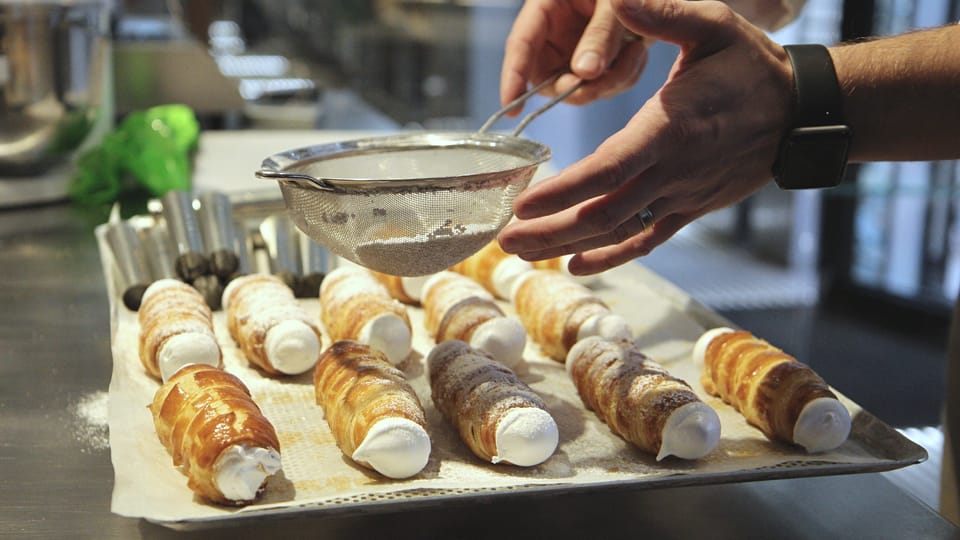
“Of course I try to publish traditional Czech recipes. But it’s not easy, because what is a traditional Czech recipe? These continue to change and evolve. And the recipes that were made one hundred or one hundred and fifty years ago were different than modern ones.”
How have they changed?
“For example, I was surprised when I first published a recipe for vánočka, the sweet braided bread made during the Christmas season. And I was surprised when people started telling me that it is not called vánočka, but houska. And there were gentle arguments on the internet about the exact name. And it turns out that really, one hundred years ago, in some regions of [today’s] Czech Republic vánočka was really called houska. And I started researching more, and discovered that vánočka is not only called ‘houska’ but also, for example ‘štedrovice’ and so on.”
Perhaps unsurprisingly, most visitors to Cook Like Czechs come from the United States, as Petra’s son recalled:

Honza: “They are usually descendants of Czech immigrants, second and third generation.”
Petra: “I did some research and about 65 percent of visitors to the site are from the States. And then there are Canadians, some people from Britain, Australia and from the rest of the world. And they are used to the dishes that their grandparents used to cook. It’s very funny because they write to me for recipes and I have to guess what recipe they mean.”
What are the most popular dishes?
“Among the most beloved dishes on my website are Czech beef goulash. Dumplings, sweet dumplings, dumplings as a side dish. And because my father’s family comes from the Krkonoše region, I started cooking these dishes. But when I asked my friends if they, for example, knew hubník – a kind of mushroom bake or pudding – they didn’t know what it was. So I then started to collect the regional recipes as well. Firstly, from the Krkonoše region, where there are many dishes made with mushrooms, potatoes and cabbage – ingredients that thrive in mountain areas.”
The lesser-known regional specialties include something called Šumavská topinka, named after the mountanous southern-Bohemian region.
“A topinka is stale bread fried in a pan and then rubbed with fresh garlic. And then a Šumavská topinka is topped with scrambled eggs and grated cheese. Sometimes I buy regional cookbooks. You can’t imagine how many cookbooks I have on my bookshelf! I like learning about regional recipes, and sometimes I find them on the internet. And when the recipes are interesting, I write them down and try to cook them according to the regional methods and publish them on my website. Šumavská topinka is very popular. I was surprised! Easy to make; that’s what people want! Because not everyone is used to cooking every day. It is a simple snack and I can recommend it.”
Most videos on the site, or published via its social media channels, are simply set to music as Petra quietly prepares the given dish. But in a few, we also hear her voice – for example this guide to making fruit dumplings, which, she noted, foreigners often struggle to see as a main course:
“Now for a little instruction: once the yeast (leavened) dough has risen nicely, roll it out into a rectangle – not too thin – and cut into squares. Mix the cleaned and well-drained blueberries with a spoon-full of sugar. Place a small amount of the fruit in the centre of each dough square. Then gently roll each one into a round dumpling between your palms…”
Petra explained that Cook Like Czechs remained an ongoing project, with constant improvements to the site and recipes.
“It is definitely still evolving. And I realise that you can’t cook well in my opinion when you don’t know the basic cooking techniques. For example, how to make roux, or jíška in Czech. And many Czech sauces and soups are made using roux. Or how to prepare meat for cooking, and different techniques like frying, braising, roasting. These techniques need to be learned before you start making good food. In the spring, I plan to attend a cooking school for three months. And there I hope to gain more skills to make my food even better.”
Petra Kupská recently had a chance to find out just how much of an impact her website was having during a trip to the United States, where in places she and her son were treated like minor celebrities, even making front-page news in a local paper:

“Because this year I turned 50. And we decided to make a trip to America. And we started in Toronto, Canada before travelling to Minnesota and ending up in Washington, D.C. And we attended a Czech festival in Minnesota, called Koláčky Days. And it was so amazing, because everyone was asking about Czech koláče, which are a big thing for Czech-Americans, representing a connection with the Czech Republic.”
Fans of the site even served as guides during the family’s trip.
“It was great. Such nice people, I must say. I have a list of around 8,000 subscribers. And I asked the people who were living in the area where we wanted to go, if they wanted to meet. I got so many answers, and in each area we met people who knew me or us, and they were our guides in the city, in the area, and they showed us around the cities, and it was really very nice.”
Honza: “We had a really good guide in Minnesota – a local woman who was the daughter of the local sheriff or police officer or something. And the locals were so interested in us, not just because we were from Cook Like Czechs, but also that we were just from the Czech Republic. We went to a Czech festival there, and a lot of people wanted to take a photo with us and it was a bit overwhelming for me!”
Petra: “I would like to mention two ladies we met. This first is Míša Kotek. She is a lady originally from the Czech Republic, and is known as a Czech Minnesota-based baker in the city of Minneapolis. And the second was the lady Honza mentioned – her name is Sandy Procházka, a very American first name and a very typical Czech surname! She was also very nice and served as our guide at the Koláčky Days festival.”
Did Petra see this as a sign that second and third-generation Czech-Americans were still interested in their roots?

“Definitely, it was a huge event in Montgomery. And so many…”
Honza: “…yeah, competitions in both koláče baking and eating. And they had Czech-style beer, which wasn’t that bad! And we even went to the local newspaper for an interview, and we were sort of surprised by that.”
And this is the newspaper, here? The Montgomery Messenger, right? We can see here that you actually made the front page with the headline, “Czech Republic Baker Visits Koláčky Days.” And you are photographed there, Petra. And is that you on the left, Honza?
Honza: “Yup, that’s me.”

Ok, Petra, so we are in your kitchen and you have very kindly offered to make us a well-known Czech dish called chlebíčky, which are a kind of open-faced sandwich.
“Yes, open-faced sandwiches are very famous in the Czech Republic and many people abroad want to make them at home. I will show you the basic assembling of chlebíčky – let’s go!”
We see a cutting board with some sliced white bread.

“This is called veka. And it is similar to French baguettes. This needs to be cut into thin slices, which are first topped with potato salad.”
Prepared already in a bowl.
“Yes, it’s a potato salad made especially for chlebíčky.”
The potatoes, ham and other ingredients are diced into much smaller cubes than seen in a regular potato salad.
“There are more options for things you can put on chlebíčky, but the most traditional choice is sliced veka topped with this kind of potato salad, and then that is topped with cold slices such as ham and cheese and hard boiled eggs to make it decorative.”
The presentation is important because it has to look good.
“Exactly, because when it is open-faced, then it is important how it looks.”

And these are served at celebratory events, for example on New Year’s Eve or birthday parties…
“Yes, parties, family get-togethers, birthday celebrations. So chlebíčky are really a Czech hit!”
So will you be buttering these bread slices or not?
“No. There are different options, but this one is made with ham. If you are making chlebíčky with hard salami, then you do butter the veka bread. But this is a more festive recipe, and you use the salad as a base.”
So you are scooping on some potato salad onto an individual slice. Quite a healthy amount.
“Yes, because one or two of these is usually enough for someone! It depends how hungry you are.”
Slices of ham are now being folded into a kind of quarter and then twisted – again, decoration. There is already ham in the potato salad, and we are doubling up on the ham with real slices, too. Petra, there’s no actual set recipe for a chlebíček is there?

“No, no. It depends on your imagination. You can put almost anything you like on a chlebíček that suits your fancy. The most important thing is that it must be pleasant and attractive…”
Honza: “And enticing!”
Petra: “Yes, that is a nice word. Then I’ll place a piece of cheese, Czech eidam on it. And some thin slices of pickle [gherkin]. Because I want to create colours. And it is up to you if you put on two tomato slices and one pickle slice or two pickles and one tomato slice. And then I finish it off with a slice of hard-boiled egg.”
It’s wonderfully assembled. Almost with Japanese-style precision.
“Oh, thank you!”
And it is being topped off with a tiny bit of parsley.
“Yes, that is the final touch. So, dobrou chuť, enjoy!”
Thank you. It’s exactly how one imagines a chlebíček to taste – very rich, very juicy and a truly delicious experience!