“Putin is scared of political solidarity”: Former president of Ukraine Yushchenko on the EU's help to Ukraine and our future
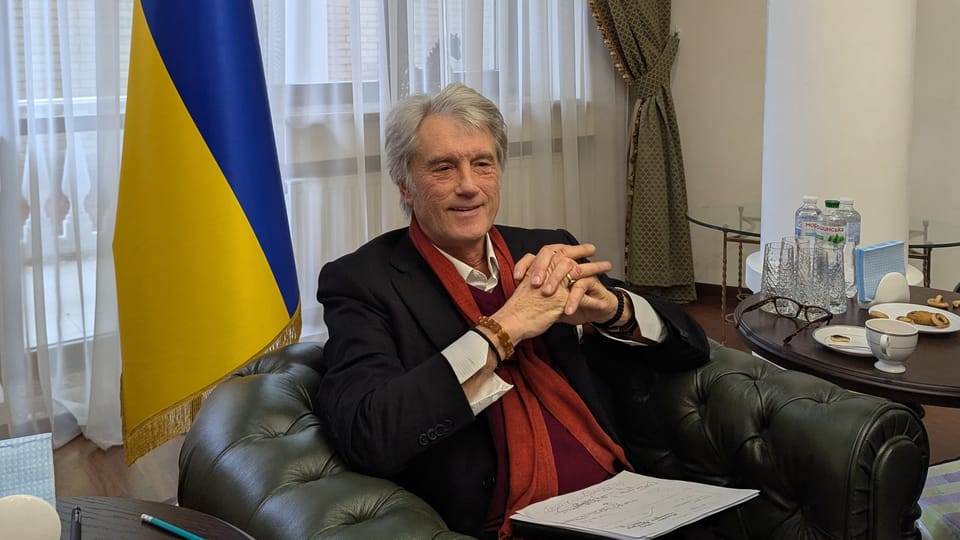
Viktor Yushchenko, who served as president of Ukraine from 2005 to 2010, was a central figure in Ukraine’s democratic trajectory. He played a key role in the Orange Revolution of late 2004, a precursor to the Maidan Revolution ten years later that fundamentally changed the country’s future. On my trip to Ukraine in early October with a group of international journalists, the former president spent three hours with us in his office discussing the country’s path since then and how Russia’s yoke over Europe’s breadbasket continues to imperil its, and our, future.
In 2004, Viktor Yushchenko was poisoned with dioxin as he campaigned to become president of Ukraine. The scars on his face from the nearly-fatal poisoning, once immediately visible, have almost entirely healed. His face is soft, and his composure calm and charismatic.

As we sat in the room, sipping the coffees and teas prepared for us, he entered and came to each of us, shaking our hands one by one. We sat in a circle on leather couches, surrounded by paintings of Ukrainian rulers, overhearing faint, distant conversations of security guards in the corridor.
What followed was a lengthy conversation on the entangled nature of conflict and history. It detailed how much the former president has thought about Russia’s relationship with the country.
A History of Oppression
Speaking to us through our translator and organiser of the trip, Taras Yatsenko, Yushchenko began with the nature of this relationship between the two countries, one that is fundamentally antagonistic:
“For us, Russia is an evil enemy that has been waging a full-scale war against Ukraine since February 24th. Putin is doing terrible things for Russia; he is leading it toward disaster. I think Russia has never gone through such a tragedy as it is experiencing today.
“This is the largest war since the end of the Second World War. I think no one in Europe or the world truly understands what the tactics and strategy for such a war should be – a war with a front line of approximately 2,300 kilometers, where hundreds of thousands of soldiers are fighting on both sides.

“In all of Europe, there are 210 military brigades, and 120 of them are Ukrainian. And I can tell you with full confidence: the best soldier is the Ukrainian soldier. Today, Ukraine is providing the strongest security defense on the European continent. That’s why when Germans, French, British, or other Europeans say that Ukraine is Europe’s most reliable bulletproof vest, I completely agree.”
For Yushchenko, the question is not whether Ukraine will win – a question most of us have forgotten to ask. He assured us that it will definitely win. The real question is whether the Putin regime will remain a part of global and European politics. Will there be nations in Europe or the world willing to build their future alongside a regime like Putin’s?
“This man kills people every single day. When we talk about Putin, we are talking about someone who commits murder daily. Morality tells us that if a person kills another person, they are a criminal. They are tried, deprived of their rights, and imprisoned. No one shakes their hand."
“Morality teaches us that if a person is a criminal who has killed someone, we cannot shake hands with them.”
The former president is used to dealing with nefarious figures. In 2004, when he was poisoned, he faced Viktor Yanukovych in the presidential election. The two figures represented diametrically opposed visions for the country.
Yushchenko represented a future intertwined with the values of the “Color Revolutions” of the early 2000s, which swept across much of post-Communist Europe. It was a vision of a Ukraine that was a member of the European Union, part of the G7, and contributing to collective defense as a member of NATO, defending itself against a revisionist eastern neighbor that saw Ukraine as integral to its empire.

His opponent, Yanukovych, who was ousted from government in 2014 and fled to Russia, represented an oligarchic vision of the country, one that depended on Russian oil, cronyist capitalism, and kleptocracy. It was this vision of Ukraine that 1.2 million Ukrainians in Kyiv alone chose to reject in 2014. Millions protested then across Ukraine, sending a strong signal to the West – and Russia – of how many thought about Russia’s yoke over the former Soviet republic.
Despite the long decades of violent opposition to the democratic vision Yushchenko espoused, the former president spoke softly. Yet there were undertones of excitement as he spoke about what must constantly occupy his mind, and the minds of many Ukrainians.
Sanctions
With that, we turned to sanctions. Many have been critical of sanctions because Russia has found ways to avert their impact in some key areas. At the Kyiv Economic Forum, which we visited the day before our time with Yushchenko, we were once again reminded of this fact. In fact, Kyrylo Budanov, Chief of the Main Directorate of Intelligence of the Ministry of Defense of Ukraine and the target of at least ten Russian assassination attempts, made this exact point at the forum the day before. Yushchenko similarly addressed this head-on:

“Well, in general, if you look at Russia’s budget over the last 15 years, every day, Putin received about one billion dollars from the Western market for energy supplies. One billion dollars. Every single day.
“Before the second general election in the United States, there were already four or five key figures leading OPEC, the group that received these payments, including from Western Europe. We’re talking about one of the richest groups in the world.
“We are speaking about Putin’s inner circle, with him at the top. According to various estimates, Russia now receives only about 30–50% of the financial resources it used to get before the war, mainly from energy exports.”
That said, Yushchenko told us it was a mistake for Putin to abandon the revenues that the European market had been paying prior to the full-scale invasion in 2022.

“I think Putin’s fatal mistake was losing the European market, the most profitable and financially reliable market in the world. Because of his policies and the ‘Putinization’ of Europe, he destroyed access to that market. The wealthiest and most stable customers were in Western Europe. Now, the main buyers of Russian energy are in Asia: about 40–45% goes to China and 30–35% to India.”
It begs the question, then, how Putin could have made such a mistake. For Yushchenko, it’s not a rational decision. We cannot think of Putin as a rational actor, he said.
“The decision that China made was essentially to provide an insurance policy to Putin: if the European market disappears, a new Asian market, led by China and India, would supposedly emerge.
“Putin mistakenly believed that leaving the European market would be immediately compensated by the Asian market. But the new Asian market is not equivalent to the one he lost. It’s not the same in size or profitability.

“Just look at the prices the Asian market pays for oil and gas. Putin built only one major gas pipeline to China (the Power of Siberia 1) with a capacity of 35 billion cubic meters per year. The price China pays is kept secret, but from what I know, it’s around $235 per 1,000 cubic meters. That’s three or four times lower than what Russia earned from Europe.”
Specifying here, Yushchenko said that Gazprom has become the company with the largest losses in Russia. So, according to the former president, sanctions don’t work as effectively as we’d like, but their impact is still noticeable. Where the sanctions mechanisms don’t work, some countries have proposed adding a ‘second level’ of sanctions, secondary sanctions, to fill the gaps.
“In any negotiation package, including those involving Putin and the US President, there will definitely be a demand not to strengthen sanctions. That’s why the sanctions mechanism remains important, but it’s far from perfect.”
Diplomacy with Putin
At the time we were visiting Ukraine, Ukrainian President Volodymyr Zelensky and US President Donald Trump were meeting. The main point of discussion was Ukraine’s need for long-range missiles, specifically Tomahawk cruise missiles, on top of the mentioned harsher sanctions.

As we traveled from meeting to meeting, we asked the many who met with us whether they were hopeful about the news. Most took a sober attitude toward any prospect of aid. At the time of the meeting, the news was not positive from Washington. As of writing, the Pentagon revisited its stance and agreed to provide Ukraine with the needed weaponry.
Before we had this news, we asked Yushchenko what he thought the outcome of the meeting would be. We all paid particular attention. But for Yushchenko, this was merely another distraction, since Putin had no desire to negotiate.
“I think that the recent conversation between Putin and Trump, maybe yesterday or the day before, brought us to another pause. It could be short or long, but it only wastes time. That’s Putin’s constant tactic: to stall. Behind these pauses, there are no honest or transparent agreements. That’s why I think these talks will lead to nothing.
“Putin’s initiatives are always just tools to waste time: to lower expectations for Ukrainian-American talks, and to weaken trust in them. That’s why, in general, I’m pessimistic about what will come out of it. All of Putin’s initiatives are malicious.”

What tied most of the conversation together with the former president is the need to achieve peace through strength. That is what, as Yushchenko said a number of times, much of the West does not understand about Putin: he doesn’t believe in democracy, diplomacy, and ceasefires; Putin understands strength, and he will only listen to strong resolutions that make war ultimately too costly to be feasible. Yushchenko with more:
“We have no doubt about how this conflict must end, through peace achieved by strength. We should not be afraid of strength, and we should not shift responsibility to diplomacy, which is powerless against such an enemy.
READ ALSO
“Therefore, we should not seek peace through a soft or gentle approach to ending the most serious conflict in Europe since the Second World War. Let’s not fool ourselves into thinking we can find an easy, delicate way to end the most aggressive war of this century. The appeasement of Putin is the wrong path. And if anyone still doubts that, we only need to look back at history: to the lessons of 1938 and the policy of appeasement.
“The big problem today is that European leaders, politicians, and officials often don’t want to make tough decisions. They try to handle things gently. This is a repeated mistake; they avoid firm, decisive action and instead attempt diplomacy or compromise, which only delays solutions.”
Yushchenko’s vision for Ukraine
In the last moments we had together, Yushchenko summarised his vision for the country. First, he said that Ukrainians “must” take back all annexed and occupied territories and restore Ukraine’s 1991 borders. Second, he said that achieving true victory requires the destruction of Putin’s regime. Third, he said that in its place, Russia must choose a democratic path and form a transparent, legally elected government.

But the biggest obstacle to these points, to Yushchenko, is indifference in Russia. He said that Putin and his enablers cultivated this indifference. In his words,
“The largest protest ever held in Russia was on Bolotnaya Square – about 10,000 people. That’s in a country that claims to have a population of 140 million. I remember in Kyiv, on Maidan, we had 1.2 million people gathered at one time – just in one city.
“So, what is Putin really afraid of? Not the army. Putin is scared of the political solidarity of millions of people. Maidan is a nightmare for him.”
As we finished our conversation with the former president, we turned to each other, surprised at how much time had passed. His final words to us were fitting for the occasion: Putin is scared of the Ukrainian people. The trip featured many of those faces, reminding us once again of the value of democracy and the resolve of those we met – and of all those they represent.
The trip to Ukraine was organized and funded by the Ukrainian news agency Your City Media Hub’s Untold Stories from Ukraine project. Our guide and translator was CEO of Your City Media Hub, Taras Yatsenko. The trip included journalists from Spain, Germany, France, and elsewhere.






