Yankele ‘Alex’ Gross: The story of an unknown Czechoslovak Holocaust survivor

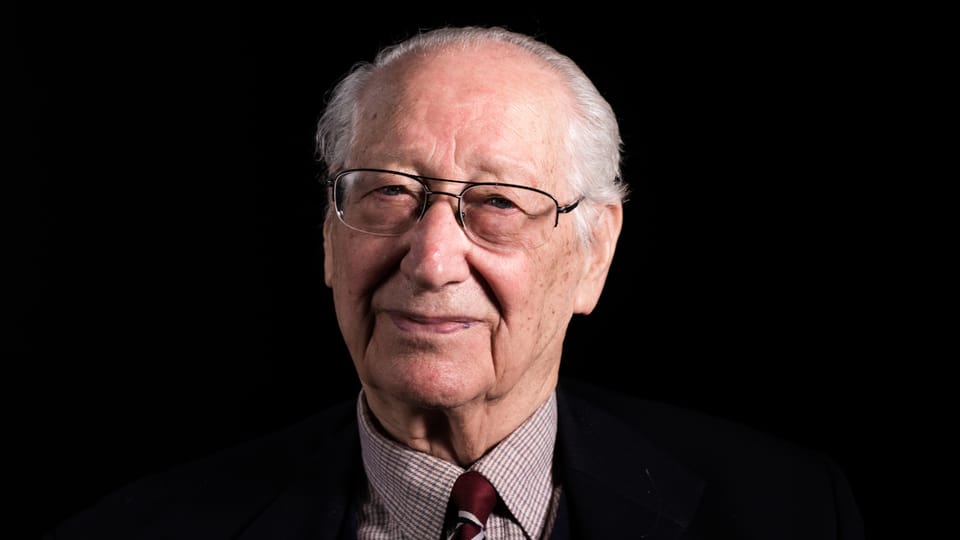
In July 2025, Yankele Gross (later known as Alex), an unknown Czechoslovak Holocaust survivor and Korean War veteran, died in the United States. He suffered through a death march and the camps of Auschwitz and Buchenwald.
Yankele Gross was born on September 18th 1928, in Palanok, a suburb of Mukachevo in Transcarpathia, at that time part of Czechoslovakia. He came from a large Jewish family, with five brothers and a younger sister. His father, Chaim Akiva Gross, was a tailor by profession, while his wife, Ettela (née Lebovitz) was a housewife. In the Yiddish language in which the family communicated, he was given the name Yankele, although officially he went by Jacob.

Transcarpathia was the poorest region of Czechoslovakia at the time. The Grosses lived in very basic conditions – without running water, electricity or a bathroom. They showered from a bucket filled with water from a well or in the nearby Latorica River. They grew vegetables and fruit in the garden, a cow provided milk, and hens laid eggs. “We often played football, but we didn’t have a ball, so we made a makeshift balloon and kicked it,” Yankele recalled.
They were an Orthodox, traditional family. They went to the synagogue and observed Jewish holidays. There was a very large Jewish community in Transcarpathia, and life in democratic Czechoslovakia was relatively peaceful for a while. However, that changed when Hungary (Hitler’s ally at the time) occupied Transcarpathia.
“It came so quickly that we didn’t even know what to take with us. They herded us into the centre of the village and from there we marched to the ghetto in Mukachevo,”
Alex Gross
“The situation was rapidly deteriorating; we were experiencing increasing anti-Semitism. The Hungarian fascist youth often attacked us. One day I was returning from cheder (Jewish religious school for boys) with my brother Sam, when ten or fifteen members of the fascist youth attacked us … They pushed us into a ditch. Sam and I buried ourselves in the mud, managed to pick up a few stones and started beating them until we were all bleeding. That’s when I knew I had to escape.”
The deportations of Jews from the Hungarian-occupied areas did not begin until Passover 1944. “It came so quickly that we didn’t even know what to take with us. They herded us into the centre of the village and from there we marched to the ghetto in Mukachevo,” he adds. This was located between Palanok and Mukachevo in an old brickyard, where the conditions were very poor.
The ghetto was newly established at the time, and the entire family was temporarily concentrated there – siblings, parents, uncles, aunts and cousins. However, the Jews did not stay in the ghetto for long – the Nazis were planning their ultimate fate, and that was Auschwitz.
There were two ghettos in Mukachevo: one for the city residents and the other for Jews from the surrounding area. There were about 14,000 people in the Shiyovitz brickyard. All the residents of both ghettos were eventually transported to Auschwitz – first those from the brickyard, and a few days later the residents of the city ghetto. In total, nine transports left with approximately 28,000 Jews. The journey to Auschwitz took several days.
“After arriving, they threw us out, beat us, shouted, separated us, and I could not find either my brother or my parents,” Yankele recalled.
“Suddenly, I was hit with a baton. An SS man kicked me and whipped me until I fell to my knees.”
“A thin man in a striped uniform muttered to me in Yiddish that I should say I was eighteen. I didn’t understand what he was talking about. But when the Angel of Death, who I later learned was Mengele, asked me how old I was, I replied, “Eighteen”. I was fifteen and a half. That day, anyone under eighteen was sent straight to the right: to the gas chamber. I was sent to the left.”

Upon arrival at Auschwitz, prisoners were marked with tattoos. Yankele had the number A-9018 tattooed on his left arm, which he wore for the rest of his life. The prisoners were then shaved and given striped uniforms.
One day, Yankele and other prisoners were loaded onto trucks and transported to the Monowitz-Buna camp, also known as Auschwitz III. Many prisoners were crowded into overcrowded barracks where conditions were unsanitary. Yankele worked at the local IG Farben factory, which was part of the Nazi war industry.
“The work went on almost continuously, it was hot outside, and we prayed for at least a little rain so we could scoop up some water in our hands and drink.”
"We had to walk out quickly into the dark, freezing winter night, not knowing where we were going.”
Alex Gross
In Monowitz-Buna, Yankele met Elie Wiesel, the Holocaust survivor, novelist and Nobel Peace Prize winner. He was the same age as Yankele.
The prisoners tried to sabotage the work to at least slow down production, but in return they suffered long roll calls and later the Buna Werke factory was bombed by the Allies.
In January 1945, the Red Army slowly approached the Auschwitz camp network, and the evacuation began. The prisoners from Monowitz-Buna were forced to embark on a so-called death march towards the camp in Gleiwitz (now Gliwice). From there they were loaded into open coal freight cars and transported west. Yankele eventually made it to Buchenwald.

“Every evening we stood in line for soup. One cold, snowy evening, when we returned from work, there was an unusual roll call. Usually our tattoos were checked and then we were given soup. But this time we didn’t wait for soup. Instead, we were lined up five by five and ordered to march out of the camp. We had to walk out quickly into the dark, freezing winter night, not knowing where we were going.”
Thousands of prisoners died after the march – from hypothermia, exhaustion, hunger, or being shot by guards. Yankele expected death and was prepared for it, but still had a great desire to live.
In Buchenwald, he met his brothers and ended up in a barracks where the leader was Antonín Kalina, the Czech political prisoner known for trying to save as many children as possible.
Yankele was again put to work. He was already weak, but liberation was approaching. “One day we heard tanks and we knew they weren’t Germans, but Americans.” It was April 1945.
In less than a year, they had reduced him to a human wreck. He survived and was given care and food. He managed to travel from the American occupation zone to Czechoslovakia, which was already occupied by the Soviet army. “I suspected we had escaped from one totalitarian regime to another.”

He found his brothers and sister Rozália, who had been liberated by the British in Bergen-Belsen. He lived in Prague before he got back to Transcarpathia, but their home region was occupied by the Soviets and Transcarpathia was now no longer part of democratic Czechoslovakia, but of the totalitarian Soviet Union.
They managed to escape, however, and Yankele returned to Prague, where he found work. “I was hired by Mr. Dosedel, who had a transformer manufacturing business, and he treated me very well.”
He learned about the help of The British Jewish Welfare Agency, which supported Jewish refugees after World War II. With their help, his family moved to England and later to the United States, where Yankele, now going by the name Alex, settled in December 1949. Shortly after arriving, he volunteered for the United States Army. He served during the Korean War, although he did not see direct combat.
Yankele started a new life, started a family, and pursued a business career. He died on July 5th 2025, at the age of 96, in Florida.
Related
-

10 Incredible Stories From World War II
Jiří Klůc has travelled around the world to find the last survivors of WWII and record the stories of soldiers and ordinary people caught up in the conflict.
-

80 years ago: How did WWII end in the Czech lands?
Eighty years ago, the most destructive and lethal war in history approached its end. In this series we map the last stages of the war and its aftermath on Czech territory.






