‘Masters of avoiding humans’: Golden jackals captured on camera in Pálava, South Moravia

Conservationists have spotted golden jackals in the protected landscape of Pálava in southern Moravia, capturing them on a camera trap. These wild canids have already been recorded in other parts of Czechia, and experts say their numbers are likely to grow.
Jackals are medium-sized, long-legged animals with long muzzles, bushy tails, and erect, pointed ears. They’re smaller than wolves, closer in size to foxes, and avoid people if possible—which makes their presence hard to confirm, says Pavel Dedek from the local branch of Czechia’s Nature Conservation Agency.
“We’ve known they’ve been present in the Pálava region for over 10 years—probably more than 20—but we’ve only just now managed to obtain solid, reliable proof of their presence, because they’re true masters of avoiding human contact.”
Although this is the first time their presence has been firmly documented in South Moravia, jackals have been reported in other parts of Czechia for some time. Nearly a decade ago, breeding was even confirmed in the former military zone of Milovice.
“The golden jackal is a species that spreads through agricultural landscapes, moving northward from the Balkans via Hungary, so South Moravia was, so to speak, the first in line,” says Mr. Dedek.
“The jackal’s migration from the Balkans actually started decades ago. Their northward movement has continued past Czechia, through Poland, and even to the Baltic states. Recently, there have even been confirmed sightings in Finland.”
The reasons behind this spread are not fully understood and are likely the result of a combination of factors, including shifting landscapes and the absence of natural predators like wolves, says Mr. Dedek:
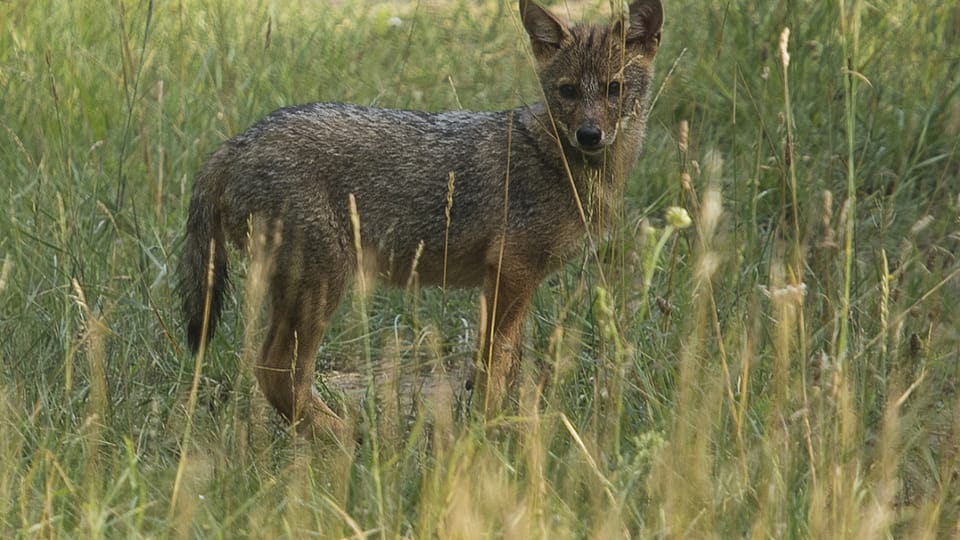
“One of them might be the milder winters without persistent snow cover. Unlike our native foxes, jackals can't hunt voles beneath the snow, even though voles make up a major part of their diet—more so than for foxes. So when winters are snow-free or the snow cover doesn’t last long, it suits them well.”
Despite being relatively new to Czechia, golden jackals are not classified as an invasive species. Unlike coypus or raccoons, they arrived without human assistance, explains Mr. Dedek.
“Those animals clearly could never have crossed the Atlantic by themselves. They were brought over by people, often for fur farming, and either escaped or were deliberately released when it became clear that it wasn’t as profitable as expected.
“So yes, the jackal can essentially be seen as a native species—just a new one. And there are quite a few of those. Every year, new species arrive on their own due to shifts in their natural range.”
Omnivorous by nature, jackals feed on both plants and animals and often stay close to farmland. But according to Mr. Dedek, there’s no cause for concern—they pose no threat to humans. In fact, their presence may even offer ecological benefits:
“Studies from Hungary and Serbia show that voles—considered agricultural pests—make up a large part of their diet. Another important food source is carrion. So in a way, jackals help ‘clean’ the landscape by consuming dead animals, which could otherwise spread disease.”
Related
-

South Moravia Region
A region of wine, beautiful UNESCO-listed castles and the Moravian metropolis Brno.
-

Czech Dog Breeds
The Czech Republic has given the world several interesting dog breeds including the Czech Terrier, the Czech Spotted Dog, the Bohemian Shepherd or the Prague Ratter.