Moose on the loose: Rare animal spotted making its way through Czechia
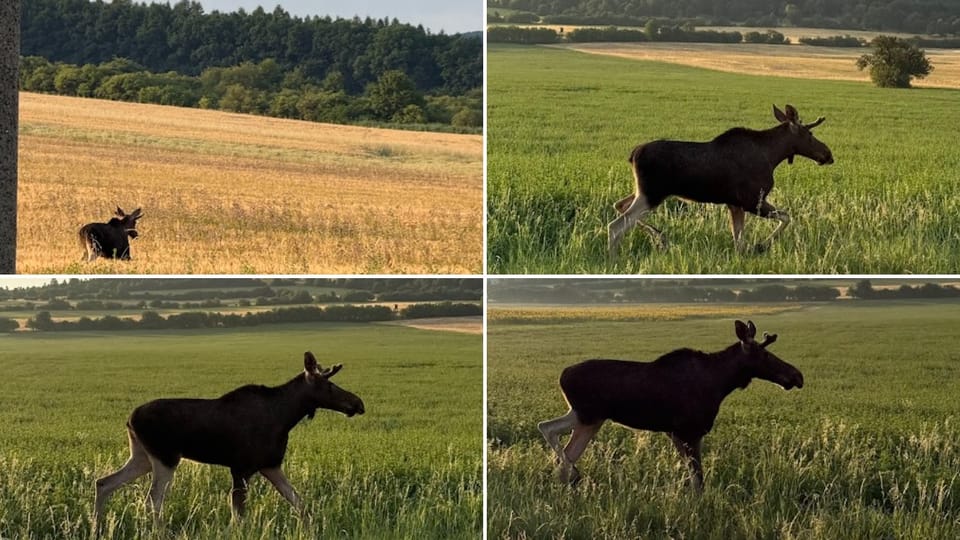
A young male European moose has recently made headlines in Czechia after being spotted in several locations in the eastern part of the country. The large herbivore, still a rare sight in the country, has been seen roaming near residential areas and even cooling off in local ponds.

The moose was first sighted on June 18 on the outskirts of Ostrava in the Moravian-Silesian Region, where it was seen crossing the Opava River. By early this week, it had made its way south to the Zlín Region. On Tuesday, locals spotted it taking a dip in a fish pond in the village of Lukov.
According to Jan Pluháček, a zoologist from the Faculty of Science at Ostrava University and also a staff member at the Olomouc Zoo, the animal is most likely migrating from Poland toward South Bohemia:
“I think this animal has come from central Poland because the natural distribution of moose in Europe ends around central Poland. From there, moose regularly migrate to our country. They travel through almost the entire country to the Šumava Mountains, where they find quite good living conditions. So, I believe this young male is on its migration route, like many other moose.”
While this ancient migration route is still used by moose today, actually seeing one in the wild remains rare. That’s because these animals are extremely shy and try to avoid any contact with humans, says Mr. Pluháček:

“It is assumed that they migrate at night, trying to avoid railways, highways, and especially large human settlements. They can cover several dozen, or even up to 100 kilometres during the night. Then they try to find a safe place to rest for the next night. They look for areas with enough water and abundant vegetation, particularly places without humans.”
The European moose is one of the largest mammals in Europe. Although once extinct in Central Europe due to human activity, the species began to reappear during the 20th century, slowly expanding its range again from Poland.
In Czechia, the highest concentration of moose can be found in the Šumava region, particularly on the right bank of the Lipno reservoir. However, in recent years they’ve also been sighted in other areas, says Mr. Pluháček, such as Bohemian Switzerland and along the Berounka and Labe Rivers.

“Between 30 and 50 moose have successfully settled in Czechia. However, they still face illegal hunting or poaching. Unfortunately, when they cross further south into Austria, they are hunted intensively in the neighbouring country. So, this area in South Bohemia represents one of the southernmost parts of the moose’s natural distribution.”
Ensuring the survival of the Czech moose population depends on allowing these migrating animals from Poland to continue reaching safe habitats. Since 2020, migration corridors for large mammals have been officially included in land-use planning across the country and must be taken into account when developing new infrastructure.






