Social Democrats ally with Stačilo! for autumn elections, dividing opinion among Czech left
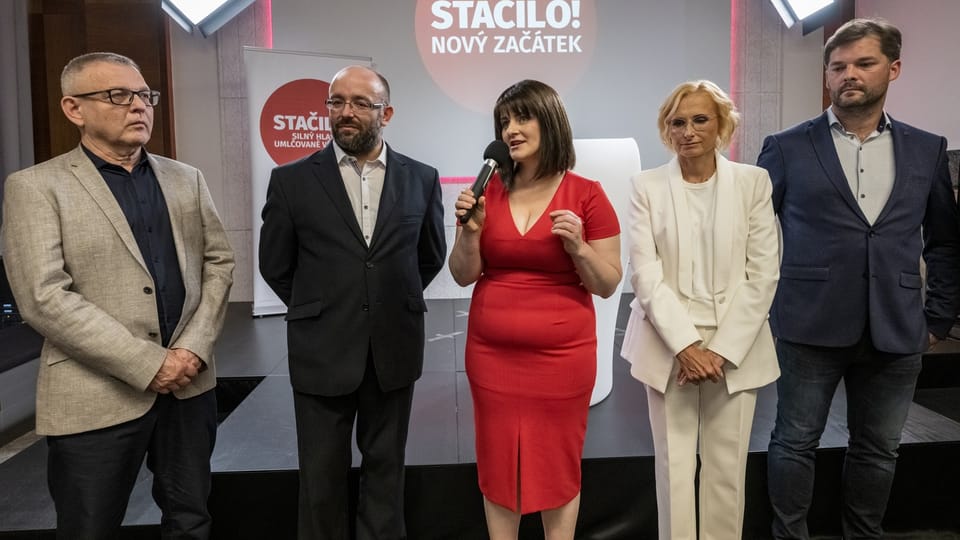
At a press conference on July 21st, the Czech Social Democracy party signed a memorandum of cooperation with Stačilo!, a party that incorporates the Communist Party of Bohemia and Moravia. The move, undertaken to strengthen the parties’ chance of electoral success, has met with severe criticism from some Social Democrats.

The Czech centre-left Social Democracy party, today known for short as SOCDEM, has a long history, stretching back to the nineteenth century. After the dissolution of Czechoslovakia, the party, then called ČSSD, was a major player in the politics of the new Czech Republic, led for a while by the former president and prime minister Miloš Zeman. It rebranded itself as SOCDEM in 2023, and since October last year has been under the leadership of Jana Maláčová.

The party is naturally looking ahead to the general elections this autumn, and has been reaching out to other leftwing parties in hopes of brokering a political alliance that will improve SOCDEM’s chances of entering the Chamber of Deputies. After months of negotiations, a memorandum of cooperation was signed in Prague between SOCDEM and Stačilo! (Enough!), the party (formerly an electoral alliance) composed of leftwing groups that include the Communist Party of Bohemia and Moravia (KSČM).

According to KSČM’s leader Kateřina Konečná, the parties “agree on 90%” of issues, such as their social programme of “cheap housing, basic food”. The memorandum included details of where the parties’ leaders will stand for election, and a pledge to form a single club of deputies in parliament.
The alliance may seem electorally advantageous, but it has angered some traditional SOCDEM voters. These include the party’s former leader, Michal Šmarda, who announced last week that he would quit the party after 32 years over this alliance:

“I have been waiting to see if the leadership of SOCDEM will think it over and take back this wrong decision and try to fight for success, so that social democratic politics in Czechia can continue and not become part of just a populist-nationalist-communist bloc, which is of course contrary to the values and traditions of social democracy.”

Given the country’s twentieth-century history, political association with the Communists is a line that many voters will not cross. Yet modern issues are also expected to strain the alliance between SOCDEM and Stačilo!, such as the latter party’s attitudes towards Russia and the West. Stačilo! is characterised as a leftwing conservative party, one that opposes any EU sanctions against Russia and supports a referendum on Czech EU membership.
Journalist and commentator Petr Honzejk expressed doubts and cynicism in the cooperation:

“People who wanted to vote for SOCDEM did so because they didn’t want to vote for anti-system parties, but for the classic European left, which recognises that Czechia belongs to the EU and NATO. I really do not think that all the SOCDEM voters would suddenly jump around the necks of [chairman Daniel] Sterzik and Kateřina Konečná, who have an exit from NATO and the EU on their agenda … It is not beneficial for SOCDEM, it is a project of Jana Maláčová and [deputy leader] Lubomír Zaorálek for political self-preservation.”
Political alliances are always fraught with danger, as they run up against party loyalties. Czechia’s leftwing voters have only a couple of months to decide whether this new alliance is acceptable to them.






