The Pope on every screen, but few in the pews: Czechs’ quiet secularism

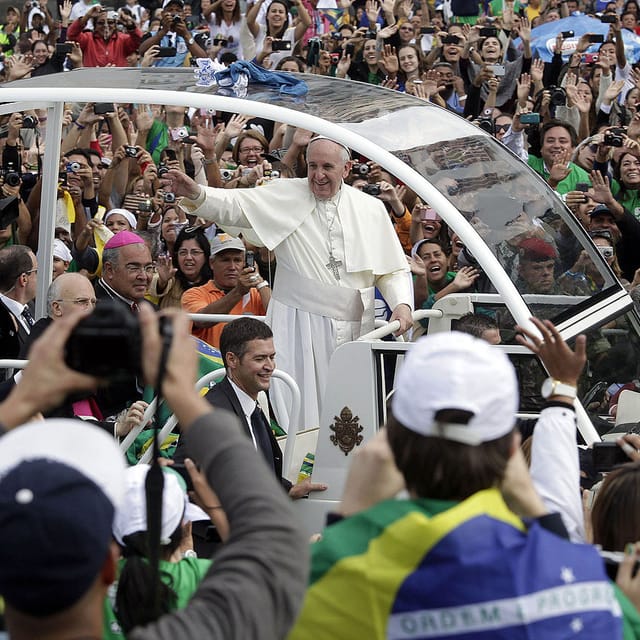
As preparations for the funeral of Pope Francis dominate the Czech media, a deeper truth about the country quietly persists. Despite their predominantly Catholic roots, Czechs are now one of the least church-going nations in Europe.

The date was April 21, 1990 — just a few months after the fall of communism and exactly 35 years before the passing of Pope Francis. That day, Pope John Paul II addressed a crowd of half a million people on Prague’s Letná Plain. Millions more watched the visit live on television. After four decades of official atheism, it seemed that religion — especially Catholicism — might once again play a significant role in Czech public life.
And for a while, it did… until it didn’t.
While churches briefly saw renewed attendance, the long-term trend was unmistakable: a return not to faith, but to secularism. This shift has roots not only in the Communist past but in earlier chapters of Czech history. As Adam Šindelář, religion editor at Czech Radio, explains, “There is a long history of secularization in the Czech Republic. I think the main reason is the Communist era, but the secularization goes even deeper, into the times of the Reformation and Counter-Reformation. And there is a persistent cultural distrust toward religious institutions, especially the Catholic Church.”

This skepticism, however, isn’t limited to the church. “In Czechia in general, people distrust institutions — not only religious ones — and that might also be one of the reasons why people are not so much connected to the churches,” says Šindelář. He points to demographic changes and evolving attitudes toward faith as further contributing factors. “There is a shift toward religion as a personal choice, rather than tradition.”
That shift means that those who still consider themselves religious may be fewer in number, but more personally committed. “So even if the number of people who go to church is lower, I think they take it much more personally,” Šindelář notes. “They really mean it when they go there.”

Regional differences also play a role. While Bohemia, the western half of the country, is largely secular, the eastern region of Moravia — especially around Zlín — remains noticeably more religious. But in the broader national context, the decline in religious affiliation has been dramatic. In 1950, around 84% of Czechs identified as Christians. By 2021, that number had dropped to around 12%. “For Catholicism in 1950, it was 76% of Czech people who were Catholics,” Šindelář explains. “So the decline is in both [Catholics and Protestants], yes. But there is some difference.”
That difference, he says, lies in how Protestant communities are held together. “Protestant denominations — which are generally much smaller than Catholics — they are more tied by family tradition. There are different families who run Protestantism in their blood. So they are smaller but stronger, I would say, than the Catholic parishes.”

Still, even in a country with such low church attendance, spiritual curiosity remains. “Even if people don't consider themselves to be religious,” Šindelář observes, “they are very interested in different kinds of spirituality — like Eastern philosophies, mysticism, meditation, yoga, and all these little things that people usually don’t consider religious, but they have very spiritual meanings.”
He recounts a striking example from a past interview. “I did one interview with a witch, and she told me that a lot of businesspeople, a lot of managers, come to her for consultations about their business. Obviously, there is some spiritual part behind this.”
With the recent passing of Pope Francis, the Catholic world finds itself in a moment of reflection. Could this resonate even in a secular country like the Czech Republic?
“It’s very hard to say,” Šindelář responds. “I can see the influence of Pope Francis on society — even on non-believers — because he was such a person that he was respected even by a lot of non-believers. They respected him as someone inspiring, who had something important to say. His emphasis on being human, kind — that resonates.”

He adds that Pope Francis may have had a subtle but real effect on Czech Christians, especially laypeople. “There is a wave of emancipation — an activation of lay Christians. And I think it’s something which can have an influence on the whole society, because religious people tend to be very active in community life, and also in politics.”
Still, the overall picture remains clear. While Pope Francis will be honored and remembered in Czech media alongside other nations, the fact remains: Czechs are among the most religiously indifferent nations in Europe.