Marcus Mucha: It’s not nice when you see your family name in Goebbels’ handwriting

Marcus Mucha is the great-grandson of the world-famous Czech painter, illustrator and graphic artist Alphonse Mucha. UK-born Marcus, who is in his mid 40s, is Executive Director of the Mucha Foundation, which preserves and promotes the work of the world renowned Art Nouveau pioneer. When we spoke at its recently opened Mucha Museum in the heart of Prague the conversation took in such topics as the artist’s fluctuating international renown, Marcus’s previous career as a Hollywood producer and the story of how a Nazi officer protected his Jewish great-grandmother, Alphonse’s wife.
How Czech did you feel growing up?
“You know, I was always aware of it, and we managed to sneak back in a couple of times before the Wall came down, in 1984 and 1989.
“It was always something that I felt as part of my heritage, but at that time, in the UK, it was this kind of exotic, far-off land.
“The Berlin Wall was still up and it was part of Ronald Reagan’s Evil Empire, so it felt very distant.
“Then once the Wall came down my dad [John Mucha] was on the very first flight back here.
“As soon as the wall came down we were back a lot – and feeling very Czech indeed.”
“We spent a lot of time here and I started eating Czech bread and felt that it tapped into something really deep in my ancestral roots.
“Then a little later I had my first taste of Plzeň [Pilsner Urquell] and felt something very similar.
“So I guess in London in the ‘80s it was some kind of piece of exotic background, but then as soon as the wall came down we were back a lot – and feeling very Czech indeed.”
When you came here in the ‘80s did you stay at your family’s famous apartment opposite Prague Castle?
“That’s right. I slept as a little boy in the bed where count Waldstein was murdered.
“But he being murdered in that bed wasn’t actually that scary for me – what was scary was that the duvet was a bear skin.
“So imagine being a little boy waking up next to a ferocious bear’s head. That was scary for me.”
Was your grandfather Jiří still alive in those days?
“Yes, he was. I only met him three or four times and I just remember him as being a very kind and gentle man.”
And your granny, Geraldine, was Scottish?
“That’s right. We spent more time with her. She was able to get out to the UK more often, because she had a British passport.
“So we would spend summers with her up at her house in Scotland. She found Prague too stifling and too hot in the summer, which I can appreciate, so we tried to get away to her Scottish roots.”
At what point did you realise that you had an ancestor who was a world famous artist?
“What’s interesting is that when I was growing up he wasn’t really a world famous artist, certainly not in the West.

“A lot of his work had been hidden away and forgotten behind the Iron Curtain.
“When he went to America for the first time, in 1904, he was greeted by a cut-out of himself on the dock in New York proclaiming him, Alphonse Mucha, the world’s greatest artist.
“But because of the sad history of the 20th century in the Czech lands his artistic achievement, or much of his artistic achievement, was forgotten.
“It’s as if Toulouse Lautrec was only known for the posters he did in Paris and not for the thoughtful oil paintings on which so much of his artistic legacy rests.
“One of the great privileges of the work that we do and what we’re doing here with the new Mucha Museum, in the Savarin Palace on Na příkopě in the heart of Prague, is reintroducing, particularly the Western art-historical establishment, to an artist who is really perhaps under-appreciated.
“When I was growing up he wasn’t really a world famous artist, certainly not in the West.”
“He was arguably the creator of the world’s first truly global artistic movement in Art Nouveau.
“His work not only as an artist but also as a utopian philosopher is really important.
“And it’s a great privilege for us to be able to wake up every day and share his vision with the wider world.”
In your 20s you went to Hollywood, where you were a producer. What drew you to the world of movies?
“I was living in London at the time and was trying to be a writer-director.
“I was having little snippets of success in London, but the future as it was kind of set out to me was that maybe, if I was lucky, I could direct an episode of a soap opera and then, maybe 10 years down the line, I could do a movie with a budget of USD 100,000.

“And I thought, Screw this, I want to do James Bond movies.
“So I moved out to Hollywood with a suitcase and a dream and quickly found that there were a lot of other people who were wanting to be directors – a lot of people who were directors, as well – and many of them were much more talented than me and most of them were unemployed.
“So I switched over to the business side of the business.
“I managed to get a position at the mail room at International Creative Management, one of the big talent agencies, and I worked my way up there.
“Subsequently I was head-hunted by Morgan Freeman and his producing partner Lori McCreary to run the business side of their production company.
“Morgan and Lori were very generous – they gave me a lot of rope to hang myself – and we were able to do some pretty cool things, even while I was still relatively young.”
What is Morgan Freeman like, at the personal level?
“He is the most amazing guy. I can’t imagine being any more lucky than I was to work with Morgan and Lori. They were a really great team.
“Morgan is really full of integrity, he’s got a very strong point of view, but he’s also just really fun to be around.
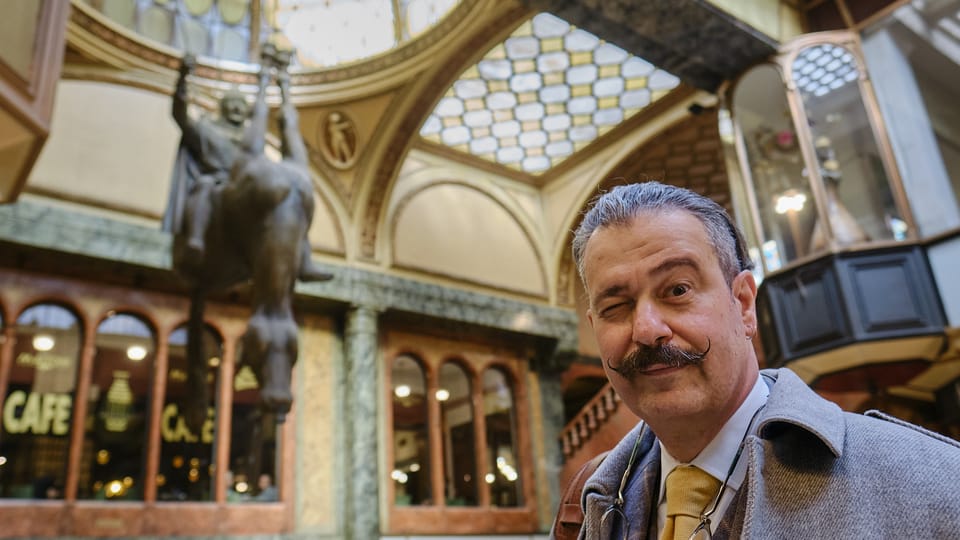
“I remember when my older son met him for the first time, when he was a baby.
“There was a party at Morgan’s house and my son was in that ‘stranger danger’ phase. So usually he’d see somebody else and kind of burst into tears.
“But as soon as he first saw Morgan he just instinctively lit up and started stuffing burgers in Morgan’s mouth.
“Morgan was on, I think, a gluten-free diet at the time, so he shouldn’t really have been doing it, but he made an accommodation for the little boy.”
So what led you to abandon the glamorous world of Hollywood?
“When my grandfather Jiří passed away in 1991 my parents, John and Sarah, and my grandmother, Geraldine, established the Mucha Foundation.
“It’s a Czech non-profit which serves to introduce people around the world to Mucha’s work and to preserve the Mucha family collection.
“And my dad came out to visit my family and I in Santa Montica and said that he was planning to retire soon and would we consider uprooting our young family and moving back to Europe to continue this work.
“For a second it was a pretty hard decision. My wife and I both had relatively successful careers as producers in Hollywood.
“The future looked pretty bright for us in Hollywood. But after 20 minutes of talking about it we were pretty clear this is what we had to do.”
“I had just been listed in Variety, which is the trade magazine of the entertainment industry, as one of the best producers under the age of 35, literally a couple of weeks before my dad came out.
“So the future looked pretty bright for us in Hollywood. Not to mention that all my wife’s family were there close at hand and our kids were born there.
“But after about 20 minutes of talking about it we were pretty clear this is what we had to do.
“I mean, it’s in my blood, it’s in my bones, it’s in my heart. There really wasn’t any alternative.
“So I went out there with a suitcase and a dream and I came back with a shipping container, 100 boxes, a wife and two kids.”
We’re here at the Mucha Museum. How much of the foundation’s energy is focused on work here, in Czechia, and how much on your international activities? I know you do a lot of travelling exhibitions.
“Alphonse thought his work was a universal benefit for humanity, so he wanted it to be seen by as many people as possible.
“And we try to do that as much as we can, through our own programmes, whether that’s our exhibition programme or this museum or our commercial licensing programmes or our other educational programmes.
“We’re fortunate that we enjoy a deep collection. The Mucha family collection is over 11,000 art works and we are able to present them in exceptional museums around the world.
“In recent years we’ve done shows at the Art Gallery of New South Wales in Sydney, we’ve just closed a show at the Phillips Collection in Washington, DC.
“So, yes, that’s a big part of our focus.
“But what’s really exciting for us about this new museum here in the heart of Prague is that while in the last 30 years we’ve been able to share a narrative around the world, with this wider understanding of Mucha’s work, of not just the posters that are part of our collective subconscious wherever we come from, but also the works leading up to those and the latter part of his career, where he put his talents in the service of his new Czechoslovak nation.

“We’ve been able to share that with about six and a half million people around the world over the years. About half a million people see our exhibitions at the moment.
“But we’d not really had a permanent way to present that to the Czech public.
“We were lucky a few years ago when President Vystrčil of the Czech Senate invited us to do an exhibition at the Waldstein Riding School as the cultural centrepiece of the Czech rotating presidency of the European Union.
“There we were able to present such an exhibition, but unfortunately the Czech presidency only lasted six months so the exhibition only lasted that long.

“So we’re really thrilled that now we’ve been able to move into this incredible space here.
“Alphonse also was a great admirer of Mozart and if you look at the windows you’re directly opposite the theatre [the Estates Theatre] where Mozart conducted the world premiere of Don Giovanni.
“So I think for him to have imagined that his work would be in such an exquisite location would have made him incredibly happy.”
How much do you feel that you are growing his brand? Or are you simply trying to maintain it at the high level it’s at already?
“No. We strongly believe that there’s still a gap between how he was perceived when he first arrived in New York, as one of the greatest artists in the world, and where he is today.
“We think that because of the technology at the time, both the lithograph and the means of transportation there were, his work was able to diffuse throughout the world very soon after it was created – and that made his style the first really global artistic style.
“He was the father of modern advertising, one of the first people who realised that when you’re doing a poster for a product you’re not selling that product, you’re selling a dream.”
“He was also, I think, the father of modern advertising, or one of the first people who realised that when you’re doing a poster for a product you’re not selling that product, you’re selling a dream.
“One of the other aspects that I think is really interesting, and where we focused in some of our recent touring exhibitions, is that his work really influenced all sorts of generations of artists who came after him.
“I think a big reason for that is that while his work might not have had found space in the artistic mainstream narrative in the West, in the second half of the 20th century, Alphonse grew up as part of a discriminated-against minority in Austro-Hungary.
“So there’s something ethical, as well as the aesthetics of it, that speaks to freedom.
“You can see that in the free and empowered women in his work.
“What’s been exciting for us as we’ve researched it in recent years, and we’ve become friends with a lot of these people, is to find other artists who have also, for whatever reason, been marginalised and ignored by the mainstream Western art-historical narrative.

“Those people have found something in Mucha’s work. I’m thinking, for example, of female manga artists in Japan in the 1970s.
“At that time manga was very much a boy’s club, it was really, really hard to break into, and the comics that were made for women were pretty boring. It was like, Here’s a nice salary-man, pop out a couple of kids and you can have a life of making bento boxes.
“Whereas pioneering artists like Hiroko Nakano, who came in and started working in that space, were like, You know what, if you want to have an affair with a rock star, that’s a valid life choice as well – go for it.
“And they combined Mucha’s aesthetic line with the broader, ethical cry for freedom that’s in his work.
“The other guy who I think is amazing for this is Joe Quesada. He’s a Cuban-American, originally a comics artist, doing comics for Marvel, and he worked his way up at Marvel until he recently stepped down from his role as Chief Creative Officer of the entire Marvel Entertainment group.
“He was responsible for the whole artistic direction of all of the Marvel multi-character universe, all of the comic books, all of the TV shows and all of the movies.
“And again, Mucha was such a seminal influence on his work. From the covers of the X-Men, where you see Wolverine done in the style of a Mucha lithograph, through to at the end of his career when the ethical universe that the characters in the Avengers movies inhabit is so much richer and so much more complex and so much more philosophically than the superhero world when I was watching superhero movies as a kid.”
What’s the greatest misconception about Alphonse Mucha? Is it that he’s French?
“That’s one of them. I admire our friends in France who’ve managed to appropriate such great ‘French’ artists as Chopin and Van Gogh and Picasso, as well as Mucha.
“I wonder if we could do the same here and appropriate Mozart, Beethoven and Mahler and claim them as Czech composers?

“But I think the main misconception, which is one of the main reasons why my father started the foundation, was, as my father puts it, I wanted to dynamite the notion that Mucha was just an afficiste [poster designer].
“So to really tell the story beyond the posters that everybody knows and everybody loves.
“Obviously we want to show them and the selection we have here are ones that Alphonse rolled up as soon as they were off the presses, so the colours are just as fresh as they were in Paris in the 1890s.
“I think that’s unique for any collection of his posters anywhere in the world.
“Obviously we want to show those, but we want to tell a much richer story about Mucha as an artist and a philosopher.”
Is there much Bohemian or Moravian influence on his work?
“Yes. If we look at this poster for Gismonda – which is the first one he did when he first moved to Paris and got his big break with Sarah Bernhardt – if you look behind her face there’s a kind of halo shape, and in that halo is a Byzantine Cross.

“For Alphonse the Byzantine Church was a symbol of Slavic culture. So here, even in the first poster of his Paris period, you can see the roots of what will eventually become the Slav Epic.
“And all the through these posters, like Reverie for example here, which is seen as kind of an icon of Parisian Art Nouveau, where the lines and the shapes of it are woven into the scenography of Paris even today, this is a Moravian picture.
“The structure of the lithograph very closely echoes a painting of the Virgin Mary that Alphonse saw in his local church in Ivančice growing up, as a choirboy.
“The flowers that surround the female figure are the same flowers that Alphonse saw in the fields and the forests of Moravia in the spring.
“And the clothes that she’s wearing are the same folk clothes that Alphonse would see wearing in his village on festive days.
“So imbued deep into the DNA of Parisian Art Nouveau is a strong Moravian element.”
Obviously his greatest work in that area was the Slav Epic. It’s now in Moravský Krumlov. He donated the series of paintings to the City of Prague in 1928. What is your foundation’s relationship to the Slav Epic?
“As a family and as a foundation, we consider the Slav Epic to be Alphonse’s late, great masterpiece.

“We are really excited that in a few short years, just a stone’s throw from here in another part of the Savarin complex, the world renowned architect Thomas Heatherwick – who recently built Little Island of the coast of Manhattan and is currently building Google’s new headquarters in Mountain View, California; also for Londoners, he did the new beautiful buses that go around London – he was inspired by Mucha as a student and he’s really thrilled to be doing his first ever building in the EU here as the permanent, purpose-built hall for the Slav Epic that Alphonse envisioned, in line with his original stipulations in the gift to the City of Prague.
“We’re really thrilled that that’s going to be here and we can’t wait to welcome people from the Czech lands and from around the world to come and see that.
“But in the meantime we’re also thrilled that it’s in Moravský Krumlov.
“The city and the people of Moravský Krumlov looked after the Epic, along with our family, through the darkest days of the 20th century, when, for example, the first Communist minister of culture sought to have the Slav Epic destroyed.
“So without the people and the town of Moravský Krumlov, the Slav Epic would not exist today.
“Without the people and the town of Moravský Krumlov, the Slav Epic would not exist today.
“Alphonse’s vision was that it would always be here in Prague so that people from around the world could come and see it and appreciate it the role of the Czech peoples, and also the Slavic peoples in general, in the universal world peace that he saw as just around the corner.
“But until that purpose-built hall that Tom Heatherwick is building for us is ready, we wouldn’t want it anywhere else but in Moravský Krumlov.”
Will the Slav Epic definitely be here in three years’ time? Or are three still some outstanding legal questions surrounding it?
“We’ve signed an agreement with the mayor of Prague that settles litigation that my father had with the city and that stipulates that it’s going to be placed in the Savarin complex.
“I understand that a lot of people want it, but as a family and as a foundation we like to follow contracts and we’re looking forward to the Slav Epic being here.
“At the same, please come and see our museum. The Slav Epic is not here yet but we show a range of original studies from it, some of which we’re showing publicly for the first time ever.
“We tell a story about it so that when it does come here to Prague, people are going to know more about it and appreciate it in a way that they wouldn’t have done before.”
We spoke previously and you told me that you have a great idea, I think, to bring school kids to Prague on a special “Mucha bus” in future.
“That’s right. One of the things where we’re currently soliciting sponsorship is to have such a bus.

“The vision we have is that every schoolchild at some point in their upbringing will be able to come to Prague and to enjoy the Mucha Museum – and also the Slav Epic, once it’s here – and to see how a boy from a small village in Moravia could go on and influence the way that the world looks around us, even now, 165 years after he was born.
“Already we have an initiative where… we’re not open to the public yet, but you’ll see once the doors open it’s going to be busy here with school groups.
“We’ve got school groups coming through here every day, as part of our educational programme.
“We’re giving free entry to organised school tours, so that all the children in Prague can come here for free and really appreciate Alphonse’s work and his achievement.”
Just a few streets from here in the centre of Prague is the Petschek Palace, which was the headquarters of the Gestapo during WWII and the Nazi occupation. Alphonse was interrogated there and died a few months later [in July 1939]. Why did the Nazis target him?
“There are a number of reasons for that.
“First was that he was the de facto national artist and he had a strong sense of Czechoslovak national identity, and that was at odds with Hitler’s vision for the Bohemian and Moravian lands as being part of a greater German Reich.
“Second was that his wife, my great-grandmother, was Jewish.
“But third, and perhaps most importantly was that Alphonse was a prominent Freemason. He was in fact the head of the Czech Freemasons.
“Among the many things that the Nazis hated, Freemasonry was one of them.
“The Freemasonry is one of the aspects that we really lean into here in the museum, as part of the kind of bridge between the Paris period and the section about the Slav Epic.
“It’s one of the first places where he really crystallised his idea that all of the religions and all of the countries around the world had something to contribute to a kind of synthetic identity that leans towards universal world peace.
“Also on the Freemasons, we had a very sinister moment a few years ago where somebody we know found a handwritten note in some archives in Berlin in Goebbels handwriting.
“It was a list of the Masons that he wanted to get and Alponse was on that list.
“So not nice when you see your family name in Goebbels’ handwriting.”
Was there also a story that some Nazi saved your great-grandmother’s life?
“That’s right. It’s an extraordinary story.
“Alphonse had a villa in the Bubeneč district in Prague where he lived and had his studio. And a high-ranking officer of the Wehrmacht took over that house during the war.
“He knew that my great-grandmother was Jewish and that my great-aunt was Jewish and he protected them and protected the collection, through the war.
“There’s a beautiful coda to that story, which is that in the 1970s my grandfather Jiří organised an exhibition in Frankfurt and when he was opening it an elderly gentleman came up to him and introduced himself – and it was in fact this officer from the Wehrmacht.
“My grandfather took him through the exhibition and talked to him about it and asked him which was his favourite.
“The gentleman said, I really like this poster, because this was something that I had in my study. I know that you were fighting in the Royal Air Force, I was fighting on the Eastern Front, but when I was on leave and I could come home this is something that reminds me of happy times with my family in your family’s house and in your family’s gardens.
“So at the end of the show my grandfather gave that work to him.”
I believe also the Nazis tried to ban a funeral for Alphonse, but people turned out anyway in great numbers.
“Yes, that’s almost right.
“My great-grandmother petitioned the Protectorate to ask if the family might be able to bury Alphonse in the Slavín [pantheon of great Czechs] at Vyšehrad.
“Somewhat surprisingly, the Nazis said yes, but on the condition that only the immediate family turned up.
“We think that was because my grandfather, who was a prominent young Czech Jew, had already fled to France and had joined the Foreign Legion.
“Rather than listening to the Nazis, the regular Czech people, over 100,000 of them, lined the streets of Prague to bid farewell to their national artist.”
“We think that they wanted him to come back so that they could seize him – and then I wouldn’t be here today.
“My grandfather did come back, but rather than listening to the Nazis, the regular Czech people, over 100,000 of them, turned up and lined the streets of Prague to bid farewell to their national artist.
“So my grandfather was able to slip in and slip out, unnoticed.
“And that was one of the last cries of freedom before the dark days of the Second World War here in Prague.”
My final question is, you know so many of Alphonse’s works, you’re really an expert on him – what is your favourite either single work or period?
“I love the posters from the Czech period.
“They’re really great, because for me it’s Alphonse using all the talent and all the skills that he developed in Paris – but applying them to something that’s close to his heart and the new country of Czechoslovakia that he’s helping to establish; he wants to give all of his work in the service of his new country.
“In particular, for personal reasons, I really like the poster Princess Hyacinth.
“The reason is that, as you mentioned, before I was doing this work I was a producer in Los Angeles.
“One day I had a phone call from a friend of mine who worked at Disney, who said, Hey Marcus, are you related to Alphonse Mooch-ah?
“I said, Yes, I’m his great-grandson. And he was really excited, because they had just started having concept art meetings for a new animated film that they’re doing.
“What they’d done was they had taken the princess from Princess Hyacinth and put her in an ice palace. And that was one of the first pieces of concept art for the movie that went on to become Frozen.
“If you watch Frozen again with that in mind you can see Mucha’s artistic DNA in every snowflake, in every piece of furniture, in every banister in the palace.
“I think that’s something we really treasure: how great artists around the world – whether they’re fine artists like Jiří David or Liu Bolin, or graphic artists like Joe Quesada, who I mentioned earlier, or Yoshitaka Amano, who’s responsible for the Final Fantasy video games, or indeed the team at Disney who came up with Frozen – are still finding something in Mucha’s artistic DNA that speaks to not only his beautiful aesthetic but also his desire for art to be a bridge between people of all nations.”