Malešice Botanical Garden: history, peace, and nature in Prague’s overlooked district
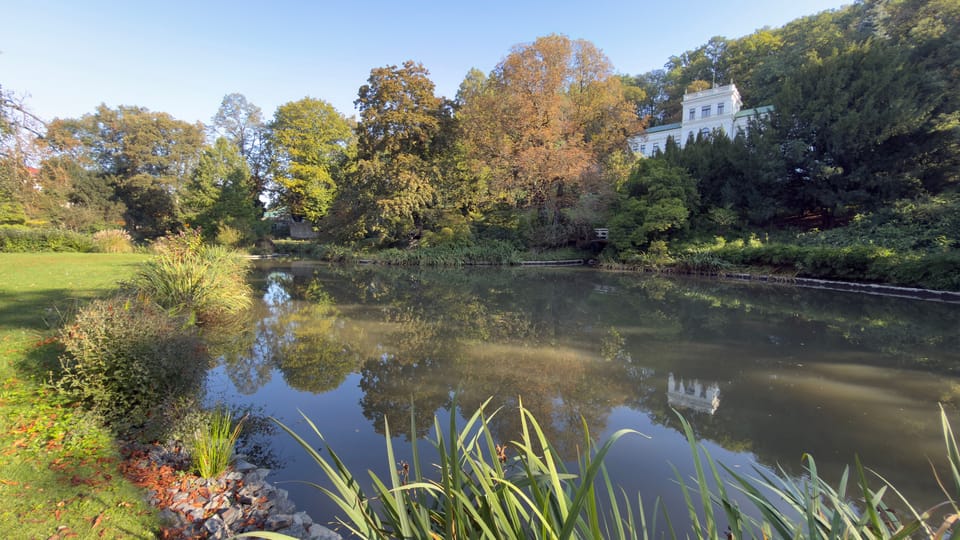
In this episode of Prague off the Beaten Track, we visit the Malešice Botanical Garden, a quiet oasis few people in Prague have heard of. Run by a horticultural school, it offers an arboretum, rock garden, and peaceful paths away from the usual tourist crowds. Nestled under Tábor Hill, it reveals a surprising blend of history, nature, and tranquillity in one of the city’s overlooked districts.
A hidden oasis in the shadow of industry

When Prague locals hear “Malešice,” they often think of the massive waste incineration plant, whose chimney towers over the district and processes hundreds of thousands of tons of rubbish every year. Yet just a short walk away from this industrial landmark lies a completely different world: the Malešice Botanical Garden. Few tourists ever make it here, but those who do discover a green enclave filled with rare trees, alpine plants, and the kind of peace that’s rare to find in a busy capital.
Unlike the city’s other two botanical gardens—Troja, with its famous tropical Fata Morgana greenhouse, or the venerable Charles University garden “Na Slupi” near Charles Square—Malešice is small, quiet, and resolutely local. The official name is the Botanical Garden of the Secondary School of Construction and Horticulture, and education remains at its heart. But for visitors, the appeal lies in its blend of history, atmosphere, and accessibility.

A villa, a park, and a layered history

The garden’s roots stretch back to the 19th century, when the land belonged to a farmstead with orchards and vegetable plots. In 1889, Rudolf Egbert built an imposing Neo-Renaissance villa on the site, complete with a broad terrace and double staircase. Locals, impressed by its grandeur, nicknamed it the “Malešice zámeček”—the little château—even though the real château already stood elsewhere in the village.
Later, industrialist Jirásko transformed the grounds with the help of renowned landscape architect František Josef Thomayer. Together they planted rare trees and constructed hillside greenhouses to catch the sun. During World War II, however, the estate was seized by the Gestapo and turned into a military hospital. Sculptures vanished, documentation was lost, and the once-carefully tended park fell into neglect.

After 1945, the property was nationalized and, in 1947, assigned to the horticultural school. Under communism, the focus shifted from private luxury to practical training, with students learning their craft among the greenhouses and planting beds. Since 1990, the grounds have been formally designated as a school botanical garden, part of the curriculum and open to the public.
Exploring the garden today
Spread across more than seven hectares on the slope of Tábor Hill, the garden is an eclectic mix. There is an arboretum, a working cultivation garden, and, since 1998, a rock garden with a small waterfall. The greenhouses—partly repaired in the 1980s—are still used for training, while a flower shop at the entrance sells bouquets, seedlings, and young plants grown by students.
Visitors may hear the hum of traffic from nearby roads, but the dense vegetation muffles most of the city’s noise. On weekdays, the only company may be a jogger or a gardener with a chainsaw tending the trees. The atmosphere is intimate, worlds apart from the crowds in Troja.


Since 2020, the Malešice Botanical Garden has been open daily during the main season from May to October, not just on school days. The upper production garden remains off-limits, but the lower sections are more than enough for a pleasant stroll. Twice a year, the school organizes exhibitions of student projects, which draw local families and plant enthusiasts alike.
Malešice: a district of contrasts
The location adds to the garden’s charm. Malešice itself is a patchwork Prague neighborhood: partly in Prague 9, partly in Prague 10, with a history that includes noble estates, burgher ownership, and eventual incorporation into the capital in 1922. Today, it combines housing estates, parks, and forest, with the botanical garden forming an unexpected pocket of tranquillity just below the industrial skyline.

For visitors, reaching the garden can be a small adventure. A nearby bus stop makes it accessible by public transport, but parking is limited and often occupied by employees of nearby businesses. That inconvenience, however, ensures the garden remains largely undiscovered—a genuine hidden corner of Prague.
More botanical treasures in Prague
The Malešice garden may be the least known, but it’s not Prague’s only botanical treasure. The Charles University garden “Na Slupi,” used for teaching and research for centuries, lies just steps from Charles Square. In Troja, the City of Prague operates a sprawling botanical complex that includes the spectacular Fata Morgana greenhouse. Both are well worth visiting, but for travellers who prefer to escape the usual tourist circuits, Malešice offers a quieter, more surprising alternative.
- Location: Tábor Hill, Malešice, Prague 9
- Area: ~7.5 hectares
- Founded: Assigned to horticultural school in 1947, became official school botanical garden after 1990
- Features: Arboretum, rock garden with waterfall, historic greenhouses, flower shop
- Opening hours: Daily, May–October (lower garden accessible to the public)
- Unique aspect: Managed by the Secondary School of Construction and Horticulture; a true “hidden garden” off Prague’s tourist routes
- How to get there: bus number 195, 177
Related
-

-

Prague Gardens
Gorgeous views of Prague, gushing fountains and ornamental flower beds. Greenery and calm amid the hustle and bustle of the big city.