Inside Ukraine: Meeting amputees, frontline soldiers, and the spirit of a nation

In 2024, Czechia sent 1.5 million rounds to Kyiv and aims to supply 1.8 million by the end of 2025. This is by far the largest part of Europe’s vital ammunition supplies to Ukraine. Czech support for Ukraine has been steadfast. But can we expect it to continue? It was also because of this that I traveled to Ukraine with an international group of journalists in October. I wanted to get a sense of how morale is holding up and how Ukrainians view western support amidst another surge of nativist populism on the continent.
Arriving in Lviv, Ukraine, the air was brisk and significantly colder than the lukewarm early October fall weather we were having in Prague. I wouldn’t stand in the cold for long, luckily, as my shivers made clear I was not yet ready for the winter months.
I went straight to my hotel for a quick nap after which I had borscht and pierogies (known as varenyky in Ukraine) at a Ukrainian restaurant. But my quick stint in tourism had to be cut short. I went over to two French journalists, meeting in front of the neoclassically adorned Lviv Opera. We went to meet our guide and organizer of the trip, Taras Yatsenko, at his office space at Your City Media Hub.
After a few introductions and uniting with the other twelve, or so, journalists on this trip from France, Germany, Spain, and elsewhere, we were on schedule to go to our first destination: the Superhumans Center, a state of the art rehabilitation center. The organization is leading prosthetic design for amputees, helping recovery, and providing a community for, mainly, soldiers but also civilians and humanitarian workers.
Superhumans Center in Lviv

There, we met Eddy and Andriy, who were our guides. Eddy began the tour. His story was remarkable, making him a frequent subject of media interviews. He lost both his leg and arm after being injured while serving in a humanitarian unit and now works as a senior communications manager for the company.
Starting in an area of the floor dedicated to exercises for amputees, Eddy showed us some of the equipment and explained the work they do with veterans and civilians.
“So the center is in two halves. We have the rehabilitation site, which was completed in early 2023, and then there's the residential and surgery side, which is the other half of the building. The center was set up in three months, from initially finding a site, getting funding, and assessing the scale of work needed to repair veterans. They got the center going in three months. We're aiming for a similar timeline with the center we're working on in Odesa [apart from the other existing one in Dnipro]. There is a very important need to get these places running as quickly as possible, not just to start treating people but also to begin research and improve rehabilitation, learning from the war. Ultimately, our goal is not just to repair veterans but to learn and improve.”
We continued from there to see how amputees exercise to rehabilitate:
“People work up to three hours a day here. We start with walking or basic exercises like parallel bars, taking steps, using prosthetics, and then move to more complex activities.”

But Eddy told us the real work begins when you get back to the real world. In Eddy’s words:
“The real rehabilitation starts once you leave the center and enter the real world. The city is not set up for disabled access, so our goal is to give people confidence and practice to face real-world obstacles. It’s hard work learning to walk again with prosthetics—the hardest thing I’ve ever done—but it’s incredibly rewarding. People with more severe injuries take longer, and we never rush anyone. Our goal is independence. Everything we do pushes toward that independence.”

At one time, the center holds between 250 and 300 patients. There are 86 beds in the ward and an old military hospital next door. Some patients stay temporarily, while others stay longer. Outpatients come in for specific procedures, he told us. But people’s duration at the center differs based on their needs. In Eddy’s words:
“It depends on injuries. We have direct evacuation from frontline hospitals, meaning some people arrive within 48 hours of injury. Treatment length ranges from a few months to over a year for severe injuries. Everyone progresses at their own pace.”
Thanks to donors like Howard Buffett and Richard Branson, the center ensures they aren’t financially burdened.
At the center, services are also adjusted for people who have been injured, as Eddy explains:

“In the center, we teach patients how to live independently and adapt to their homes. For example, cabinets can be raised or lowered with a button for wheelchair users. Adaptive tools like chopping boards, utensils, and prosthetic-friendly knives are available. We encourage patients to come up with their own designs and ideas for accessible living.”
And when they leave the center, they also receive support from the Ukrainian government. Eddy continues:
“Disabled veterans receive benefits depending on injury severity, including free utilities, housing priority, and healthcare. I’m still registering as a foreigner and not a soldier, so I’m in the process of getting benefits. We are also working on an Australian-style assistance scheme to make it easier for veterans to transition to civilian life. Ukraine is moving away from its post-Soviet neglect of disabled people, bringing them into the center of society.”
Fitting for the selfless work Eddy is doing, it was only now that he started talking about his own journey and what led him to the center:
“I’m a humanitarian worker. I’ve been here since October 2022. I’m a sailor by trade. I came intending to stay three months to work on the front lines in a humanitarian role, but I realized I needed to stay longer.

“I don’t have a connection to the country. Honestly, I just felt like I needed a holiday, and I thought that coming to Ukraine would be a great break from work. I spent about two and a half to three years here, working primarily in Donbas. I lived in Kramatorsk for two years and did humanitarian aid in the frontline, cut-off villages. We worked on infrastructure projects, repairing roads, and delivering fresh water to frontline towns. I also worked with medical teams, and I’m trained as a medic. We carried out civilian evacuations as well.
“For example, in December and January of this year, we were evacuating civilians out of Pokrovsk. On the 30th of January, we went into the city, picked up three people and a dog, dropped them off, went back in, and picked up two more people. On our way out, with four of us in our armored van—clearly marked as a humanitarian vehicle—we were targeted and hit by an FPV drone. It hit the roof, through the armor of the van, went through my seat, and I lost my arm almost completely at the shoulder. My leg was destroyed; I describe it as a ‘punched lasagna.’
“I was incredibly lucky. My team lead, a Ukrainian guy, got to me quickly and applied two tourniquets in two and a half minutes, which saved my life. I was then evacuated in a military pickup to an ambulance and reached a hospital within an hour. That saved my life. Any longer, and I wouldn’t have survived.
“Despite these horrendous injuries, I’m lucky to be alive. I had no other injuries besides my arm and leg, thanks to a good helmet and ear protection, without TBI or shrapnel. I’ve come out of this in the best way possible for someone losing two limbs. I’m right-handed, can still drive an automatic car, and live independently. I consider myself very lucky.”

Eddy said he considers Ukraine his home now. He has a Ukrainian goddaughter and family there. When he was first injured in late January, he was offered evacuation anywhere, but he chose to stay in Ukraine, as long as he wasn’t taking a bed from a Ukrainian. That decision turned out to be the best one for him, he said with a smile.
Now he works as a senior media manager for Superhumans. Essentially, in his words, he’s an ambassador for the center.
“I work with foreign media, foreign guests, and promote my story, Ukraine’s story, and the Superhuman story outside of Ukraine. Superhumans are well known in the country, but we’re still establishing our presence internationally.”
Despite losing limbs earlier in the year, Eddy has recovered enough to resume life, including sailing, traveling, and living independently. Some things he’ll never do again, but that’s the reality when you survive something like this, he said, laughing.
The center also works with civilians and others in emergency services, for example:
“About 95% are military, but we also have civilians, some state emergency services personnel, and children. For instance, we’ve had two under-18s. One was an eight-year-old named Matty, injured in a rocket attack that hit a playground in Krimerik. His mother was killed saving him, and his father decided to amputate his arm to save his life. We provided him with a new arm in time for the school year, and our team accompanied him on his first day to help him ease back into life. Seeing him adapt is amazing.”

As we listened to the work that the many selfless workers were doing, it was clear that no one we spoke to pitied themselves. The former soldiers, civilians, and workers alike greeted us or simply ignored us.
I asked Eddy how many amputees are in Ukraine:
“Ukraine has about 86,000 amputees, though the government doesn’t release exact numbers. It’s probably closer to 100,000 now. Daily additions are unknown, as both sides are careful about data release.”
As Eddy began answering more questions from our group of journalists, I turned to Andriy, who was walking alongside him and making humorous comments during our tour, to get a sense of his work at the center.

“I spent four years in the Ukrainian army during the war in Donbas, from 2015 to 2019. I started as a civilian journalist and cameraman, then became a press officer. Even in my brigade, I handled media duties, visiting the frontline and reporting from there. Ten or even eleven years ago, I was a war correspondent here in Lviv. Our channel decided to send a group to the frontline, and I said I’d go. I was a cameraman. I was there for four years.”
He started working at the center in 2023, but it was far from the state it was in when our group of journalists came. Andriy with more:
“Even before, I was surprised when I first came here. The building was under total reconstruction, and I said, ‘Okay, where’s the center?’ They told me, ‘Wait a little bit,’ and actually, in just about six weeks, they opened it. Our doors were open, and there were already a lot of people here.
“It was crowded in the early days. It was the official opening day. The First Lady was here, Howard Buffett was here, the Minister of Health and officials from different countries. There were a lot of guests, and I was surprised, because at that time we could only show them the prosthetic lab and reception area. But that was the real start of the center.
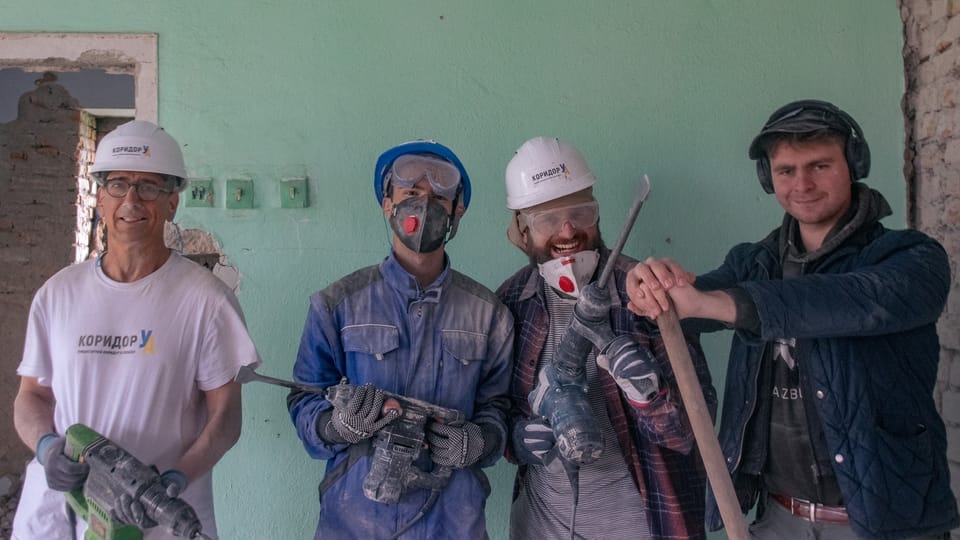
“It’s expanding too; we’ll have another building soon. Right now, we have one block for prosthetics and rehabilitation, and another for reconstructive surgeries for limbs and facial recovery. The next block will be for hearing treatment. We already have a small department for that, but we need more space because those injuries are very common.
“There will also be an educational department there, because education has been an important part of the center from the beginning. We had to learn a lot very quickly and start sharing our experience right away, since we suddenly had many patients with trauma, injuries, and amputations, but not enough specialists.”
Eddy and Andriy introduced us to Sava, who lost both his legs and arm to a drone strike on the frontline in Donetsk earlier in the year. He has been in the center for five months and shared that he wants to return to the frontline and is helping his unit in logistics from the center in the meantime.
“I’m a soldier of the 93rd Brigade, ‘Cold War.’ My nickname is Sava.”
Sava, short for Vyacheslav, has been at the center for about half a year.

He already has prosthetics, but his operation was necessary because his bone in the stump was too long, so the surgeons had to shorten it. Before that, he was very good at walking on what we call “stubbies,” short prosthetics. Patients with bilateral amputations can’t walk on full-length prosthetics with knees right away; they start with short ones, then gradually move to longer ones with knees.
Once, he even climbed to the 10th floor on his short prosthetics; it took about 20 minutes, but he did it. Unfortunately, after that, the surgeons told him he needed another operation to shorten the bones slightly and reshape the muscles. Now he’s waiting for the day he can start walking again with new sockets.
We spent a couple of hours at Superhuman, talking to some of the amputees and to our guides Eddy and Andriy about their stories. All of them were inspiring.
The evening featured a dinner and night train to Kyiv, where we were set to attend the Kyiv Economic Forum, with an excellent selection of speakers, in the morning.
Arriving to Kyiv at the Kyiv Economic Forum
The Forum was held at the InterContinental Kyiv Hotel in the center of the city.

What stood out was listening to Kyrylo Budanov, Chief of the Main Directorate of Intelligence of the Ministry of Defense of Ukraine and the target of at least ten Russian assassination attempts. All of the panels deserved silent audiences, but this one had a particularly sombre tune. Budanov spoke quietly and with few words. The chief of intelligence is greatly respected in Ukraine, if not the world, for his position and career in the Ukrainian Armed Forces.
Our time in Kyiv was divided between the Forum, where we spoke to economists, generals, and other political representatives, and meetings with both Greek Orthodox and Greek Catholic representatives, who discussed their work on the frontlines and their efforts to help war victims across Ukraine.
Meeting former president of Ukraine, Viktor Yushchenko
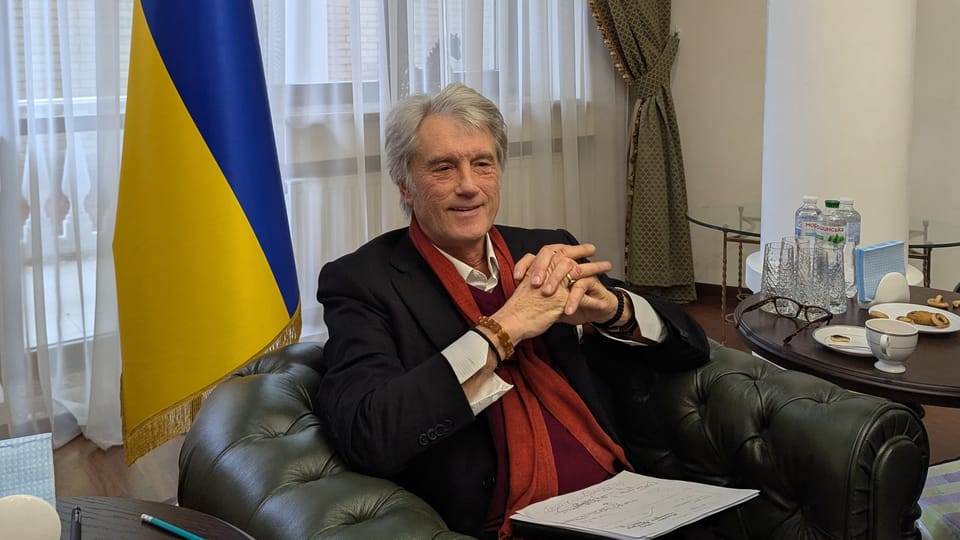
After that, former president of Ukraine from 2005-2010, Viktor Yushchenko, was gracious enough to give us three hours in his office spaces to discuss all things Ukraine: past, present, future, and more. You can access the full details of the interview on our website, published previously as a separate feature.
Meeting with Yushchenko was another reminder of how often Ukrainians had to deal with figures who frequently lied about their intentions. Yushchenko himself suffered a near-fatal poisoning while campaigning for the presidency in 2004, against the pro-Russian Viktor Yanukovych, who was subsequently ousted after a bloody crackdown on peaceful protests in 2014.
Meeting Mayor of Lviv Andriy Sadovyi
After another day packed with meetings and interesting talks, we returned to Lviv the following day to meet with the Mayor of Lviv Andriy Sadovyi, who shared the work the city has been doing to help refugees in Ukraine, including pioneering the Unbroken Center.

The mayor began with a brief presentation for us. He said that approximately 20% of the city budget is reserved for purchasing military equipment. Every day, they buy and send equipment to the front line for our soldiers. And a large percentage of the population serves in the military; as of writing, 58,000 citizens of Lviv serve in the Ukrainian army on the front line. But the city does more than send its, mostly men, to the frontline.
The mentioned Unbroken Center in Lviv is a pioneer as a rehabilitation and support hub for both civilians and veterans. It provides medical care, prosthetics, mental health services, and sports programs, including adaptive sports like sledge hockey. The center also offers social housing and specialized facilities for people who have survived torture.
An important feature, and one the mayor was understandably particularly proud of, was its prosthetics workshop, which produces up to 1,000 prosthetics per year, alongside training programs for specialists. Art and cultural initiatives are integrated into rehabilitation, highlighting the center’s innovative approach to mental health care.
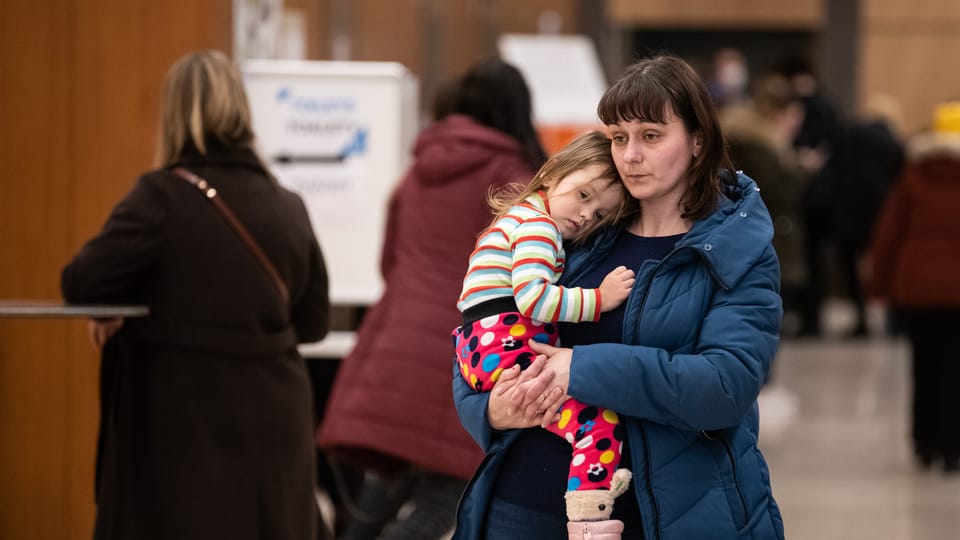
Unbroken has also expanded into education through Unbroken University, focusing on medical and municipal training. The center operates alongside broader city resilience efforts, including shelters, emergency infrastructure, and support for local businesses and innovation in the military sector.
As our time was ending with the mayor of Lviv, he shared how many guests have visited him in the office space, including figures like Tom Cruise. We laughed and left the building only to be welcomed by rain. We did not mind. It was our last day in Ukraine. But certainly not for long.
In all of this, we saw that the Ukrainian people continue to be brave and committed in protecting their people and the future of democracy. Once again, we were reminded of how much we take for granted in parts of the world where democracy has steadily taken root in recent decades. And what an important reminder that was.
The trip was organized and funded by the Ukrainian news agency Your City Media Hub’s Untold Stories from Ukraine project. Our guide and translator was CEO of Your City Media Hub, Taras Yatsenko. The trip included journalists from Spain, Germany, France, and elsewhere.