

From fishnets to schools: How Czech NGO Koridor UA supports Ukraine’s communities
Through the work of the Czech NGO Koridor UA, we take a look at what everyday life is like in parts of Ukraine and what it means to help on the ground. How do fishnets help save lives? How have humanitarian needs evolved since the beginning of the war? How can a comparatively small Czech NGO have a big impact? And what motivates volunteers?

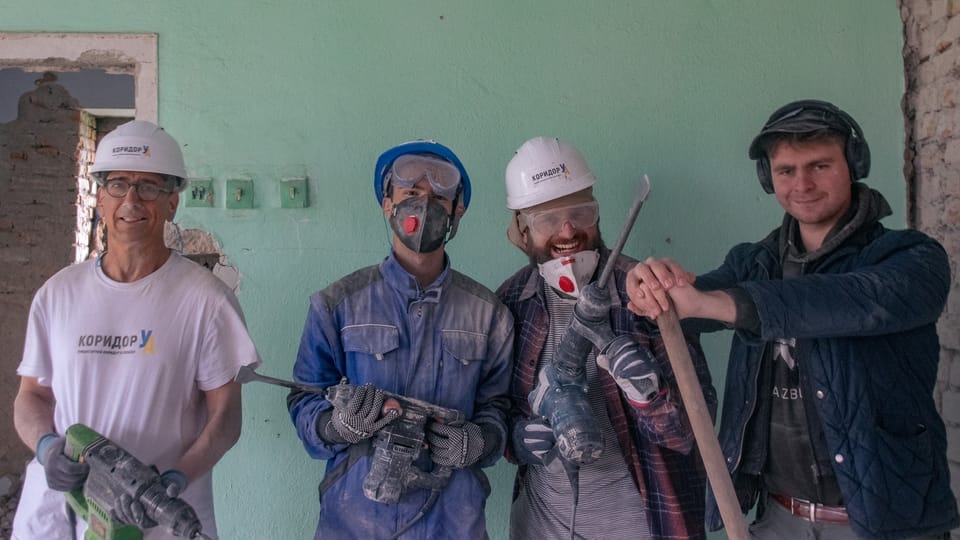
Koridor UA is a Czech NGO and though smaller than many other organizations, it plays a crucial role in delivering aid directly to those in need. It was founded in 2022 and its expertise lies in humanitarian logistics. The team built to a great part of volunteers also repairs houses and schools destroyed by bombings, adapting its support as needs on the ground evolve.
To find out more, I spoke with Adéla Pafková, one of the co-founders of Koridor UA, who recently moved from the NGO’s Prague offices to its humanitarian headquarters in Mykolaiv – just a two-hour drive from the Kherson front. Pafková describes Mykolaiv, a city of around 470,000 inhabitants, as “just a nice place to be, really. It feels just like walking down the street of any other city.” The transition to living in Ukraine seemed natural to her and overall, she feels inspired by what she has seen.
"About 90% of children in the war-affected areas are traumatised in some way."
Adéla Pafková
Pafková’s job is primarily to coordinate volunteers, including for Koridor UA’s current project of rebuilding two schools in the Mykolaiv region. Gradually, more schools in both the Mykolaiv and Kherson regions are being repaired. Still, some two million children across Ukraine had no school to return to this September and children growing up in Mykolaiv have had anything but a normal school experience. Some have not set foot in a classroom for six years – meaning that there are 13-year-olds who have never attended school in person. First came the Covid-19 pandemic, and then the war.

Pafková stresses how crucial it is for children of this age to return to school, not only for their education, but also to ease the burden on parents and support the children’s mental health. “About 90% of children in the war-affected areas are traumatised in some way, and being alone and isolated at home is horrible for their mental health,” she says.
The renovation of schools and other projects carried out by Koridor UA rely heavily on skilled volunteers from around the world. “I cannot stress this enough, we could not exist without volunteers,” Pafková emphasizes. “There is a place for anyone.”

Other aid includes delivering fishnets from Holland and windows from the Czech Republic. First-person view (FPV) drones pose an increasing threat to civilians. “One way to stop drones is to set up fishnet corridors because they physically prevent drones from approaching you or your car,” explains Pafková. “There was a call on social media for more fishnets, and because we have our own logistics, we were able to respond quickly.”
Supported by the Ukrainian-Czech Chamber of Commerce, this project highlights how Koridor UA’s logistics expertise, built on three years of experience, allows for immediate aid. Similarly, the Windows for Ukraine project imports windows that would go to waste in the Czech Republic, helping to repair houses damaged during attacks.
“The longer you are in a place, the more effective your help becomes.”
Adéla Pafková
These activities and more depend on financial and material support from donors. Contrary to what one might expect, Pafková notes that aid has not diminished. “Even though it might seem like support is faltering, I would say that it has remained quite stable. Obviously, there was a big wave of solidarity at the start that has since faded, but our donors have been incredible.” She adds optimistically, “So, don’t lose hope — there are still many people who care.”
While the future of the conflict in Ukraine remains uncertain, the need for humanitarian aid continues. Organisations like Koridor UA, with over three years of on-the-ground experience, understand both what kind of help is needed and how to deliver it effectively at the local level. As Pafková puts it, “The longer you are in a place, the more effective your help becomes.”
Listen to the full interview in audio.






