Globsec report: Czechia strong in defence industry but lags in crisis decision-making

A new Globsec report published this week places Czechia among “mid-tier” countries on NATO’s eastern flank. Analyst Martin Sklenář says the country has solid foundations but slower political decision-making. At the same time, its defence industry remains a key pillar of European deterrence.
Strong capabilities, but a question of readiness

A new report published this week by the GLOBSEC, an independent, non-partisan think tank based in Bratislava that focuses on security, geopolitics and international relations in Europe and beyond, offers a comprehensive look at the readiness of ten NATO countries on the alliance’s eastern flank—and places Czechia firmly in the middle of the pack.
The study, titled Annual Battle Readiness on the Eastern Flank 2026, highlights that while the region has seen a major increase in defence spending since 2022, the ability to act quickly in a crisis varies significantly between countries. According to analyst Martin Sklenář, who contributed to the report, the key issue is no longer just how much military capacity countries have built, but whether they can actually use it when needed.
“As we see across the region, there have been increases in military capability and capacity,” Martin Sklenář says. “What we wanted to assess is whether countries are actually ready to use that capability when necessary.”
This focus on readiness rather than resources is what places Czechia in the so-called “mid-tier” category—countries with strong institutional frameworks, but less predictable decision-making in times of crisis.
Democracy and decision-making speed

The report identifies political decision-making as a crucial factor in overall defence readiness. Even well-equipped countries may struggle to respond quickly if their institutional processes are slow or complex.
“In order to use military capability, you need political decisions—decisions by governments, parliaments, and other institutions,” Martin Sklenář explains. “And in this respect, countries differ quite significantly.”
In Czechia, strong democratic safeguards play an important role—but they can also slow things down. The report notes that procedural complexity and layered decision-making may hinder rapid responses in emergencies. At the same time, Martin Sklenář stresses that this is not necessarily a weakness, but rather a reflection of how democratic systems are designed to function.
“There is a lot of deliberation and procedure before decisions of this nature are taken, which is perfectly fine,” he says. “This is what we expect from democratic institutions—they must take into account the values and principles we want to protect.”
Faster decisions without losing democratic control
Rather than calling for sweeping reforms, the report suggests that countries like Czechia could improve their readiness by streamlining procedures while preserving democratic oversight. The goal, Martin Sklenář says, is not to weaken institutions, but to make them more efficient in critical moments: “Countries could find ways of speeding up discussions or procedures to arrive at decisions more quickly in a crisis,” he says. “Not at the expense of democratic principles—those can still be fully protected.”
This balance is becoming increasingly important as Europe faces a more volatile security environment. According to the report, the real dividing line is no longer between East and West, but between countries that can react quickly and those that cannot.
Defence industry as a strategic advantage

Despite these challenges, the report highlights one area where Czechia stands out: its defence industry. The country is described as an “industrial and innovation stronghold” on NATO’s eastern flank, contributing significantly to Europe’s overall deterrence capability. For Martin Sklenář, this industrial base is not a substitute for operational readiness—but it is a crucial part of the broader security picture.
“Defence industry is a core element of defence readiness and deterrence,” Martin Sklenář says. “You need to show not only that you have strong militaries, but also that you have the capacity to sustain operations over time.”
In practical terms, this means being able to produce, maintain, and adapt military equipment during prolonged conflicts—something that potential adversaries take into account. “It’s not a compensation,” Martin Sklenář adds. “It’s a very important part of deterrence that adds value to the overall quality we want to see.”
A region still adapting
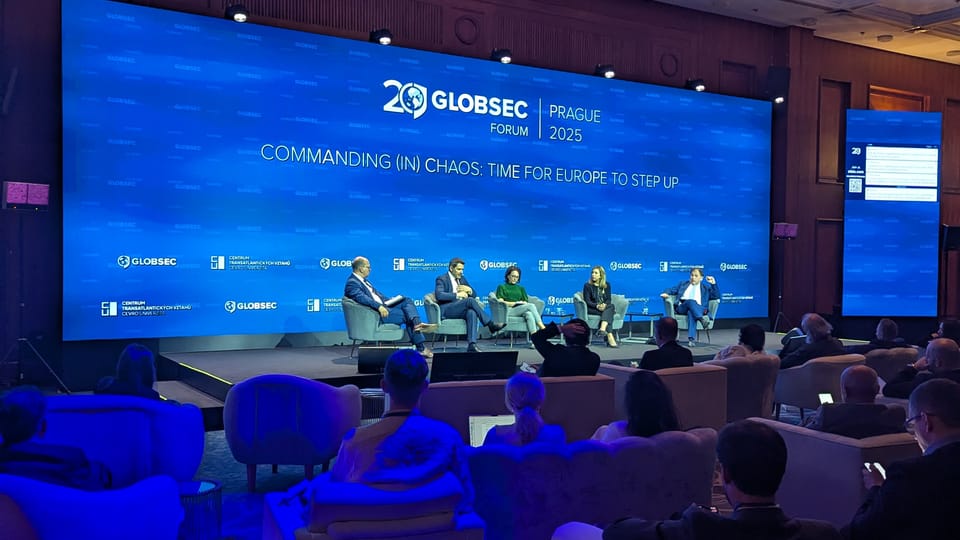
The findings suggest that Czechia’s “mid-tier” status reflects a broader regional reality. While countries have invested heavily in defence, aligning political processes with military capabilities remains an ongoing challenge. Across NATO’s eastern flank, differences in decision-making speed can have a direct impact on deterrence. As the report warns, the credibility of collective defence is only as strong as its slowest member.
For Czechia, the path forward is not about rebuilding its institutions, but about making them more agile. With strong foundations and a robust defence industry, the country is well positioned—but improving the speed and predictability of decision-making could prove decisive in a future crisis.
If you want to listen to the full in-depth interview with Martin Sklenář by Vít Pohanka, you can find it on Czechast, Radio Prague International's podcast in English about all things Czech.