Exhibition explores story of iconic Barrandov Bridge sculpture and plans for its return

A new exhibition currently underway in Prague explores the story of Equilibrium, the iconic sculpture that stood beside the Barrandov Bridge for almost four decades before collapsing last summer. It also looks at plans to bring the sculpture back.
The six-metre-high, 15-metre-wide concrete sculpture was created by Josef Klimeš, regarded as one of the most important Czech sculptors of the second half of the 20th century.

The exhibition, held at Kobka 17 on the Smíchov riverfront, traces the story of Equilibrium from its original concept to plans for a replica. It also introduces visitors to Klimeš's wider body of work, including some of his other important sculptures and designs.

Equilibrium was commissioned in 1989 as part of the artistic concept accompanying the construction of the Barrandov Bridge. Klimeš developed it in collaboration with the bridge's architect, Karel Filsak.
The original idea, however, was quite different, as the exhibition's curator, Ludmila Sedlák Mojžíšová, Klimeš's granddaughter, explains.
“Originally, there was supposed to be a figurative statue of Antonín Zápotocký, a communist president of Czechoslovakia. But thanks to Karel Filsak, the main architect of the bridge, they managed, together with my grandfather, to persuade those in charge to accept the idea of an abstract sculpture instead.”

Klimeš drew much of his inspiration from nature. Although the sculpture was not based on any particular natural feature, its shape has a striking resemblance to the landscape around the bridge, she says:
“The shape of Equilibrium can also be seen on the opposite side of the river, in the Barrandov Rocks. And if you look at a cross-section of the riverbed, it has a similar shape to the sculpture. These are beautiful coincidences that make the statue fit so naturally into its surroundings.”
Building such a massive sculpture was a major challenge, especially with the technology available in the 1980s. Suspended in the air, its entire weight rested on a single pillar measuring just one metre by one metre. Klimeš was initially told that it would be impossible to build, but his knowledge of descriptive geometry helped him prove otherwise.

“Together with engineers and structural specialists, he managed to develop the project. They built a huge wooden mould reinforced with iron elements, which was then filled with concrete. The structure had to remain in the mould for about a month before the wooden formwork could be removed and the sculpture was complete.”
The exhibition also highlights Klimeš's versatility as a sculptor, presenting some of his other works, including Everyone Has the Right to Education, created for Expo 58 in Brussels. It also explores his collaborations with architects, through which he created a number of monumental works that have become part of the Czech architectural landscape.
Equilibrium was not immediately embraced by the public, as is often the case with Brutalist architecture. But over time, it became a familiar part of Prague's landscape, says Mojžíšová.
“I would say that Brutalism is not really something people fall in love with at first sight. You have to learn about it and think about it a little more than you would with a more classical work of art. Secondly, the sculpture gradually became part of the place. People eventually realised that it was actually the perfect sculpture for this large concrete bridge, with so much traffic passing over it every day.”


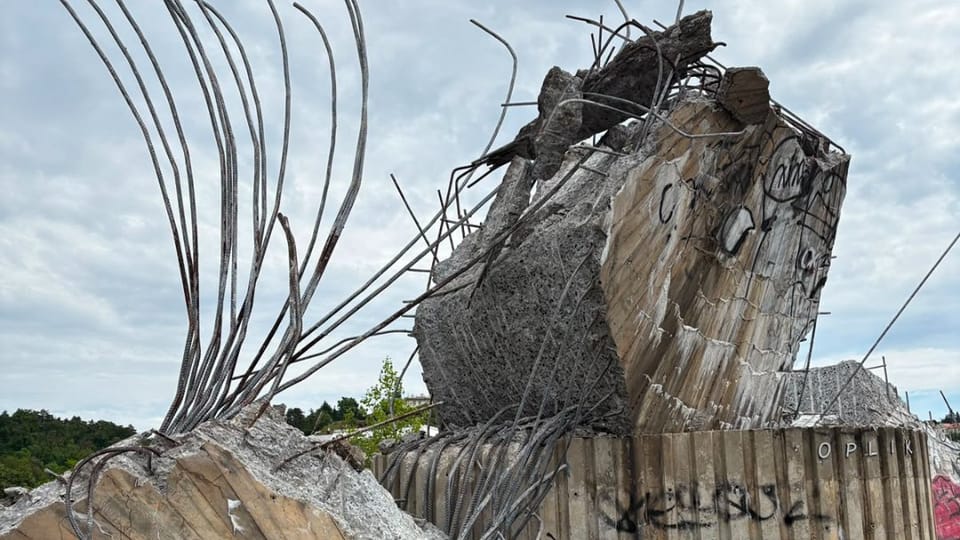
Last summer, after almost four decades beside the Barrandov Bridge, Equilibrium collapsed. By then, however, Prague City Hall and the Prague City Gallery were already discussing plans for a replica, as expert assessments had shown that restoring the original would be extremely difficult. The Prague City Gallery is now preparing the replacement together with the sculptor's family.

“We have even secured funding from the city, allocated to the Prague City Gallery. Now it is a matter of going through the necessary procedures and getting the work done. There is still a lot to do, but we hope we will manage it. Our aim is to have the sculpture back in place by 2028, when Josef Klimeš would have celebrated his 100th birthday. We really hope we will manage to do that.”
The exhibition runs until November 15, with two more guided tours scheduled before it closes.
More information about Josef Klimeš is available at www.josefklimes.cz, which also includes a link to the ongoing fundraising campaign for a monograph about the sculptor.