Czechia’s drought crisis puts government action and funding to the test

As the country counts the costs of prolonged drought, Prime Minister Andrej Babiš (ANO) has announced the revival of the National Anti-Drought Coalition, which had been dormant for several years. He is promising fast, targeted action, but questions remain over the actual road map and funding.
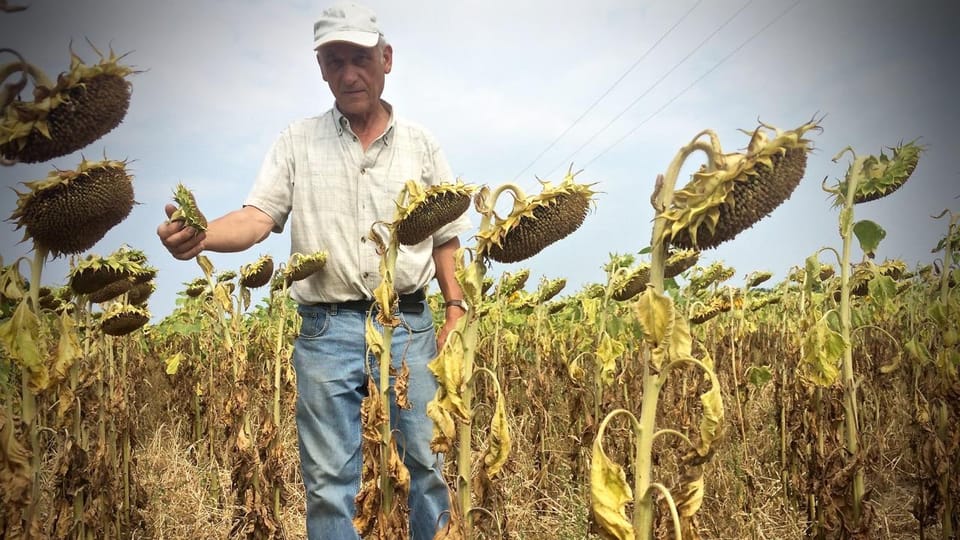
The impact of the extended summer drought is being felt across the country. It has damaged crops, as well as fruit and vegetable production. Some livestock farmers have had to cull animals early because of a lack of fodder. Fisheries in many parts of the country have begun harvesting fish from ponds ahead of schedule after losses caused by low oxygen levels. Some smaller streams have dried up completely, killing populations of freshwater crayfish, while environmentalists have had to provide drinking water for wildlife in forests. Several small villages whose wells and boreholes dried up have had to rely on drinking water from tankers.

In response to the crisis Prime Minister Babiš last week ordered the revival of the National Anti-Drought Coalition and requested a map of critically affected areas to enable fast, targeted action. He said the government was not starting from scratch and that billions had already been spent on anti-drought measures during his former term in office.
“We set up the Anti-Drought Coalition in 2018 and it did a lot of good work between 2018 and 2020 when we had to respond to the Covid crisis. We will now build on those measures and take them further. The environment and agriculture ministries both have projects lined up and we will approve the legislation needed to build 20 new reservoirs. So yes, fighting drought is certainly a government priority.”

Adequate funds crucial for effective measures

With details of the 2027 budget still being finalized, it is not yet possible to determine exactly how much the government will actually spend on fighting drought. Although under pressure to lower the deficit in public spending, Minister Schillerova confirmed that the government would respond to the crisis, saying that drought was on the list of government priorities.

Environment Minister Igor Červený said that this year the ministry was allotted CZK 3.4 billion for anti-drought measures and next year it plans to invest another CZK 2 billion from the State Environment Fund. Červený said he would wait for the European Commission to clarify how much funding it would provide before committing further money to tackling the problem. He estimated that restoring the landscape would cost around CZK 9 billion a year.
The Agriculture Ministry has been promised CZK 4 billion, primarily for building new reservoirs, but Minister Šebestyán made it clear that, in view of the circumstances, he is seeking around CZK 5 billion for the task in budget talks with Finance Minister Alena Schillerová this week.

Plans under close scrutiny from Czech Agrarian Chamber
The government’s plans are coming under scrutiny from the Czech Agrarian Chamber, which said it expects a blow-by-blow action plan combining better water management, more resilient agriculture, landscape restoration, the use of new genomic breeding techniques and support for precision farming.
READ ALSO
The Chamber identified the restoration and construction of landscape features such as ponds, wetlands and tree avenues as immediate priorities. It also called for a backbone irrigation system and retention reservoirs, as well as measures implemented directly on farmland.
Farmers are reportedly already carrying out some of these measures at their own expense, but have yet to see long-term economic benefits. The state should not only support such measures but also make them easier to implement, the Chamber said.
Above all, agricultural and environmental experts warn that the effort must not fizzle out with the first rainy season or change of government.
President calls on experts, urges broader approach to tackling drought
President Pavel has also joined in the debate, inviting environmental experts to Lany Chateau this week. The head of state welcomed the fact that the government is addressing the problem and is considering broad measures. However he advised against “quick solutions” saying experts from different fields need to be given space.

“There is a whole range of measures that need to be considered, and the expert community has accumulated a huge amount of knowledge and skills that would help address the situation effectively. Unfortunately, their advice is not always heeded. We often succumb to pressure to solve things quickly, to find a form of action that looks decisive at first glance, but fails to consider many aspects that need to be taken into account,” Pavel said.
According to the president, looking for inspiration abroad is also an option, since –as he put it - there is no need to come up with a specifically Czech solution to every problem that arises.

Czechia hit by worst drought since 1961
According to experts, in mid-August the soil in 70 percent of Czechia contained less than a tenth of the amount of water it is capable of retaining. This is a point beyond which plants have no water left to draw on and begin to wilt. The most severe level of drought affected 57 percent of the country, while more than a third was suffering from milder but still significant levels of drought.

Related
-

Turning the tide: How man-made forest ponds are bringing water back to the landscape
Forest managers in Western Bohemia are fighting climate change with man-made ponds and wetlands.
-

Why drought is unlikely to shut down Czech nuclear power plants
Unlike Hungary’s Paks plant, Czech nuclear power plants Temelín and Dukovany use cooling towers, making them far less vulnerable to drought and low river levels.
-

Can trees keep Prague cool as temperatures rise?
In Czechast, Prague climate adaptation specialist Jan Richter explains how trees, rainwater and even urban farming could help the Czech capital face a hotter future.