Czechia at Eurovision: An awkward story of trying to stand out

Czechia has officially taken part in the Eurovision Song Contest 13 times, first joining the competition in 2007. However, Eurovision was not entirely unknown in the Czech context even before that. Join us today as we take a look back at the Czech musicians and songs that have battled for Eurovision glory over the years.
The first Czech singer to appear at Eurovision was Karel Gott, who represented Austria in 1968 with the song “Tausend Fenster”. How did that happen? The beginning of 1968 was the era of the Prague Spring, and the Austrian public broadcaster ORF selected Gott as a symbol of support for the liberalisation taking place in neighbouring Czechoslovakia. Austria and Czechoslovakia shared very close ties at the time, which was reflected in the choice of Karel Gott as Austria’s representative. The song itself also carried strong symbolism, as it was about neighbours who do not know one another — something that could be interpreted as a hidden reference to the Iron Curtain.
Soviet Eurovision? Intervision!

Getting a Czech artist from behind the Iron Curtain to Eurovision almost happened again twenty years later. In 1988, Lenka Filipová received an offer to perform at Eurovision for Switzerland with the French-language song “Ne partez pas sans moi”. However, the Czechoslovak authorities refused to allow her to travel, reportedly arguing that she could not represent a foreign country. A last-minute replacement was found in a then little-known singer named Celine Dion, who went on to win Eurovision with the song and launch her international career.
Although Czechoslovak artists could not officially compete at Eurovision, viewers were still able to watch the contest on television. Since there were many ambitious musicians even behind the Iron Curtain, an Eastern Bloc equivalent of Eurovision called the Intervision Song Contest was held in the Polish city of Sopot between 1977 and 1980. In 1977, Czech singer Helena Vondráčková won the contest with the song “Malovaný džbánku.”
Ups and downs (and downs) of Czech musicians at Eurovision
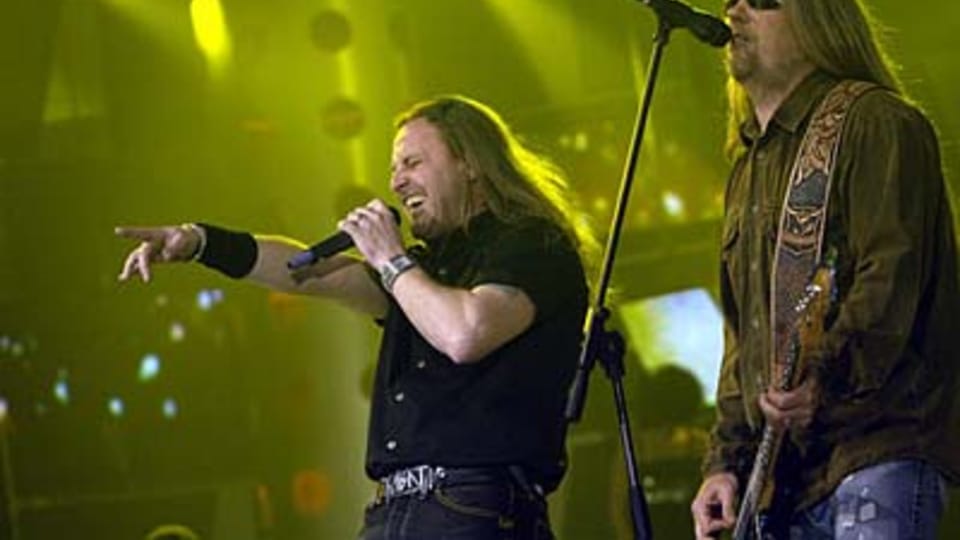
Czechoslovak Television continued broadcasting Eurovision until the breakup of Czechoslovakia, after which the contest disappeared from Czech screens for a while, and the country made no attempt to send its own artists. That finally changed in 2006, when Czech Television confirmed participation in Eurovision 2007. The rock band Kabát travelled to Helsinki after winning the national selection Eurosong 2007. Unfortunately, the group received just a single point in the semifinal and finished last.
An even worse result came in 2009, when Czechia was represented by Gipsy.cz. The band failed to receive a single point and also ended in last place. After this fiasco, Czechia withdrew from Eurovision entirely. The break lasted until 2015.
After an eight-year pause, Czech singers returned to Eurovision in 2015. Czech Television selected the duo of Marta Jandová and Václav Noid Bárta with the song “Hope Never Dies”. However, the entry failed to make it from the semifinal to the grand final.
From cheating partner to empowered women
A much more successful year for Czechia came in 2018, when singer Mikolas Josef represented the country with “Lie to Me”, in which he sings about a relationship that ended because of infidelity. He finished third in the semifinal and eventually placed sixth in the final — still Czechia’s best Eurovision result to date. Before his rise to fame, Mikolas was known for busking on the streets with his guitar. Following his Eurovision success, he co-founded the independent record label Vivienne Records with his family.
READ ALSO

The following year was also successful. In 2019, Czechia was represented by the indie-pop band Lake Malawi. The group reached the Eurovision final and ultimately finished in 11th place with the song “Friend of a Friend.” The band was founded by musician Albert Černý in 2013, and the Eurovision song later became the official anthem of the Ice Hockey World Junior Championship in 2020.
The most recent major Czech Eurovision success came with the all-female band Vesna, which combines pop music with folklore influences. In 2023, the group reached the Eurovision final with the song “My Sister’s Crown.” The track blended four languages — Czech, English, Bulgarian and Ukrainian — and marked the first time Czech was ever heard in a Eurovision final.

According to singer Patricie Fuxová, the song was meant to represent femininity and Slavic identity, while also addressing themes such as oppression, solidarity among women and minority rights. The band also wanted to express support for Ukraine during the Russian invasion, which is why Ukrainian lyrics appear in the song. Both the song and its music video were banned in Russia and Belarus.