Český Krumlov should get more protection as UNESCO site in case of war
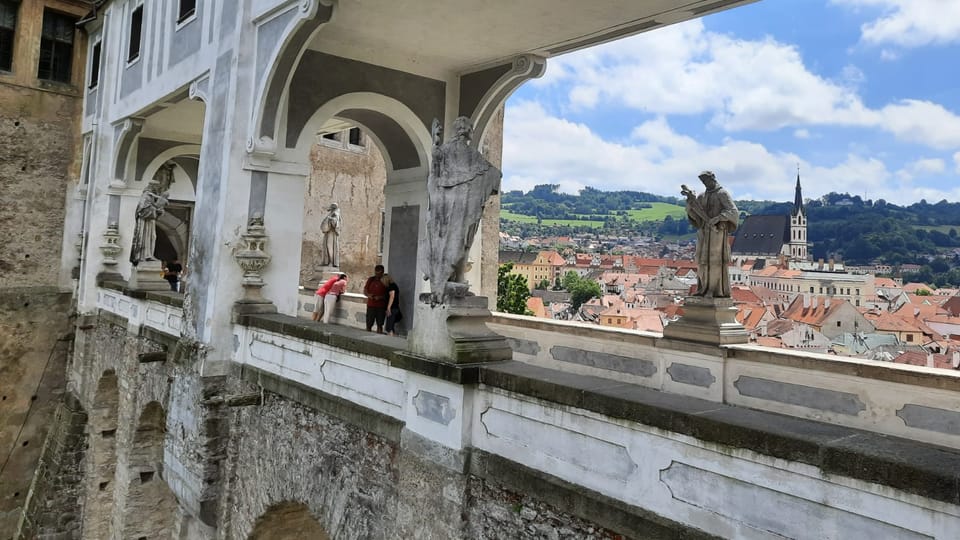
The destruction of monuments during armed conflicts in various countries prompted the National Heritage Institute to take preventive action in the case of Český Krumlov. The Institute has asked UNESCO to register the castle among the cultural assets granted enhanced protection. The nomination was submitted by the Institute in February, and a decision is expected in December.

If the nomination is accepted by the relevant UNESCO committee, the two monuments will be under "enhanced protection in the event of armed conflict" in Czechia.
The higher level of protection is based on the Hague Convention adopted after the Second World War, in 1954. According to the Hague Convention, cultural property is to be safeguarded in peacetime. And in times of war, they are to be spared under international humanitarian law. Safeguarding involves the marking of an international protective sign, an inventory of movable cultural property or the preparation of depositories.
The Český Krumlov castle complex above the Vltava River and the historic town have been on the UNESCO World Heritage List since 1992, as well as the center of Prague and the Průhonický Park. The state castle and chateau of Český Krumlov, which is nominated for increased protection, has also been a national cultural monument since 1989.

Czech Radio spoke to castellan Pavel Slavko about why the changes were initiated in the first place and what they mean:
“First and foremost, this protection means a responsible approach by the state in the management of cultural heritage. And above all, because it is internationally registered, internationally recognised not only in the social structures of states and governments, but also in military structures, it gives a higher degree of protection in the future than the normal procedure.”

But if enhanced protection is to be granted, the application must meet a number of requirements, Slavko explains:
“The first and most important condition, which has already been mentioned here, is that it must be a cultural monument protected by national legal and administrative measures that recognize its exceptional cultural and historical value.

“The next stage is that the monument must also meet the highest level of international protection, meaning it must be included on the UNESCO World Heritage List.
“And the third important condition is that the cultural monument must not be used for military purposes.”
The institute sent extensive documentation to Paris in February to increase the protection of Český Krumlov and expects a decision at a meeting of the relevant committee with representatives of 12 countries in December. The scope of the nomination was considered by the inter-ministerial National Group for the Implementation of International Humanitarian Law.

Slavko also commented on the chances of success:
“Probably significant. Český Krumlov Castle is, of course, an extraordinary monument, distinguished from the outset by the nature of its UNESCO inscription, which clearly highlights its exceptional natural, architectural, and artistic values.
“And in terms of the site itself, it can be clearly defined—its boundaries, the entire area, and the individual buildings can be precisely described, along with the extent of the significant furnishings and the arts and crafts objects located there. In this respect, I believe that Český Krumlov Castle ranks among the top ten most important cultural and historical buildings in Europe.”

That said, in other previous cases, Czech applications for a higher level of international protection for monuments have not been successful. However, the Institute of Monuments gained experience with the 2018 listing of Villa Tugendhat for enhanced protection. The functionalist villa, built in 1930 to a design by German architect Ludwig Mies van den Rohe, met the conditions.
In mid-April, UNESCO registered 91 cultural properties from around the world on the enhanced protection list. Only 62 of them have received it temporarily.
Related
-

Discover Czechia's regions
With its rich history, stunning architecture and beautiful skyline Prague attracts visitors from all over the world. But there is much more to see in Czechia.
-

Prague Gardens
Gorgeous views of Prague, gushing fountains and ornamental flower beds. Greenery and calm amid the hustle and bustle of the big city.