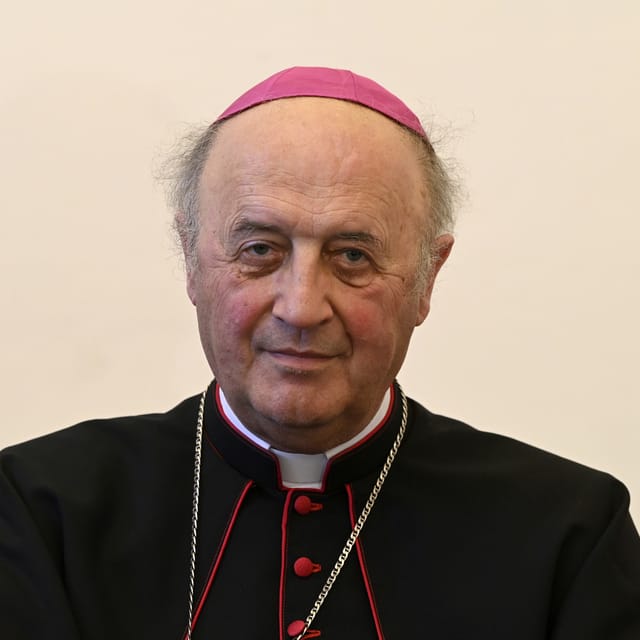
Cardinal Dominik Duka dies at 82: former archbishop of Prague led Czech Church through restitution era

Cardinal Dominik Duka, one of the most prominent figures in the Czech Catholic Church, has died in Prague at the age of 82. A former dissident priest imprisoned under communism, Duka later became Archbishop of Prague and Cardinal under Pope Benedict XVI. His tenure was marked by the church restitution deal, outspoken views on social issues, and occasional controversy.
Cardinal Dominik Duka, the 36th Archbishop of Prague and one of the most influential Czech Catholic leaders of the post-communist era, passed away early on November 4 in Prague. The Archdiocese of Prague announced his death in a statement on Facebook:
“Today, on Tuesday, November 4, at three o’clock in the morning, the Lord of Life called to eternity the emeritus Archbishop of Prague, Cardinal Dominik Duka. May the infinitely merciful God open His arms to him and fill him with His love and bliss.”
Duka underwent emergency surgery at the Central Military Hospital in early October and, although briefly discharged, was readmitted in serious condition just days before his death.
From dissident priest to cardinal
Born Jaroslav Duka in Hradec Králové on April 26, 1943, he grew up in a family deeply marked by 20th-century history. His father served in the Protectorate army but later defected to the Allies in Italy and joined the ground forces of Britain’s Royal Air Force. After the communist coup of 1948, he was imprisoned for several years—a fate that profoundly shaped his son’s worldview.

After completing military service and training as a locksmith in the engineering industry, Duka entered the Cyril and Methodius Theological Faculty in Litoměřice in 1965. Three years later, he joined the Dominican Order, adopting the name Dominik, and was ordained a priest in 1970.
His official ministry lasted only five years. The communist regime withdrew his state authorization to serve as a priest, forcing him to work as a draftsman at the Škoda Plzeň engineering works for fifteen years. During that time, he continued to conduct secret religious activities and was imprisoned from 1981 to 1982 in Plzeň–Bory prison, where he met dissident playwright Václav Havel.
Despite repression, Duka remained active in the Dominican Order, becoming its provincial head in 1986. After the fall of communism in 1989, he could finally work openly in the church and was appointed Bishop of Hradec Králové in 1998.
Twelve years at the helm of the Czech Church

In 2010, Pope Benedict XVI appointed Duka Archbishop of Prague, and two years later elevated him to cardinal. His tenure coincided with one of the most significant milestones for the Czech Catholic Church—the long-debated restitution of church property confiscated under communism. Duka played a central role in negotiating and implementing the restitution law, which returned church property and secured financial compensation totaling over 47 billion crowns.
Supporters hailed the agreement as a necessary act of justice. Critics, including many secular voices, accused the church of excessive demands and Duka himself of being too close to political elites.
In a later reflection, Duka admitted that the complex legal and political disputes over property often weighed heavily on him:
“Is this really the work of a priest, of a normal man? … Sometimes I felt happier working as a draftsman at Škoda Plzeň after my release from prison.”
A voice that stirred debate

Dominik Duka was never a quiet or purely spiritual figure. He was known for his outspoken views on politics, national identity, and morality. In 2017, he spoke of his hope for a “democracy without adjectives” and urged voters to “give voice to the silenced majority.”
He publicly supported President Miloš Zeman and often commented on international issues, from the war in Ukraine to relations with Russia. His letter to President Zeman in 2021, following revelations about Russian agents’ involvement in the Vrbětice explosions, called for a proud and sovereign Czech state.

During the COVID-19 pandemic, Duka controversially described the coronavirus as a “Chinese biological weapon.” Earlier, he drew attention for blessing the rebuilt Marian Column on Prague’s Old Town Square, which he defended as “a monument of gratitude, not arrogance.”
Duka also filed a lawsuit against the Brno theater festival for staging provocative plays by director Oliver Frljić, arguing that the performances insulted religious beliefs. The courts dismissed his claim, but the incident reinforced his reputation as a defender of Catholic values against what he saw as blasphemy and moral relativism.
Faith, controversy, and modern media

Duka’s leadership combined a traditionalist moral stance with an awareness of modern communication. He maintained an active online presence, launching a personal blog and social media accounts on Twitter (now X) and Facebook to reach believers and critics alike.
He also rejected the common portrayal of Czechs as the “most atheistic nation in the world,” insisting that the country’s spiritual life was more complex than statistics suggested:
“I don’t believe we are the most atheistic state in the world. Surveys cannot fully capture people’s inner faith.”
Final years and farewell

After reaching the canonical retirement age of 75 in 2018, Duka submitted his resignation to Pope Francis but remained in office for more than four additional years. In 2022, he was succeeded by Archbishop Jan Graubner of Olomouc.
In recent months, Duka faced serious health issues. After undergoing emergency surgery in October 2025, he returned briefly home before being hospitalized again on November 1. He died three days later.
A funeral Mass for Cardinal Duka will take place on Saturday, November 15, in St Vitus Cathedral at Prague Castle, where he will be laid to rest in the archbishops’ tomb in the Chapel of St Vitus.
Legacy of a divisive yet defining church leader

For many, Cardinal Dominik Duka embodied steadfast faith and the resilience of the Czech Catholic Church after decades of oppression. For others, his political involvement and uncompromising views made him a controversial figure.
Yet even his critics recognize his role in restoring the church’s position in Czech society and his deep personal courage during the years of persecution. His life traced the dramatic arc of modern Czech history—from totalitarian repression to democratic freedom—lived with conviction, intellect, and an unshakable belief in divine providence.