Call of the Forest: Prague exhibition explores people’s deep connection with trees
An exhibition titled The Call of the Forest, currently on display at Prague’s Kunsthalle, invites visitors to leave behind the noise of the city and step into the quiet, contemplative world of the forest. Created by the Czech-born, New York-based artist duo Kristýna and Marek Milde, it explores the deep and often overlooked connection between people and trees.

Developed over the course of more than two years, The Call of the Forest includes a selection of new, ongoing and earlier works spanning animation, installation, sculpture, and sound. According to Marek Milde, the exhibition is a continuation of the artists’ long-standing research into the cultural, emotional, and ecological significance of trees.
We have lived in Brooklyn for over two decades. It's a culturally rich environment, but it is also an island, which sometimes seems disconnected from nature. As Czechs, we like to leave the city for the weekend. It’s not as easy to do here, but the nature around New York is beautiful.
“This connection to nature has become a strong thread in our art practice. Inspiration often begins with small observations—plants growing through concrete, or spotting people with tree tattoos on the subway. These brief moments where city life and nature meet often become the seeds of our projects.”

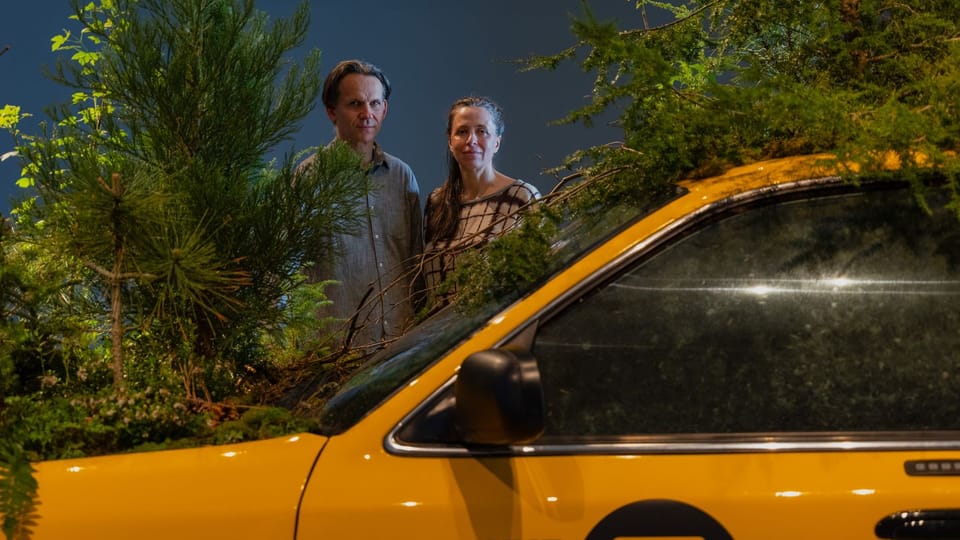
This tension between city and forest runs through much of their work, including their most recent object in the show, called Arbomobile, which features a typical New York cab with trees growing out of it.
The idea for the artwork came on one of their forest hikes, when they came across abandoned cars overgrown with vegetation, says Marek Milde:

“We were struck by the strength of nature reclaiming human artifacts,” says Marek Milde. “We decided to revive the ultimate urban symbol—a New York yellow taxi—and turn it into a vessel of growth. But rather than symbolizing decay, it represents vitality and hope that nature prevails.”
The trees planted in the cab are all native to North America, many of which have deep historical roots. For instance the Eastern White Pine, which was pictured on one of the flags used during the American Revolution.
Kristýna Milde says their fascination with American trees dates back to their early years in the US, when the unfamiliar landscape caught them by surprise:

“Although we were familiar with European forests, we couldn’t recognize many of the trees. We later discovered that America has over 1,200 tree species, while Europe has only around 80. The reason is that many European species died out during the glacial period.
“This tree diversity is overwhelming, and we found it fascinating. Early settlers in the New World shared this same fascination and began bringing trees back to Europe between the 15th and 19th centuries.
“Many of these trees are now well established in Europe. So, although we consider them European trees today, they originally came from North America.”

Kristýna and Marek Milde hope the yellow cab will live on long after the exhibition ends. They’re already searching for a permanent location where the trees can continue to grow.
Another key work is The Call of the Forest animation, which brings together tree tattoos collected from people around the world. The idea came from time spent in New York’s subway system, says Kristýna Milde:

“Living in New York, we spend a lot of time in the subway. Especially in summer, we noticed many tattoos, and quite a few featured trees.”
“We were fascinated by this psychological connection people have with trees, marking their bodies with tree symbols as a way to feel connected.
“We thought it would be interesting to build a collective forest from these individual tattoos and asked people to send us images and their stories.”
To their surprise, the idea struck a chord and submissions began arriving from around the world. Working with Prague-based animator Jakub Kouřil, the Mildes transformed these tattoo images into a flowing, animated forest.
“The tattoos reveal that trees are more than plants—they are emotional landmarks. It was fascinating to explore why people get such tattoos, especially since we don’t have any ourselves,” says Marek Milde.
“For many of them, trees symbolize resilience, grounding, or a connection to a place. In the animation, we explore the idea of trees as emotional anchors in both personal and collective memory.

“These individual trees, which had been on people’s bodies, are put together into this large animated collage—and together they create a forest.
“So the forest becomes not only an external landscape, but also an internal one—an emotional space visitors are invited to enter and experience.”

Another installation, In Tree Net—a play on the word “Internet”—uses tree trunks to mimic the underground pipes and cables that run beneath cities.
The concept began back in 2009, well before it was widely recognized that trees communicate through underground fungal networks, says Kristýna Milde:
“We found it interesting that our cities also rely on hidden networks—pipes and cables—to function. We wanted to visually connect the forest and the city, using tree trunks in the form of an engineering system to link buildings to the environment outside.”
At Kunsthalle, the network begins in the building’s lobby and winds its way into the gallery, spreading into a canopy. Visitors can sit underneath, just like they would in a forest, but right in the middle of the city.

The exhibition also features a sculpture made from old issues of The New York Times, rolled and compressed into the form of a tree trunk. The project, titled Petrified Times, took five years to complete and used an entire year’s worth of newspapers from 2020.
“Originally, we thought of it as an abstract gesture: returning newspaper back into tree mass,” says Marek Milde. “But the year 2020 turned out to be historically significant due to the pandemic and global upheaval.

“As we worked, the piece became more meaningful. It turned into a meditation on time and information—how stories and headlines build up and solidify over time, much like the rings of a tree.
“In theory, one could locate the major events of 2020 within the trunk’s layers: the pandemic, the election cycle, and more.”
In parallel with the sculpture, the artists created a daily poetry series using only New York Times headlines. By the end of the year, they had written 400 short poems. Seven are on display next to the sculpture; the rest appear as a projection onto a curtain made from recycled delivery bags.

“The series, which includes Petrified Times and Petrified Parallels, evolved from each other. The poems made out of headlines were especially important, because as the year progressed, the headlines became darker.
“It became a challenge—almost a sport—to find and reshape something positive out of negative news. And now, visitors at Kunsthalle can read some of them.”
A soundscape composed by Prague-based Indian musician Abhi accompanies the exhibition, blending field recordings from nature with subtle urban noise. The result echoes the exhibition’s central message: that the forest is never really far away.
“We hope visitors leave with a renewed sense of wonder—and also urgency,” Marek Milde concludes. “For us, trees are not just scenic backgrounds. They are central to how we live, breathe, and remember. We want visitors to feel more connected to forests, even in the middle of the city, and perhaps more inspired to care for them.”