From Brno to Liverpool: building fragments to honour architect Ernst Wiesner
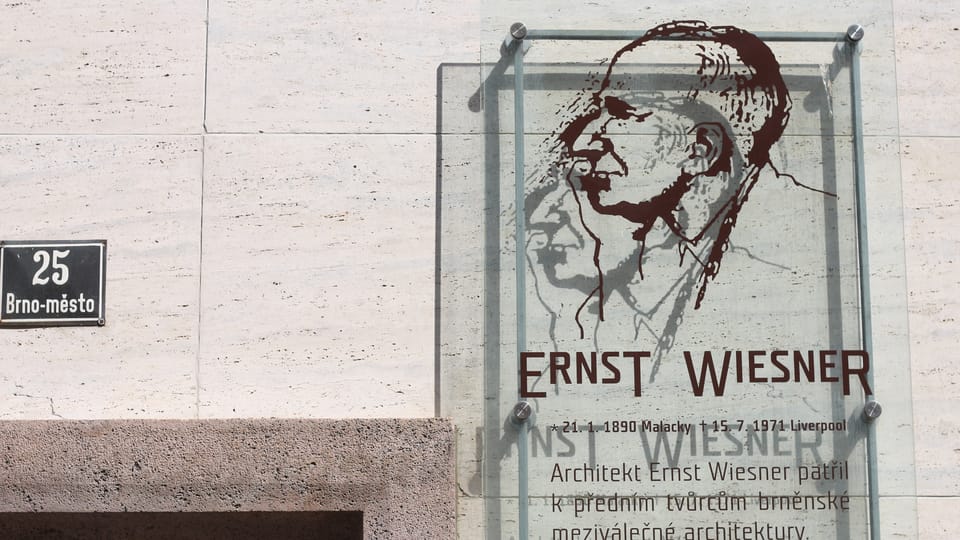
Fragments of some of Brno’s best-known buildings are about to travel hundreds of kilometres to Britain. They’re headed for a Liverpool cemetery, where they will become part of a new memorial to Ernst Wiesner, a leading architect of interwar Brno.
The Villa Stiassni, the Villa Neumark, the headquarters of Czech Radio Brno, and the Morava Palace are all landmark buildings of interwar Brno — and all were designed by architect Ernst Wiesner.

One of the key figures of modern architecture in the city, Wiesner was influenced by Adolf Loos and helped shape Brno’s functionalist face. His work ranged from private villas to major public buildings, including the city crematorium, now a national cultural monument.
His career was cut short by the Second World War. Because of his Jewish origin, Wiesner was forced to flee Czechoslovakia and settle in Great Britain. He spent the rest of his life there, teaching architecture in Oxford and Liverpool, where he died in 1971.
Wiesner is buried in Liverpool, far from the city most closely associated with his work, and for decades, his grave went largely unnoticed. Only in recent years was it rediscovered, and earlier this year, the original tombstone was restored with support from the South Moravian Region.
Now, a new memorial is being created beside Wiesner’s grave. It will be assembled from authentic stone fragments taken directly from his buildings in Brno and installed permanently at the Liverpool cemetery.
The selection and preparation of the stones is being handled by stonemason Radim Skácel.
“It will definitely be exciting work. As I look at it, there are already some candidates here — fragments that will be usable,” he says.
Helping him sort through the crates of stone is Kateřina Konečná, who manages the Stiassni Villa. She points to a piece of sandstone from the villa’s entrance gate.
“A delivery van accidentally knocked off part of the soffit a few years ago. At the time, I was furious with the driver — but thanks to that accident, we can now use original sandstone from the villa,” she explains.

According to architect Tomáš Růžička, the memorial will take the form of a circle with nine differently coloured openings at its centre. These openings will be filled with stones Wiesner could have personally touched during his lifetime.
“It’s not a gravestone, but a reminder that he died far from home — and this is Brno’s way of giving him a part of the city he helped shape,” Růžička says.
Speaking to Czech Radio, regional councillor Michal Doležel from TOP 09 explained when the memorial should reach Liverpool.
“We have a clear deadline. We would like to install the new work at the site for the 136th anniversary of Wiesner’s birth — on January 21st, 2026,” Doležel says.
People can support the creation of the new memorial through an online fundraising campaign on the Donio website.
Related
-

Adolf Loos, the enigmatic Moravian-born architect, at 150
Adolf Loos, a pioneering modernist architect raised in Brno, left a rich legacy in Vienna, Prague and beyond, despite declaring “ornament is crime”.






